
Centralized livestock slaughtering: Still has shortcomings.
(Baonghean) - In 2006, Nghe An province adopted a policy to build centralized slaughterhouses to ensure environmental hygiene and food safety for consumers. In 2010, the "Livestock Industry Competitiveness and Food Safety Project" implemented in Nghe An significantly contributed to this issue. However, the implementation process encountered numerous difficulties…
Mr. Tran Van Hoa's slaughterhouse (Hamlet 4, Nam Nghia Commune, Nam Dan District) is one of the first centralized livestock slaughter facilities in Nam Dan District and the entire province. Operating for eight years, initially, his facility slaughtered 30-40 animals per day and night. Now, the average number of cattle, goats, pigs, and other livestock slaughtered daily reaches 100-150 animals per day and night. However, according to general assessments, there are not many facilities operating as efficiently as this one in the province. According to the owner, this success is thanks to the strong support and involvement of the local government. Recently, with the commitment of support from the World Bank's Agricultural Competitiveness in Livestock Project, Mr. Hoa invested over 4 billion VND to expand and upgrade his slaughterhouse system. "We were given $30,000 in support, but we had to build, complete, and pass all the project's requirements before we could receive the money," Mr. Hoa said.
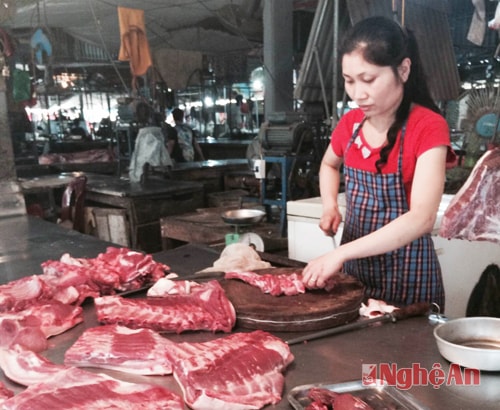 |
| Meat products from slaughtered animals are sold at Quan Lau Market (Vinh City). |
The construction of centralized livestock slaughter facilities is considered a crucial solution in bringing clean products to consumers and contributing to controlling and limiting the outbreak of diseases in livestock. Consolidating small-scale slaughtering into a single location ensures hygiene and disease safety, facilitating veterinary hygiene control and the pre-slaughter animal trade. Through decisive policies and measures, between 2006 and 2010, Nghe An province built 70 centralized livestock slaughter facilities in most districts, with investments totaling billions of dong. However, to date, only 31 out of 63 facilities remain operational throughout the province, with the highest number in Yen Thanh (16 facilities), Dien Chau (6 facilities), and the remainder in Do Luong, Nam Dan, and Nghi Loc. The city of... In Vinh, although four large-scale slaughterhouses have been built, only one is currently operational, slaughtering 30-40 pigs day and night. Meanwhile, small-scale slaughtering at household level accounts for the majority and is growing rapidly. The entire province currently has 2,350 households involved in slaughtering. These locations are scattered throughout the province, lacking proper control, and pose a significant risk to food safety and hygiene, as well as the spread and outbreak of diseases.
The main reason why centralized livestock slaughterhouses are operating at a reduced capacity, struggling, or even completely shutting down is primarily due to ingrained habits of the people. The situation of small-scale, spontaneous slaughtering and consumption of slaughtered products has existed for a long time and is not easily changed in the mindset of businesses and consumers. Unlike many other localities, in Nghe An, when bringing livestock to slaughterhouses, those needing slaughtering services must not only pay for the slaughterhouse rental and veterinary inspection fees, but also slaughter the animals themselves or hire someone to do it. Mr. Tran Van Hoa stated: "The slaughterhouse rental fee is 20,000 VND per pig, 30,000 VND per female, but if you hire someone to slaughter them, you have to pay an additional 70,000 VND per female and 50,000 VND per pig." Therefore, those involved in the slaughtering business always try to avoid bringing livestock to centralized slaughterhouses because they incur both fees and have to do the slaughtering themselves. The number of livestock slaughtered at centralized facilities is too low compared to the actual number slaughtered, leading to low operational efficiency of slaughterhouses and significantly impacting the maintenance, upgrading of existing facilities, and construction of new ones. This results in inadequate infrastructure at slaughterhouses, failing to meet the necessary conditions for food safety and hygiene, and inadequate environmental management. Meanwhile, most district and commune-level authorities lack decisiveness and genuine concern in managing centralized livestock slaughtering.
Using a model-building approach for widespread implementation, the Livestock Industry Competitiveness and Food Safety Project selected 10 slaughterhouses in the project area for investment in infrastructure renovation and upgrading. With a maximum investment of $30,000 per facility, the project requires slaughterhouses to meet scale requirements, adhere to technical standards and design specifications, have a quarantine area, ensure hygienic and safe slaughtering practices, and have solid and liquid waste treatment systems to ensure that wastewater from the slaughterhouse is properly treated before being released into the environment. Mr. Luu Cong Hoa, Head of the Livestock Department - Department of Agriculture and Rural Development, said: With such stringent requirements, to build a slaughterhouse, the investment amount is no less than 1.5 billion VND, and the funding from the project only covers a portion of the construction costs. The remaining amount must be borne by the facility owner and will only be received after the project has been completed and inspected.
Therefore, disbursing funds, monitoring, managing quality, and registering more eligible slaughterhouse owners to participate in the project remains very difficult. In reality, surveys show that many households want to register, but after learning about the mandatory conditions of the investor, they hesitate. The investment capital for construction is large, while if operating in the current manner, the fees collected will be low, making it unfeasible to recoup the investment. After three years of surveys and campaigning, only two facilities in Nam Nghia (Nam Dan) and Hop Thanh (Yen Thanh) have agreed and completed construction; two others in Nghi Cong (Nghi Loc) and Dien Tho (Dien Chau) have designs and are undergoing renovation; and one slaughterhouse in Thuong Son (Do Luong) has been registered by the local people.
Given this situation, one approach, considered a temporary solution but proving effective at present, is to support the renovation of small-scale slaughterhouses within the project area. Currently, the project is focusing on surveying and implementing this at eight facilities. The project will support repairs and renovations to roofs, construction of clean restrooms, floor leveling, and the provision of necessary equipment such as operating tables, bleeding tanks, and anesthesia equipment. This approach is very suitable for the specific conditions of Nghe An province. However, in the long term, building larger, more professionally designed slaughterhouses is a direction that needs to be considered and prioritized.
To establish centralized slaughterhouses, provinces and localities need clear regulations on the slaughter of livestock and poultry for commercial purposes, along with investment policies and preferential mechanisms to support investment in capital, land, and taxes. These policies should encourage participation from various sectors, especially businesses. The location of the centralized slaughterhouse must be carefully planned to attract both small traders and residents bringing their livestock and poultry, while also ensuring environmental standards are met. Simultaneously, both centralized and small-scale slaughtering methods at home should be maintained. The key issue is strengthening control at small-scale slaughterhouses; local authorities must be involved, coordinating closely with veterinary forces to inspect and control slaughtering, and check the health of livestock before slaughter. A crucial factor impacting disease control and protecting consumer rights and health is the habit of purchasing clearly inspected and certified food products.
Text and photos:Phu Huong


