
Preserving the cultural heritage
(Baonghean) - Quy Hop - a mountainous land in the Northwest of Nghe An province. Amidst the vibrant pulse of a developing mountain town, interspersed with the gentle and soothing sounds of traditional culture, the land and people here are confidently moving forward, partly thanks to this rich cultural heritage.
Every time I visit Quy Hop, I hear fascinating stories from the Kinh, Thai, and Tho ethnic communities living there. Each ethnic group has its own unique culture and traditions. But it seems that once they are Quy Hop residents, they all share a spirit and attitude of acceptance and willingness to share common values that shape the culture of their homeland. The story of their collective efforts to restore the Choong Temple in Chau Ly commune is a vivid example of this.
Generations of people in Quy Hop still tell each other the story of Nang Phom Hom, a loyal and heroic woman who wholeheartedly gathered food to feed the troops during the Lam Son Uprising against the Ming invaders. The Choong Temple on Pu Den Mountain was established to worship Nang Phom Hom, a beautiful symbol of the virtues of a Thai woman, as well as the brotherly solidarity between the Thai and Kinh ethnic groups. Time has quietly passed, and although only a few traces of the old Choong Temple remain, Nang Phom Hom lives on in the hearts of every person in Quy Hop.
Therefore, when the plan to restore and renovate Choọng Temple was approved, every citizen directed their hearts with reverence, hoping to contribute their efforts to this symbolic project. In just over three years, the temple on the old site at the top of Pu Đên was built with nearly ten billion dong. “What is truly commendable is that all the money for the restoration of Choọng Temple was mobilized from social contributions,” Comrade Cao Duy Thái, Secretary of the Party Committee of Châu Lý commune, who is also a very dedicated person who devoted much time and effort to the restoration of the temple, proudly shared. The joy for the people of Quỳ Hợp was multiplied when Choọng Temple was recently recognized as a Provincial-level Historical Monument.
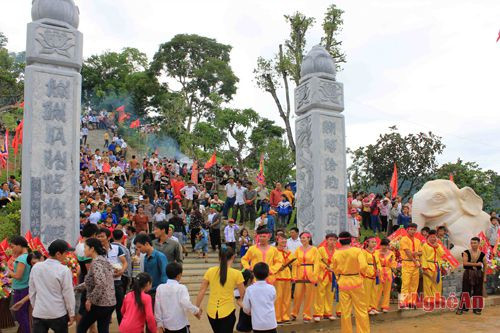 |
| The people of Quỳ Hợp joyfully receive the certificate recognizing Choọng Temple as a provincial-level historical relic. Photo: Cao Duy Thái. |
Deeply imbued with culture as the spiritual foundation of society, serving as both a goal and a driving force for socio-economic development, Quy Hop district has implemented appropriate solutions and steps to preserve and promote local cultural values. Particularly, during the 10 years of implementing the "Building a Model District for Mountainous and Ethnic Minority Culture in Quy Hop District, 2001-2011" project, many communes established folk culture clubs and organized effective activities. The district has built 5 purely ethnic cultural villages, 11 exemplary information and arts performance groups, 3 models of weddings and funerals according to cultural traditions, and numerous folk clubs. The district's literature and arts club operates effectively, publishing 23 newsletters and nearly 12,900 magazines to serve the people and promote the homeland and people of Quy Hop. The project has effectively developed and promoted the activities of the purely Thai ethnic village in Vi village, Bac Son commune; the purely Tho ethnic village in Mo hamlet, Nghia Xuan commune; and the multi-ethnic cultural village in Hoa Thanh hamlet, Chau Quang commune. The Thai language teaching club in Chau Cuong commune has organized 8 classes with over 300 students participating in learning the Thai language. Activities such as folk art festivals, culinary competitions, costume competitions, traditional rice wine culture competitions, and competitions in traditional sports like furrow carving, tug-of-war, bamboo pole jumping, throwing the ball, stick pushing, crossbow shooting, and stilt walking are organized enthusiastically from the district to the grassroots level, especially during holidays and major festivals. Thanks to correctly identifying the goals and tasks of the project, over the past 10 years, Quy Hop has preserved many unique traditional cultural features of ethnic minorities such as: language, writing, costumes, cuisine, housing, folk songs, folk music, and folk dances…
Building on the achievements, the district continues to develop a plan to implement the Project "Building a model district for mountainous and ethnic minority culture in Quy Hop, giai đoạn 2012 - 2015". Accordingly, the district has set 15 targets to be achieved, especially linked to building "communes meeting the standards of new rural culture" and "towns meeting the standards of urban civilization". Hop Tam hamlet, Tam Hop commune, has 171 households with 708 inhabitants. The hamlet was separated from Dinh hamlet in 2007, so the infrastructure is still lacking. Faced with this reality, the hamlet's Party branch initiated a campaign to mobilize people to contribute to building a cultural center. With the exemplary spirit and leadership of the Party members, the entire hamlet contributed funds to purchase over 1,000 square meters of land worth 25 million VND and continued to contribute to the construction of the cultural center with a value of 180 million VND. After much effort and hard work, in early 2014, the hamlet was recognized as a Cultural Village. Comrade Nguyen Thai Man, Party Secretary and Hamlet Head, happily shared: “The cultural facilities and spiritual life of the people have been improved. This is not only a place for holding meetings but also a place for daily cultural and sports activities. The sense of community and neighborly solidarity has therefore become even stronger.” To date, in Tam Hop commune, all 19 hamlets have spacious and well-equipped cultural centers; 17 out of 19 hamlets have achieved the title of Cultural Village.
Over the past three years, Quy Hop district has mobilized all resources to implement the project of building a cultural district. The majority of central and provincial funding has been focused on investing in the construction of cultural facilities meeting district and commune standards, such as: renovating Thung May Lake Park, the Sports Center; and the Commune-level Cultural and Sports Center. At the hamlet and village level, the people have actively and voluntarily contributed labor and money, effectively utilizing their internal resources to build cultural, sports, and information facilities. Many hamlets and villages in the communes of Nghia Xuan, Dong Hop, Chau Quang, Minh Hop, Tam Hop, and the town... have successfully implemented the socialization of cultural, sports, and information activities. The total investment in supporting the construction of cultural and sports facilities throughout the district over the past three years is 23.92 billion VND. Of the total investment, 7.35 billion VND came from the central government budget, 1.5 billion VND from the provincial budget, 4.55 billion VND from the district budget, 1.54 billion VND from the commune budget, and nearly 9 billion VND from people's contributions and social mobilization. To date, Quy Hop district has 21 out of 21 communes and towns with community halls and cultural centers, including 17 out of 21 communes with multi-functional cultural centers meeting standards. The entire district has 263 out of 287 hamlets, villages, and blocks with cultural centers; and 277 out of 287 hamlets, villages, and blocks have equipment for activities such as loudspeakers, ceremonial equipment, and sports equipment. All of this is mainly mobilized from people's contributions and social mobilization. All hamlets, villages, and blocks have performing arts and sports teams and regularly organize activities.
Mr. Dau Ngoc Tuan, Head of the Culture and Information Department of Quy Hop District, said: “To achieve these results, the Standing Committee and the Executive Committee of the District Party Committee have strengthened leadership throughout the entire political system from the district to the grassroots level in implementing the project. At the same time, the District People's Council, through its sessions, has passed resolutions with many contents related to the project of building a model cultural district, including prioritizing budget and funding for its implementation.”
Besides its achievements in economic development, Quy Hop district focuses on preserving, promoting, and building cultural life within the community. This is a continuous source of inspiration for realizing the goal of becoming a model cultural district.
Nhat Le


