
What rice varieties are suitable for the saline-acidic soil of Quỳnh Thanh?
(Baonghean.vn)In Quynh Thanh commune (Quynh Luu district), 90% of the population lives by rice farming. Finding a salt-tolerant rice variety to replace the Khang Dan variety is a difficult problem to solve for farmers in this saline-acidic soil area.
Seeing the plight of the people of Quynh Thanh, toiling under the sun and pouring salty sweat onto the acidic soil, only to have their rice grains remain shriveled and empty, the staff of the Quynh Luu Agricultural and Fisheries Extension Station were deeply concerned. After many meetings and debates, the staff of the Agricultural Extension Station, along with the commune leaders, finally decided to go south to find some rice varieties with higher yields and better quality than Khang Dan 18 and other varieties currently being grown in the acidic and saline soil.
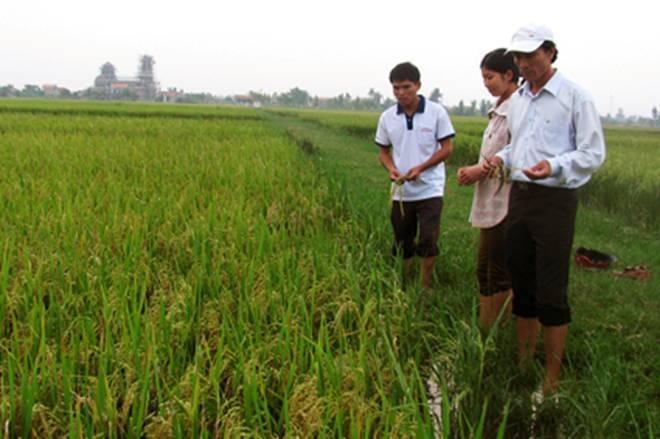
Engineer Ho Thi Chung and her colleagues inspect the OM.5464 rice variety before harvest.
During the 2011 summer-autumn crop season, due to the impact of typhoon number 2, many areas of rice seedlings and newly transplanted rice were flooded, affecting most of the experimental rice varieties. A week after sowing the seedlings, engineers discovered that the OM.6162 rice variety had died completely. Two weeks later, the seedlings were transplanted, but due to the flooding, the OM.4218 rice variety also died after transplanting. The remaining 10 varieties developed normally.
Young engineers Ho Thi Chung and Bui Duc Thanh, along with selected farmers, meticulously counted every basket of cow and pig manure, every kilogram of nitrogen, potassium, and NPK compound fertilizer applied to the fields, and carefully tended to each rice plant as if it were in their own garden.
From September 25th to October 6th, 2011, 11 rice crops of 10 experimental varieties and the control variety Khang Dan were harvested. The results showed that: variety OM.4488 yielded 196 kg/sao, variety OM.5464 - 172 kg/sao, and variety OM.2395 - 167 kg/sao, while variety Khang Dan 18 yielded 169 kg/sao. Thus, three rice varieties (OM.4488, OM.5464, and OM.2395) had yields equivalent to or higher than variety Khang Dan 18 under the same production conditions.
In terms of product quality, the salt-tolerant rice grains are small, long, and have thin husks, resulting in high yield and better rice quality than Khang Dan 18, but the panicles are short, the grains are sparsely arranged, and it is susceptible to brown spot disease.
Although only one summer-autumn crop trial has been conducted on a plot of land in one commune, and the weather has been unpredictable, the results cannot yet be accurately assessed. Further trials in other local fields are needed before conclusions can be drawn and large-scale production can be implemented. However, this is still a positive sign and a promising direction in structuring the production of new rice varieties for saline-affected rice fields in Quynh Luu district, and further, for application in other areas of the province.
Minh Thong


