
Preserve folk songs, cherish the village courtyard.
(Baonghean) - ...The communal house in Nghe An province is also the place where traditional festivals take place, a cultural center, a venue for traditional folk games, cultural and artistic performances, and village meetings... In the imagination of many people from the homeland of the folk songs and dances, this traditional art form is inextricably linked to the performance space of the communal house. There, under the moonlight, in the communal house without lamps or torches, young men and women sing love songs, exchanging words and making promises.
The rehearsal of the Dien Hoa (Dien Chau) Folk Song Club at Phuong Lich communal house saw the full participation of all 16 members. Construction workers after mixing mortar and laying bricks, farmers finishing their work in the fields, and schoolchildren on their day off – they all came to the communal house to sing and play music with great enthusiasm. First, they sang the melodies and songs, then they took on different roles and performed. The captivating nature of the folk songs drew many people to the communal house to enjoy them…
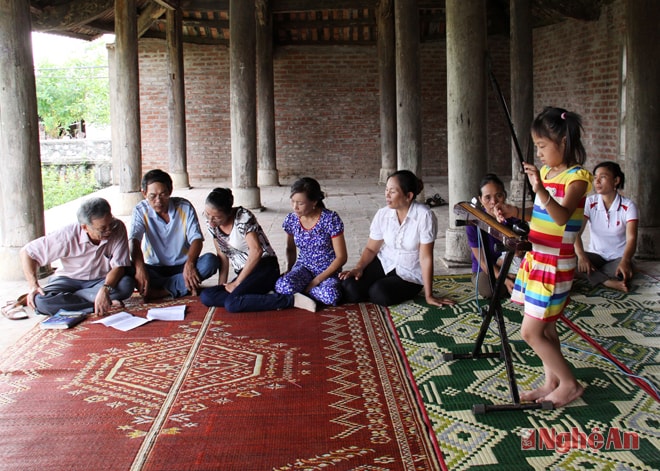 |
| Practicing folk singing (ví, dặm) at Phượng Lịch communal house. Photo: Thanh Hải |
During a break between practice sessions, Mr. Cao Van Bao, Chairman of the Dien Hoa Village Folk Song Club, told us: Phuong Lich communal house was built by the villagers in 1866 as a meeting place and cultural center; it is also a place of worship for the village's patron saint, Princess Hong Thi Chau Nuong (the third wife of General Tran Quang Khai). The princess came here to encourage people to settle, teach them how to grow mulberry trees, raise silkworms, weave silk, grow cotton, and weave cloth… Artisan Cao Xuan Thuong, the director and "master" of the club, said: When he was young, he heard stories from the elders in the village about the folk songs performed in this communal house. And folk songs have been present in Phuong Lich for a very long time, perhaps since the birth of the weaving craft here. In the past, Bui Phuong Lich cloth was very famous, and there was a saying: "Live wearing Bui cloth, die buried in gold." The folk songs of the Ví and Dặm genres include the line, "On a long moonlit night, we sit together for three years/ First, we work as weavers, then we sing and play music/ Borrowing the moon and wind to express our feelings/ The mountains and rivers, the deep human emotions…" The communal house was the political and cultural center of the old village, and bringing the club here to practice aims to revive that atmosphere. Through these practice sessions, people will love and cherish this space more, thereby preserving Phượng Lịch communal house – a historical and cultural relic – while creating a ripple effect and fostering the development of Ví and Dặm folk songs.
According to Ms. Cao Thi Nga, Head of the Culture Committee of Dien Hoa Commune: The Phuong Lich communal house, a provincial-level historical and cultural relic, is entrusted to Dien Hoa Commune by the Department of Culture, Sports, and Tourism and the People's Committee of Dien Chau District for preservation and safekeeping. However, due to limited local budget, restoration, preservation, and promotion of its value have been limited. Previously, to promote the value of the communal house, the district and commune organized numerous performances of Ca Tru and folk songs there; many local people and delegations from within and outside the province came to watch and appreciate the performing arts and the values of this structure… Although the Phuong Lich communal house has undergone several renovations, it has suffered considerable damage and deterioration. With a deep love for the communal house and the Vi and Dam folk songs, artisan Cao Xuan Thuong earnestly hopes to turn Vi and Dam into a tourism product. Organizing Vi and Dam folk song performances at Phuong Lich communal house for tourism would create a new destination in the area, alongside Dien Thanh Beach and Cuong Temple. The performances of folk songs and dances at Phuong Lich communal house attract many visitors, which will help this art form spread further and provide the local area with funds for the restoration of the communal house.
Clearly, the proposal by artisan Cao Xuan Thuong to develop Vi and Dam folk songs into a tourism product to preserve related historical and cultural heritage is a good and feasible idea, especially since Vi and Dam folk songs have already been recognized as a Representative Intangible Cultural Heritage of Humanity.
Currently, Nghe An province has over 50 folk song clubs specializing in the Ví and Dặm genres, with nearly 1,500 members. The movement to introduce folk songs into schools and teach them on radio and television, implemented since 1996, has yielded many positive results, helping generations of Nghe An people understand and appreciate Ví and Dặm folk songs, contributing to the deep connection between Ví and Dặm and the people, especially young people and children, in contemporary life.
Currently, Nghe An province has over 100 communal houses (dinh), of which 20 are classified (12 at the national level and 8 at the provincial level). Many village communal houses have seriously deteriorated. In recent years, many localities have coordinated with the Management Board of Historical Sites and Scenic Spots of Nghe An province to research and find solutions for restoration and preservation. However, in reality, while classified historical sites receive funding, it is not substantial, and unclassified historical sites still lack the resources for restoration and repair. Ms. Vo Thi Loan, Head of the Relic Restoration Department of the Management Board of Historical Sites and Scenic Spots of Nghe An province, said: Every year, the province allocates about 600 million VND for the restoration and preservation of historical sites. Funding from the National Target Program for New Rural Development is also available, but because so many historical sites are in disrepair, the funds have to be divided into many parts, and with the current scattered investment, the effectiveness is not high.
We visited the 5th Southern region of Nam Dan district, home to the famous Hoanh Son and Trung Can communal houses, which are considered by experts to be among the best in the Central Vietnam temple system in terms of decorative and sculptural art. Both communal houses are now severely dilapidated, especially Hoanh Son communal house, which could collapse at any time. Upon inquiring with the local authorities, Mr. Nguyen Trong Canh, Vice Chairman of the People's Committee of Khanh Son commune, stated: The commune is well aware of the imminent danger to the Hoanh Son communal house; the restoration of the communal house stems from the needs of the people and cannot rely solely on funding from the central government. It requires contributions from the State, the people, the clan, and descendants, but unfortunately, it is very difficult to raise funds given the poverty of the locality… Mr. Canh also expressed his desire to create a tourism product featuring folk songs and dances performed at the communal house grounds in his hometown to attract visitors and generate funds for the restoration and preservation of the historical site.
Developing the Ví and Dặm folk songs into tourism products to preserve historical sites is currently a concern for professionals and local authorities. Meritorious Artist Phạm Tiến Dũng, Deputy Director of the Department of Culture, Sports and Tourism, stated: “Now that some popular traditional craft villages have almost disappeared, those spaces need to be replaced by folk festivals, traditional craft villages, and historical and cultural relics such as temples and pagodas. These spaces can still captivate the Ví and Dặm folk songs when performed there.”
Meanwhile, People's Artist Trinh Hong Luu - Deputy Director of the Center for Preservation and Promotion of Nghe An Folk Songs - observed: "The environment now is not like it used to be; we can't force the existence of traditional fishing villages, rice-growing villages, or handicraft villages anymore. But the village communal houses, temples, and historical sites still remain. Developing folk songs like 'Vi' and 'Dam' into tourism products, performing them right in the communal houses and temples, is a way of preserving to promote and promoting to preserve."
To turn Vi and Dam folk songs into tourism products, thereby preserving historical sites, we don't need large-scale investors, but rather dedicated individuals and responsible authorities. Developing Vi and Dam folk song tourism products could follow the model of the Xoan singing groups in Phu Tho or the Quan Ho singing groups in Bac Ninh. In that case, the clubs would not just be hobby groups but purposeful groups, and surely Vi and Dam folk songs would develop and spread, and the historical sites and performance spaces would be better preserved.
Thanh Son


