
Preserving family traditions
(Baonghean) - Family will always be a peaceful haven that every member must return to, no matter where they go. Because there, there is not only love but also sharing and understanding... To build a strong family tradition and preserve the Vietnamese family home, the joint efforts of all members are essential...
In Dong Minh, Chau Thai, Quy Hop, if you ask about the family of Ms. Nguyen Thi Can, everyone in the village admires a well-ordered, harmonious family with children who excel in their studies and achieve success. Their spacious and beautiful stilt house sits amidst vast acacia forests and lush fruit orchards. Looking at this impressive property, few would know that in the past, her family was one of the poorest households in the village.
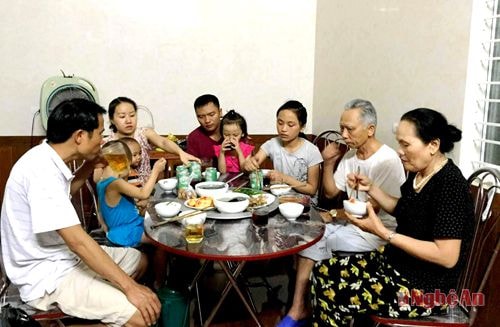 |
| A warm and cozy family meal at Mrs. Nguyen Thi Nhu Hoa's house (Hamlet 8, Hung Chinh Commune, Hung Nguyen District). Photo: Dinh Nguyet |
In the past, the whole family lived in a small hut perched precariously on the mountainside. When they first got married, they started from scratch. To provide for their elderly parents and three children, ensuring they had enough to eat and wear, she diligently worked in the fields, cultivating corn, rice, and cassava. Besides farming, her husband also worked as a seasonal laborer for the Quy Hop Forestry Station. Despite the hardship, their income was barely enough to make ends meet. There were times when they had to sell their newly built house, constructed from the small amount of timber her husband earned as a forestry worker, to support their family.
However, the couple remained determined to overcome difficulties in every way possible. Ms. Can confided: “My father passed away when I was only two years old, so I had to struggle from a very young age. After finishing junior high school, I had to quit school to work and earn a living. My husband and I always believed in working together to take care of our family and ensure our children received an education so they could have stable jobs and avoid hardship.” Through years of hard work and saving, they gradually accumulated a small amount of capital, which they boldly borrowed – sometimes a few million dong – to invest in economic development. In 1997, when the government encouraged people to plant forests under Project 135, her family boldly undertook the task of planting 3 hectares of forest. Initially, they greened the hills with cinnamon trees, but later switched to planting acacia. In the beginning, their income was only enough to cover their children's education, but now their family earns nearly 150 million dong per year.
The couple's determination to overcome poverty inspired their children. Out of love and respect for their parents' hard work, the children were all self-disciplined, well-behaved, and excellent students. Now, all three of their children are successful: their eldest daughter is an accountant at Vinh University of Industry, their second son works at the Quy Hop District Military Command, and their youngest daughter works for a foreign company in Hanoi. Sharing her approach to raising children, she simply confided that parents are role models for their children, and therefore they always maintain harmony and exemplary behavior in their lives, thoughts, and actions.
As a member of the Thanh ethnic group, she always instills in her children a sense of pride in their family and ethnic traditions. Although all family members can speak standard Vietnamese, whenever the children and grandchildren gather, the whole family communicates in the Thanh dialect. She teaches her children the customs of ancestor worship on holidays and Tet (Lunar New Year). Her sons, daughters, daughters-in-law, sons-in-law, and grandchildren all have traditional ethnic costumes made by their parents to wear on holidays and Tet. During warm family meals on holidays and Tet, she always prepares a full spread of traditional Thanh dishes such as sticky rice cooked in bamboo tubes, white sticky rice, fish stew, bitter soup, etc., to further cultivate love and pride in her children and grandchildren for the traditional culture of their ethnic group.
In Dien Yen, everyone was surprised to witness the performance of Mr. Pham Tai Khoan's family in Hamlet 10. The husband played the drums, the wife and daughter-in-law sang, and the son played the zither. Not only did the music and singing leave a deep impression, but this "singing troupe" of "ca tru family" also earned everyone's admiration for their intense love and passion for the traditional art form passed down from their ancestors. Mr. Khoan confided: "From the age of 10, I listened to my grandparents and parents sing ca tru, and it seeped into me. Although ca tru was forgotten for a time, I still played and sang for everyone in the family. I realized that the art of ca tru left by our ancestors is a priceless heritage, and the younger generation has a responsibility to restore and preserve it. These family gatherings to perform ca tru, with the husband playing the zither and the wife and children singing, have spread and rekindled the love for ca tru among the people here. Then, my wife and I advised the commune's cultural department to encourage talented people to establish a ca tru club." With their passion and perseverance, they successfully established a club with the participation of 4 female singers and 3 male instrumentalists.
Associate Professor Dr. Nguyen Thi Huong, an education researcher, believes that love, care, close relationships, harmony, and unity among family members are essential and crucial factors for a happy and progressive family. There will be no conflict, no violence, no discrimination between daughters and sons, and family members will not fall into social vices or violate the law within the family thanks to this loving connection. A strong, responsible relationship within the family also forms the foundation for healthy relationships outside the home, contributing to building a stable and civilized society. We need to promote the theme of Vietnamese Family Day so that everyone understands that love is the core of family happiness and the happiness of each individual, contributing to limiting and reducing domestic violence and family breakdowns, and preventing social evils from infiltrating families. Besides striving for self-improvement and focusing on building warm and happy families, all segments of the population will actively participate in building new rural cultural villages and communes.
As a managing agency, Ms. Hoang Thi Quynh Anh, Deputy Director of the Department of Culture, Sports and Tourism, stated: Currently, many families are affected by the market mechanism; parents are preoccupied with work, prioritizing money over the value of morality and intellect, and neglecting their children. This leads to children becoming delinquent, addicted to drugs, and sexually abused, especially with the alarming increase in gender inequality, divorce, and domestic violence. The good customs, identity, and traditions of Vietnamese families are fading. Recognizing that family culture is the "root" of village and national culture, the Department of Culture, Sports and Tourism has recently promoted the movement to build culturally exemplary families and villages throughout the province.
Among the criteria for a culturally exemplary family and village, one is the preservation and promotion of national cultural identity. It can be said that the movement has truly deepened and spread strongly, with an increasing percentage of culturally exemplary families and a continuously improving quality of the title. Some districts, cities, and towns have proactively and creatively developed the title of "Culturally Exemplary Clan." In various localities, on Vietnamese Family Day each year, they organize ceremonies to commend and reward families with multiple generations living together harmoniously; families raising healthy and well-behaved children and living happily; Catholic families who "live a good life and uphold moral values"; and families excelling in economic activities, etc.
The movement has contributed to preserving Vietnamese family traditions while enriching the cultural life in residential areas, especially in rural and mountainous regions. In addition, the department has implemented the "Propaganda and Education on Vietnamese Family Ethics and Lifestyle" project, piloted in Dong Van commune, Thanh Chuong district, and achieved many positive results. In the coming time, the department will expand this project throughout the province. Furthermore, the plan to prevent and combat domestic violence throughout the province for the period 2012-2015 and subsequent years has been implemented. Over the past six years, under the direction of the Ministry of Culture, Sports and Tourism and with active support from the Ford Foundation, the Provincial Department of Culture, Sports and Tourism has selected Cua Lo town to build a highly effective network of domestic violence prevention and control facilities. The Department of Culture, Sports and Tourism is planning to expand this model throughout the province next year. These activities also play an important role in building a cultured and traditional family.
Reporters' Team
| The theme of Vietnam Family Day 2015 continues to promote the theme "A warm and loving family meal," aiming to cherish the moments of reunion for all Vietnamese families around a happy and warm family meal, and to highlight the invaluable values of family: the affection between grandparents, parents, children, spouses, siblings, respect for elders, and loving care for children. "A warm and loving family meal" is linked to the 2015 family-related communication theme: "Building the character of Vietnamese people through moral and lifestyle education within the family." Activities will convey the following communication messages: Celebrating Vietnam Family Day (June 28th); A warm and loving family meal; The family is where the beautiful cultural values of the nation are preserved and maintained; Building the character of Vietnamese people through moral and lifestyle education within the family; The family is the cell of society, the stronghold of the Fatherland. Building a healthy family, community, and social cultural environment. The campaign to encourage families to organize family meals nationwide will take place on Sunday, June 28, 2015. |


