
Preserving the traditional charm of Nghia Lac
(Baonghean) - Nghia Lac is a remote commune in Nghia Dan district, home to three ethnic groups living together, with the Tho and Thanh ethnic groups accounting for 97.8% of the commune's population. It is also a locality with many traditional customs and festivals such as the gong festival, wrestling festival, new rice offering ceremony, New Year's blessing ceremony, and the rice planting ceremony, associated with folk games like furrow carving, bamboo pole jumping, Xoe dance, San Khan, and throwing the ball...
The Nghia Lac Commune Gong Club was established in January 2014 with the aim of bringing the songs and dances of the Tho ethnic group to the people and passing on a unique cultural aspect of the community to future generations. The members of the Gong Club are amateur artists who find solace in music after a hard day's work, singing and dancing together to strengthen community bonds. To date, the club has 40 members. We visited Mr. Le Huu Chi (61 years old) in Lac Hamlet, the initiator of the Gong Club and currently its secretary. Mr. Chi has been proficient in singing call-and-response songs, dancing folk melodies, and playing gongs since he was 15 years old. His parents are also renowned artists known for their beautiful singing, dancing, and gong playing. Mr. Le Huu Chi said: Lac Hamlet has 146 households, 669 inhabitants, 98% of whom are Tho ethnic people.
On major holidays, the club often organizes gong-playing exchanges with clubs inside and outside the commune, such as the Lung Ha and Mit hamlet clubs in Nghia Loi commune, and the Tan hamlet club in Nghia Lac commune. They also organize gong-playing competitions between different neighborhood groups. Gongs are a spiritual belief of the Tho people; their deep, resonant sounds, blending with the sound of streams and wind, will live on forever with the earth, sky, and people. In terms of musical instruments, the gongs of the Tho people are not significantly different from those of other ethnic groups, but the playing style and rhythm have their own unique characteristics. While the Thai people have a more diverse way of playing gongs, with single, double, triple, and quadruple gongs, the Tho people only play triple and quadruple gongs. The three-gong drum is commonly used in rituals praying for peace and a good harvest, while the four-gong drum is used in festivals and traditional games like throwing the ball... "The good news is that since the club was established, both the elderly and the young have actively participated in training, creating opportunities to pass on techniques and preserve the cultural values of the Tho ethnic group, especially the gong culture," Mr. Chi proudly said about his club.
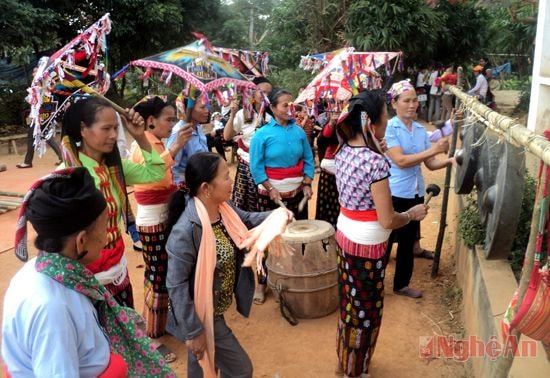 |
| A meeting of the gong club in Lac hamlet, Nghia Lac commune. |
While the Tho people are preserving their call-and-response love songs and gong playing, the Thanh people in Nghia Lac are proud of their "loong" rhythm and lively bamboo pole dance, along with their graceful circle dance. According to Ms. Le Thi Huong, one of the first people to establish the "loong" rhythm club in Mon hamlet, in the past, "loong" (or "loong") was a trough used for pounding rice, closely associated with the daily life of the Thanh people. Just a few people pounding rice together was enough to create a "loong" rhythm. When creating the "loong," people would use pestles to strike the sides of the trough or thrust them into the bottom, producing loud, strong, decisive, or rapid sounds. This is a unique, rudimentary musical instrument of the Thanh people, performed during festivals and holidays. Especially when welcoming distinguished guests, the villagers here organize lively furrow carving activities... "Initially, only about 10 women in the hamlet knew how to carve furrows. Whenever there was a cultural event or festival, we would form a group and participate spontaneously. In early 2014, with the suggestion of the Commune People's Committee, we established the Mồn Hamlet Furrow Carving Club to operate in a more organized and structured manner. After a year and a half of operation, the club has now attracted 97 members, holding monthly meetings on the 16th at the hamlet's cultural center. Operating expenses are covered by member contributions, with the hamlet's Front Committee allocating 50,000 VND per month to the club," added Ms. Le Thi Huong.
With the desire to preserve their ethnic identity, the Xoe dance club of Vang hamlet was established in 2014. Ms. Ha Thi Linh, the club's leader, said: "Xoe dance is an indispensable dance in major festivals and is considered a traditional dance of the Thanh Hoa people. Usually, at each festival, the Xoe dance is the final part, with everyone holding hands and dancing together in rhythm, creating many emotions for the participants. The Xoe dance of the Thanh Hoa people also expresses solidarity within the community, helping festival participants forget their fatigue and worries after periods of hard work." A beautiful and graceful circle dance is one that is natural, with everyone holding hands comfortably, moving in unison, and turning in the same direction... "After days of hard work, we dance the circle dance together, and the fatigue seems to disappear. Especially after the festival, everyone feels more in love with life and more enthusiastic about working, waiting for the next festival," Ms. Linh confided.
Mr. Ha Van Lieu, Chairman of the People's Committee of Nghia Lac commune, said: "To continue preserving and promoting the cultural values of ethnic minority communities in the area, the Party committees and authorities at all levels have intensified propaganda efforts to raise awareness among all segments of the population about the profound significance of cultural values. At the same time, they have mobilized the people to effectively participate in social mobilization to secure resources for the preservation and restoration of traditional festivals and unique folk art forms. In addition to the clubs mentioned above, Nghia Lac commune currently has the Khap singing club (Gay hamlet), the Giao Duyen singing club (Tan hamlet), and the bamboo pole dancing club (Men hamlet). The establishment of these clubs has attracted a large number of people from all walks of life to participate. Through the club's activities, members can interact, learn, enjoy the beauty of their ethnic culture, and pass it on to the younger generation to preserve and promote their ethnic cultural identity..."
Text and photos:Ngoc Anh


