Preserving village traditions
(Baonghean) - From National Highway 46, following the road at the foot of Nguoc Mountain, crossing Ben Loi Bridge, you will reach Phuc Xa village, Ngoc Son commune (Thanh Chuong district) - a rural area located on the left bank of the Gang River, which has preserved its familiar rural charm for generations.
The village boasts the Phuc Xa communal house, a magnificent ancient structure renowned throughout the region. Perched on the Ru Dang hill, beneath a centuries-old banyan tree, stands the five-bay communal house. In the past, the three outer bays housed three platforms for officials and villagers to sit on during ceremonies. The two inner bays were the place of worship, separated by a wooden partition with two doors on either side, which were only opened during religious services. Three large Chinese characters—Phuc, Dong, Du—hanged on this partition. Inside the communal house, there are swords, daggers, umbrellas, fans, a dragon throne, gongs, and drums. The yin-yang tiled roof, ridge, and eaves are all adorned with dragon motifs. The communal gate features two pillars with kneeling mythical creatures, and the front and back sides are inscribed with couplets in Chinese characters.
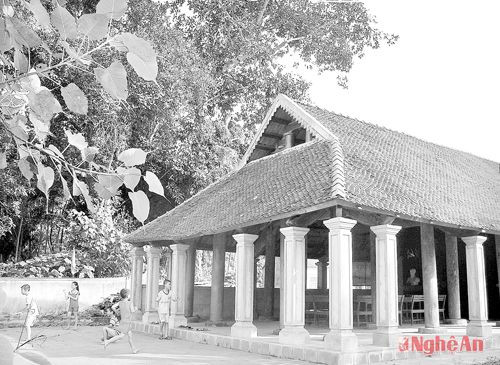 |
| Phuc Xa village communal house, Ngoc Son commune (Thanh Chuong district). |
According to Mr. Le Van Hau (90 years old), the village communal house was built in the year of the Water Dragon (according to the inscription on the wood), but the exact century is unknown. In the past, the communal house was used for peace-praying ceremonies and offerings to the god of agriculture. The village owned one acre of rice paddy on the Lay Huong hill, which was cultivated by the villagers, and the annual harvest was used to commemorate King Mai Hac De. During the French colonial period, the communal house served as a place of detention and interrogation for revolutionaries. On the day of the seizure of power, under pressure from the people, the village headman and village officials Nguyen Thinh Luyen and Nguyen Thinh Toan had to surrender their books and seals to the village. The local revolutionary committee also worked at the communal house. During the resistance war, the communal house was used to organize literacy classes for the people and served as the headquarters of the Provincial Political School. The Americans bombed the village, burning houses, killing people, and collapsing a corner of the communal house. After decades of being a ruin, in 2014, the ancient communal house was restored and renovated by the villagers. Although not as intact as it once was, the return of the familiar communal house is a long-held wish of the people of Phuc Xa. In its old setting, the villagers annually hold feasts for the elderly, celebrate birthdays in the spring, commemorate King Mai, and hold gatherings, social events, and reunions…
Having settled on this land for many years, the villagers built temples and shrines to worship gods, Buddhas, and those who had contributed to the country and the village. In the old days, near the communal house, there was a three-bay temple. On the first and fifteenth days of the lunar month, the villagers would prepare sticky rice, make offerings, cook porridge, and go to the temple to offer prayers and seek peace. At the end of the Rú Đấng hill, amidst a dense grove of trees, stood the Cả Temple with its two upper and lower buildings, dedicated to Cao Sơn and Cao Các. Inside the temple, there were swords, spears, and majestic guardians; it was once a sacred place of the village. Today, after many changes, the Cả Temple has been restored by the local people. In front of the temple, under the trees, the gate still stands, covered in moss, solemn and tranquil.
On the Rú Chuỳn hill, there is the Hai Temple, formerly consisting of two upper and lower buildings, dedicated to the god Kim Sơn. From the temple's entrance, one can take in a picturesque landscape of the Gang River, rice fields, and mountains… The elders in the village recount that: Although the temple was situated on a high hill, during the rainy season, the entire area would be flooded; the temple caretaker had to use a boat to transport all the sacrificial offerings and bring the god to reside in the communal house. During the subsidy period, the temple was dismantled and moved to a collective construction project. Now, on the old site, the villagers have erected a small shrine, with the foundations of the old temple still remaining. The two massive pillars in front of the temple are still intact, as a testament to the ups and downs of history. The Ba Temple, located at the head of the Rú Đấng hill, is dedicated to the god Bạch Sơn. The lower hall had three bays, the upper hall had one bay and two gables; it was also dismantled during the subsidy period like the Hai Temple. After decades, only the stone bases of the pillars remain. Now, the temple has been restored by the villagers, and the incense offerings continue as before.
According to the elders, when the three temples were dismantled, the artifacts, royal decrees, etc., were all gathered at the communal house; later, the cooperative moved them to the Nguyen Thinh family's ancestral temple, the largest family in the village. Today, the Nguyen Thinh family's ancestral temple still preserves 11 royal decrees granted to the village by various feudal dynasties. The oldest decree dates back to the 44th year of Le Canh Hung (1783), and the most recent to the 9th year of Khai Dinh (1924). The ancestor of the Nguyen Thinh family, Phuc Son Thach Tru Ba Tuong Cong, was granted two royal decrees.
The village used to have three banyan trees, but now only the Đình banyan tree remains, closely associated with the ancient communal house; and three wells: Hồ, Trùa, and Nuông, each a source of cool, fresh water for the village, dug in key locations. Even in the scorching summer heat of the Lao wind, when everywhere else is dry, the village wells remain full. In recent years, the villagers have been repairing and beautifying the wells, making them cleaner and more beautiful. For them, the village wells are not only a place for daily water use and a place for friendly gatherings among neighbors, but also an image of their traditional homeland etched in the memories of generations of villagers.
Visiting Phuc Xa to see the Gang River, Bac Mountain, and Bau Wharf, one can see how much has changed in this once impoverished land, yet the image of the banyan tree, the well, and the village communal house remains as it was in the old days, connecting the past and present of the village…
Huy Thu