
Helping infants develop a healthy psychological state.
From the moment they are born, babies have a need for bonding. Therefore, mothers should quickly make contact and hold their babies so that the baby's skin touches the mother's skin.
According to Master of Psychology Nguyen Thi Minh, lecturer at the National Academy of Public Administration in Ho Chi Minh City, from the moment they are born, children have basic psychological needs such as:
1. The need for attachment to others (primarily in the mother-child relationship)
Immediately after birth, babies exhibit behaviors such as: sucking, clinging, crying, smiling, nuzzling their heads against their mother's chest (because they want to find the breast and want to be close to their mother for hugs and comfort), showing the mother-child bond...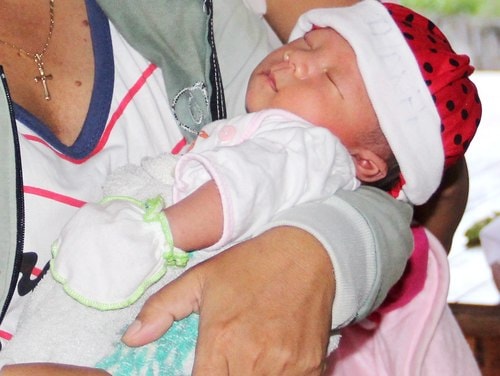
As soon as the baby is born, the mother should hold the baby close so that the baby can feel her warmth. (Photo)Thi Tran
The mother-child bond through touch is of paramount importance and appears earliest. After birth, both mother and child are highly sensitive to close skin-to-skin contact due to the need for maternal bonding. At this time, both mother and child send signals to each other. Even though they are still very young, children can sense their mother's expressions and react with movements. For example, when being held, cuddled, and comforted by their mother, children show comfort, security, smile, cry, squirm, etc.The mother-child bond from the very first days of a baby's life prevents developmental delays and physiological and psychological abnormalities later in life. Many psychological studies show that children who lack maternal love from a young age often feel lonely, anxious, and fearful. Later in life, these children tend to have low self-esteem in social interactions and are more likely to develop psychological disorders such as autism.Attention deficit hyperactivity disorder (ADHD).
The need for mother-child bonding is the foundation for a child's later communication needs with those around them. The mother is a source of impressions and external influences, essential for the neurological and sensory development of the child. Therefore, it's important to evoke emotions in the child, such as joy (laughter) when their needs are met and crying when their needs are not.
Regarding this point, Master's degree holder Nguyen Thi Minh advises that mothers should quickly connect with their newborns. Hold the baby so that skin-to-skin contact is achieved, while looking at the baby affectionately (within a range of about 30cm because the baby's eyes can't see far) and smiling lovingly at the baby. This positive impression will help establish a good mother-child bond, making the baby feel welcomed into the world and contributing to normal psychological and physical development.
2. Safety needs
This is a psychological state that arises when a child's basic needs and attachment needs are met. At this time, the child needs protection, shelter, warmth, and peace in the loving embrace of their mother. The need for safety is a condition for the normal development of the body, mind, emotions, and social relationships. Without safety, the child's emotions will become disordered.
Note: Do not leave your child alone for extended periods. If your child is fussy or crying, find out the reason and address it promptly. They may be feeling insecure; in this case, pick them up and don't let them cry for too long. Be careful with objects, especially sharp, small, or hot toys; keep them out of your child's reach.
3. The need to receive impressions from the outside world.
The need to receive impressions is linked to the orientation reflex; infants tend to follow moving bright objects with their eyes and react to sounds. From the second month, infants begin to pay attention to adult faces, often smiling when someone leans down to talk to them. The need to absorb impressions from the outside world forms the basis of other social needs such as communication and later cognitive needs. If infants are "starved of impressions," their development will be severely delayed.
Therefore, caregivers should create many positive external experiences to stimulate the child's development. Talk to the child frequently, even if they don't yet understand language. Avoid letting the child watch television; if they do, limit it to about 5 to 15 minutes per day.
4. New psychological structures in children
Because infants cannot satisfy any of their own needs, they are completely dependent on adults. In the early stages, it is adults who create the unique "social environment for development" of the infant. This is the bond between the child and the adult.
By the end of the second month, the "joy complex" begins to appear. This is a combination of limb movements and sounds emitted by the baby. For example, positive reactions such as smiling or drooling when the mother or relatives appear or cuddle the baby.
Special reaction: Smiling upon seeing their mother's face is an indicator that social interaction and psychological development in infants have begun to form. Gradually, babies are able to recognize and react to their mother's voice, smell, and taste of breast milk. They begin to develop an attachment to their mother. The baby's joyful expression, clearly formed by the end of the second month, is considered a milestone marking the emergence of the baby's first social need: the need for communication.
Note: Whether a child exhibits the joyful complex earlier or later than two months depends on the intensity of their interaction with those around them, especially their mother. Children who are deprived of interaction often show this later than others, so mothers should spend more time caring for, interacting with, and talking to their child.
According to VnExpress - NT


