
Untangling the credit bottleneck for agriculture and rural areas.
In recent years, the banking system has implemented many policies prioritizing capital allocation for agricultural and rural development, with an average growth rate of approximately 20% per year. However, credit policies for this sector have not yet met the needs and have not been as effective as expected.
This was the content of the online discussion organized by the Government's Electronic Information Portal yesterday (August 15).
Agricultural credit outstanding equals GDP.
According to Deputy Minister of Agriculture and Rural Development Vu Van Tam, Decree 41 on credit for agriculture and rural areas, which has been in effect for the past three years, has made a significant contribution to the meaningful achievements of Vietnamese agriculture during a period when the country's economy faced many difficulties. "This demonstrates the Party and State's concern for the agricultural and rural sector, aiming to alleviate current capital difficulties in production," Mr. Tam said.
Over the past nearly 10 years, the banking system has implemented many policies prioritizing capital allocation for agricultural and rural development. Since 2008 alone, credit growth for the agricultural and rural sector has averaged around 20% annually.
Particularly since the issuance of Decree 41, credit flows have been strongly directed towards the agricultural and rural sectors. Agriculture and rural areas have always been priority targets in the credit policies of the State Bank of Vietnam and other credit institutions.
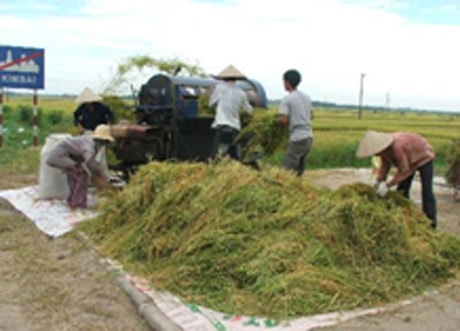
Credit contributes to the development of agriculture and rural areas.
Mr. Nguyen Viet Manh, Director of the Credit Department (State Bank of Vietnam), said that starting with Decree 41, credit for agriculture was 292,000 billion VND, and now, after 3 years, it has reached 622,000 billion VND, an increase of 2.1 times. “This credit capital accounts for about 18-19% of the total credit of the entire sector, and if we include the outstanding loans of the Policy Bank, it accounts for about 20-22%, corresponding to the contribution of the agricultural sector to the country's GDP,” Mr. Manh said.
Sharing the same view, Deputy Minister Vu Van Tam stated that, thanks to credit capital, agriculture has always been a lifeline, helping to stabilize society and improve people's lives through the global financial recession from 2008 to the present, which is a very clear point.
"I believe that Decree 41 has had a positive impact. Many times, when I and delegations visited the Mekong Delta provinces, we saw that bank capital has indeed had a significant impact on farmers, especially those engaged in aquaculture," Mr. Tam emphasized.
Prior to 2010, unsecured loans were limited to 10 million VND or less for farmers, 50 million VND for farms, and 100 million VND for cooperatives. However, after Decree 41 was issued, the unsecured loan limit for farmers was increased from 10 to 50 million VND, for farms from 50 to 200 million VND, and for cooperatives from 100 to 500 million VND, providing a significant amount of capital and facilitating access to credit for the people.
Farmers still have difficulty accessing loans.
Mr. Lai Xuan Mon, Vice Chairman of the Vietnam Farmers' Association, stated that although policies have become more open, farmers still find it difficult to access loans. Over the past three years, credit allocated to farmers through the Association has only reached 13,000 billion VND, while there are 14 million farming households nationwide. This means less than 4% of farming households have access to loans, whereas normally around 50% or more have a need for capital.
Agreeing with this viewpoint, Deputy Minister Vu Van Tam added that, in reality, not only farmers but also businesses in the agricultural sector urgently need credit support. “Unfortunately, most businesses in our agricultural sector lack the capacity to take advantage of market opportunities to organize linkages and work alongside farmers in production. I think that in the agricultural sector today, besides capital and technology, the business of selling products is very important,” Mr. Tam analyzed.
Explaining this, Deputy General Director of the Vietnam Bank for Agriculture and Rural Development, Nguyen Tien Dong, said that the credit policy is generally consistent and always has certain principles in capital recovery.
"In the past, we've been producing in a disorganized manner, without any linkages. If a sector is doing well, we rush into it; if the market needs 10, we produce 15, leading to unhealthy competition and unsold goods resulting in bad debts. Therefore, to have a credit policy, we need to have specific planning for each industry group and production region, with linkages. Only then will credit be sustainable, and loans may even be granted without collateral," Mr. Dong proposed.
According to (NNVN) - LC


