
Suggested solutions for the 2014 High School Graduation Exam in History
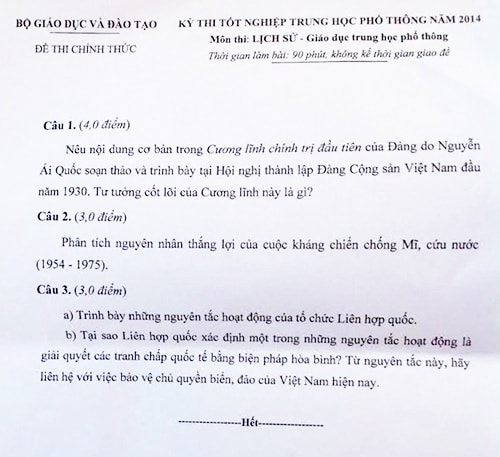
The third subject of the 2014 high school graduation exam, History, has just concluded. Below are the exam questions and answers for History, completed by candidates on the first day of the exam...
| RELATED NEWS |
|---|
 |
| History exam |
Suggested answer:
Question 1:
A. Circumstances:
From January 6th to February 7th, 1930, under the chairmanship of Nguyen Ai Quoc, the founding conference of the Communist Party of Vietnam took place in Kowloon Port (Hong Kong), China.
- The conference unified the communist organizations and adopted many important contents. Among them, the first political program drafted by Nguyen Ai Quoc was adopted by the conference with the following content:
B. Basic content of the Political Platform:
- Identifying the path Vietnam must take: Carrying out a bourgeois democratic revolution and an agrarian revolution to advance towards a communist society.
- The task of the Revolution was to overthrow French imperialism, feudalism, and the counter-revolutionary bourgeoisie, to make Vietnam independent and free, to establish a worker-peasant-soldier government; to confiscate all imperialist property and carry out a land revolution.
- The revolutionary forces are citizens, peasants, petty bourgeoisie, intellectuals… rich peasants, middle and small landowners must be utilized or remain neutral.
- The revolutionary leader is the Communist Party of Vietnam, the vanguard of the working class, with Marxism-Leninism as its ideological foundation.
- The Vietnamese revolution must be an integral part of the world revolution.
C. The core ideology of the program
- The first political program of the Communist Party of Vietnam, drafted by Nguyen Ai Quoc, was a creative national liberation program that combined the national question with the class liberation question.
- The manifesto reflected the ideology of national independence and freedom linked with class liberation.
Question 2:
The victory of the resistance war against the US to save the nation stemmed from the following objective and subjective reasons:
A. Subjective causes:
Firstly: Thanks to the wise leadership of the Party, headed by President Ho Chi Minh, with its independent, self-reliant, and creative political and military line, and its strategy of simultaneously carrying out the Socialist Revolution in the North and the National Democratic People's Revolution in the South, employing flexible methods of struggle combining military, political, and diplomatic efforts:
From the very beginning of the resistance war, the Party identified the common and specific tasks of the two regions, North and South. It leveraged the strengths of each region while simultaneously working towards the common goal of national unity, liberation, and reunification.
+ At each stage, in dealing with each American strategy, our Party has always devised the correct methods of struggle, harnessing the combined strength of the entire people.
Secondly: Our people are patriotic, united, hardworking, and courageous in their labor for the liberation of the South, the building and protection of the North, and the reunification of the country. The rear area of the North continuously grew stronger, promptly meeting the demands of the resistance war in both regions.
+ The patriotic tradition of our people has been forged over thousands of years and is demonstrated through concrete actions such as: enthusiastically engaging in production, building the rear base, and volunteering to go to the front lines.
The victory in the South and the reunification of the country were made possible by the immense support of the people of the North, both materially and spiritually.
B. Objective causes
- Thanks to the coordinated fighting, solidarity, and mutual assistance among the three Indochinese countries against a common enemy, the immense sympathy, support, and assistance from revolutionary, peaceful, and democratic forces worldwide, especially the Soviet Union, China, and other socialist countries; and the American people's movement and the people of the world opposing the US imperialist war of aggression against Vietnam:
In April 1970, a high-level conference of the three Indochinese countries was held in Hanoi, pledging to fight the United States together. A fighting alliance of the three countries was formed.
In 1950, China and the Soviet Union established diplomatic relations with Vietnam. These were the first two countries, and also the two most active in providing material and moral support to the Vietnamese people during their resistance against the US.
+ The rallies and demonstrations by peace-loving people around the world were a tremendous source of moral support for the Vietnamese people in their resistance war against the US.
Question 3
A. Principles of operation of the United Nations
From April 25th to June 26th, 1945, the International Conference met in San Francisco (USA) with delegates from 50 countries to adopt the Charter and establish the United Nations.
From its inception, the United Nations has set forth the following operating principles:
+ Sovereign equality among nations and the right of self-determination for peoples.
Respect the territorial integrity and political independence of all countries.
+ Not interfering in the internal affairs of any country.
+ Resolving international disputes through peaceful means.
+ Peaceful coexistence and consensus among the five major powers (Soviet Union, USA, UK, France, China).
B.
- Explain why the United Nations has identified one of its operating principles as resolving international disputes by peaceful means:
The United Nations was established as an international forum for both cooperation and conflict in order to maintain world peace and security; therefore, all international disputes must be resolved through peaceful means to ensure that all nations, large and small, have equal rights before international law.
- Relate this to the current situation regarding the protection of Vietnam's maritime sovereignty and islands:
Since May 2014, China has brazenly deployed the HD981 oil rig, violating Vietnam's maritime sovereignty. Simultaneously, it has engaged in numerous aggressive and threatening actions against Vietnamese fishermen while they fish in Vietnam's sovereign waters.
The Vietnamese government has used all peaceful means to call on China to exercise restraint and sit down at the negotiating table to resolve the issue peacefully in accordance with international law.
The Vietnamese people, as well as peace-loving people around the world, have voiced their support for the peaceful solutions offered by the Vietnamese government, while condemning China's aggressive actions and calling on China to exercise restraint and refrain from using force.
The suggested answers and solutions are for reference only and were prepared by teachers from the Vietnam Center for Educational Research and Development, which is also one of the most reputable exam preparation centers today.
According to GDVN


