
Contributing to the discussion about village communal houses in Nghe An province.
Recently, the provincial press has reported quite a lot on the issue of village communal houses in Nghe An province. This reveals a sad reality: village communal houses have almost disappeared in Nghe An, an ancient land rich in cultural traditions (currently, only about 80 remain).
Recently, the provincial press has reported quite a lot on the issue of village communal houses in Nghe An province. This reveals a sad reality: village communal houses have almost disappeared in Nghe An, an ancient land rich in cultural traditions (currently, only about 80 remain).
|
Nhan Trung Temple (Lam Son (Do Luong) - |
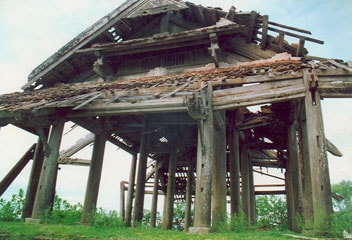
The existing village communal houses are also in a state of serious disrepair, with very few being preserved or restored. There are many reasons for this, but fundamentally, it is due to a lack of adequate attention from relevant authorities and a lack of awareness among some people regarding the preservation of historical, cultural, and spiritual relics.
Most articles urgently call on relevant agencies and the public to raise awareness of protecting and restoring communal houses that are facing the risk of collapse. This is supported by the majority of the people, because life in all aspects has improved significantly, and many people now have a need to return to spiritual life and community culture. Moreover, the country has embarked on the path of exchange and integration, so it is necessary to preserve its unique characteristics. This is the story of localities where village communal houses are facing the risk of deterioration. But what about areas that were once ancient lands but, due to many drastic changes, no trace of the village communal house remains? According to historical documents, village communal houses in Vietnam date back to the 15th century. From then on, each time people settled and established a village, they planted a banyan tree and then built a communal house for the villagers to gather, perform rituals, and worship those who had made great contributions to the village (called the village guardian deity). But in the ups and downs of history, not every village has managed to preserve its communal house. My hometown, Anh Son district, is a case in point. According to the geographical treatise by the renowned scholar Nguyen Trai, Anh Son during the Le dynasty belonged to Anh Do prefecture (including the present-day districts of Hung Nguyen, Nam Dan, Do Luong, and Anh Son). Thus, this land has been inhabited since the Le dynasty, or possibly even earlier. Sadly, however, there are almost no traces to prove it was an ancient land. I haven't had the opportunity to conduct a survey, but since childhood, I've only seen one village communal house in Vinh Son commune, which is currently in a dilapidated state. Therefore, many visitors mistakenly believe that my hometown is a newly developed economic zone from the 1960s. Given this situation, localities that no longer have village communal houses need to plan for their restoration and reconstruction to create sacred spaces that reflect the cultural identity of the village, the greatest benefit of which is contributing to regulating human behavior. It is an undeniable fact that in areas that still preserve historical relics of a communal nature, many talented individuals emerge, such as Quynh Doi (Quynh Luu) or Vo Liet (Thanh Chuong)...
Preserving, restoring, and renovating village communal houses is one of the most urgent requirements in today's cultural life; otherwise, the cultural traditions of our homeland and nation risk being broken. We know this is not an easy task, but surely our ancestors could do it, so why should we stand idly by?
Bui Cong Kien -Hamlet 1 - Tuong Son - Anh Son


