
Contributing to sustainable poverty eradication.
(Baonghean) - In recent years, vocational training programs for rural laborers have initially achieved certain successes, receiving recognition and high praise from rural workers. This has contributed to the implementation of social equity policies regarding vocational training opportunities for all rural laborers, especially agricultural laborers belonging to the poor, contributing to boosting production, increasing added value, economic income, and poverty reduction. In particular, many rural laborers have found stable employment and income after completing vocational training, gradually investing in large-scale development…
GMr. Nguyen Dinh Lam's family in Hamlet 2 (Dien An Commune, Dien Chau District) is a purely agricultural family. In 1999, using his family's accumulated capital, he decided to lease land from the commune to invest in a comprehensive livestock farm. Initially, he faced many difficulties, especially a lack of experience and knowledge in aquaculture, cattle, pig, and chicken farming. In 2011, the commune's People's Committee facilitated his participation in a local pig farming training course. He was delighted and recognized this as an opportunity to access scientific and technical information about livestock farming, particularly experience in pig farming.
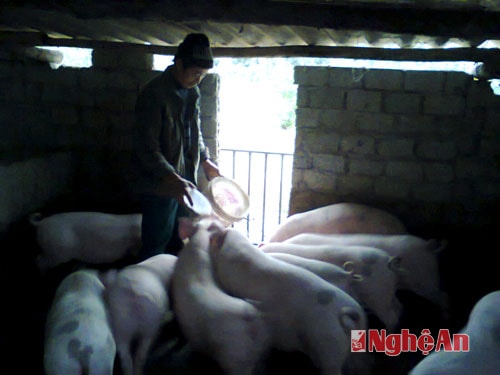 |
| The pigs belonging to Mr. Lam's family in Hamlet 2, Dien An, Dien Chau. |
After nearly three months of vocational training, actively learning, researching, and sharing experiences with fellow students, he has accumulated the necessary knowledge of pig farming to confidently invest in effective livestock production. He excitedly said: "The government providing vocational training is a very important opportunity to gain more knowledge and experience to develop agricultural production. Before receiving vocational training, during the process of raising and caring for pigs, fish, etc., I often didn't pay attention to technical aspects, so when diseases occurred, I didn't know how to prevent, treat, and handle them. After receiving vocational training, I can now calculate and choose the right feed, breed, methods of raising and caring for pigs, injection and castration techniques, and how to prevent and treat common diseases myself."
Before learning the trade, he only dared to raise two batches of pigs (15-20 pigs/batch) and 50-100 chickens per year. Now, with his knowledge of livestock farming techniques, he boldly decided to invest in developing his farm, raising three batches of pigs (25-30 pigs/batch) per year, generating a total income of 240-250 million VND per year. In addition, he also raises three breeding sows to ensure a local source of piglets, 400-500 broiler chickens per batch, and a fish pond with nearly 1,000 m² of water surface. He knows that Decision 1956/TTg only allows rural laborers of working age one opportunity to learn a trade, and any change to another profession requires the approval of the Provincial People's Committee and a maximum of three times. However, if given the opportunity, he would like to learn many other trades such as crop cultivation, fish farming, and agricultural machinery repair.
Ms. Doan Thi Luong, Chairwoman of the Farmers' Association of Dien An commune, said: “In the commune, many people, after receiving vocational training, have invested in and developed production on a scale similar to Mr. Lam's. Each year, the commune People's Committee facilitates the opening of 2-3 vocational training classes in the locality. We affirm and highly appreciate the practicality and effectiveness of this Project 1956/TTg. Through vocational training, rural laborers have gained more scientific and technical knowledge and advanced farming and livestock methods, creating jobs for rural workers, contributing to sustainable poverty reduction, and working together with the locality to complete the criteria for building new rural areas. Currently, the demand for vocational training among rural laborers is very high. The State needs to diversify vocational fields for people to choose from, increase the number of vocational training classes annually, and provide policies to support loans and guarantee the purchase of products for those who have completed the training to ensure high efficiency and sustainability.”
It is believed that Prime Minister's Decision 1956/TTg continues to affirm the effectiveness and success of the Project. Vocational training in agriculture is currently a necessary and anticipated need for all rural workers. It helps them gain more opportunities to learn a trade, improve their skills and abilities, create more jobs, and increase economic income per unit area and livestock farm. However, for the vocational training project for rural workers to truly be implemented, ensuring effectiveness and sustainability, the State needs to continue paying attention to planning and orienting agricultural occupations for each region and locality. It also needs specific mechanisms and policies for those who have completed vocational training, and should mobilize all resources and economic sectors to participate and support farmers in training and guaranteeing the purchase of their products to help them maintain and develop their skills after training.
Ha Thao
(Provincial Agricultural Extension Center)


