
Professor Tran Dinh Huou - The man who exposed Greater Han chauvinism.
(Baonghean) - Professor Tran Dinh Huou (1926 - 1995) was known as an expert in the field of Eastern thought and Vietnamese medieval literature. His life of research and teaching went through many ups and downs, but was ultimately recognized and honored by posterity. Nearly 20 years have passed since his death, but his scientific arguments remain extremely valuable for the present and for the future...
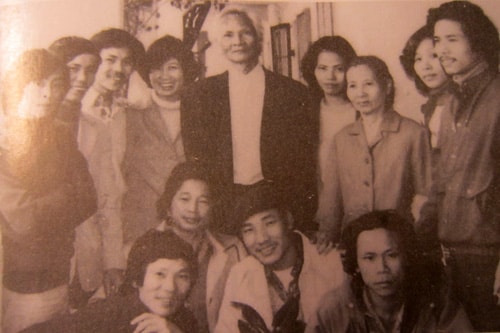 |
| Professor Tran Dinh Huou and his generations of students. (Archival photo) |
Professor Tran Dinh Huou was born and raised in a scholarly family in Vo Liet village (Thanh Chuong district). After the August Revolution (1945), Tran Dinh Huou returned to his hometown and participated in the Viet Minh organization from the commune, district, provincial, and regional levels, becoming a leader of the "Researchers of Marxism" branch in Nghe An. Later, he was sent to study at Dao Duy Tu School (Thanh Hoa province), and then in the preparatory program of the Resistance University. After graduating, Tran Dinh Huou was assigned to teach at Huynh Thuc Khang School (Nghe An province). In 1959, he was sent to Moscow (Soviet Union) to officially become a postgraduate student in philosophy. At Moscow State University (MGU), Tran Dinh Huou supervised research on ancient Chinese philosophy. Upon returning to Vietnam, Tran Dinh Huou worked at the Faculty of Literature - Hanoi University until his retirement (1963-1993).
With his practical experience and keen insight, Tran Dinh Huou has made scientific conclusions that help us better understand the origins and nature of Greater Han chauvinism. In 1979, 35 years ago, after the end of the Northern border war, Tran Dinh Huou wrote an article titled "The Application of Confucianism and Legalism and the Expansionist Path of the Celestial Empire" (collected in the work "Tran Dinh Huou Selected Works" (Volume 1), Education Publishing House, 2007, pp. 689-713). In this article, he delved into fundamental issues: the autocratic regime of the emperor, the expansionist path of the Celestial Empire, and the relationship between domestic authoritarianism and foreign expansionism. According to him, the feudal dynasties of China combined Confucianism and Legalism to serve their expansionist policies. In other words, Greater Han expansionism stems from the combination of Confucianism, which always emphasizes benevolence and righteousness, and Legalism, which encourages and glorifies violence and war. This combination created an autocratic emperor who was harsh towards his subjects and constantly plotted to invade neighboring countries: "Both Legalism and Confucianism arose on the socio-economic basis of the Chinese autocratic regime. The two doctrines complemented and combined with each other, giving Chinese expansionism – imperial expansionism – characteristics that bear the imprint of that autocratic regime."
Professor Tran Dinh Huou wrote: “Invading neighboring countries is a way to gain profit, but primarily to increase prestige. Attacking is about plundering, but also about demanding more tribute. However, attacking is also about showing off, demonstrating that one still has the strength to punish those who dare to oppose. Therefore, often, attacking is about buying prestige. The submission of vassals – often only nominally – also increases domestic and foreign prestige, saving a declining state. That is the emperor's way of securing internal peace and external stability.” We can easily see that this conclusion is not only true for the nature of Chinese feudal dynasties but also for the nature of China today. Facing numerous domestic problems such as unrest in the Xinjiang Uygur Autonomous Region, signs of economic instability, and population pressure, the Beijing authorities immediately seek to push conflicts outward. This is demonstrated by aggression towards neighboring countries, such as border disputes with India, and territorial disputes with Japan and other ASEAN countries.
In the aforementioned article, Professor Tran Dinh Huou pointed out the basic characteristics of Greater Han expansionism: belligerence, arrogance, and delusion. This stems from a belief in one's own strength and perceived righteousness, along with the divine blessing of being a father figure to others, leading to arrogant behavior, little consideration of practical advantages and disadvantages, and a tendency to act recklessly and opportunistically.
The second characteristic is hypocrisy; the brutality of Greater Han expansionism is always disguised with words of benevolence and morality. A tyrannical regime is inherently weak; its survival is based on deception and insidious tactics. The weaker it is, the more it seeks to win over others through threats and deceptive hypocrisy.
The third characteristic of Greater Han expansionism is prioritizing prestige over substance. According to Professor Tran Dinh Huou, the Chinese autocratic regime thrives on political prestige. It invades to protect its reputation rather than to gain real advantage. The habit of wanting to be superior also leads to a greater focus on prestige than on practical considerations. This often becomes the cause of reckless actions.
Professor Tran Dinh Huou passed away nearly 20 years ago, but many of his scientific arguments are still worth contemplating by future generations, especially in the context of building a modern society and relations with neighboring China. That is why, whenever he is mentioned or remembered, many people express their affection and admiration for our "Master of Nghe An."
Cong Kien


