
The journey from Hanoi to Ho Chi Minh City takes 24 hours and 24 minutes.
At a meeting of the Steering Committee for Priority High-Speed Railway Sections organized by the Ministry of Transport on August 14th, a delegation from the Japan International Cooperation Agency (JICA) proposed upgrading the existing railway line to shorten the travel time from Hanoi to Ho Chi Minh City to 24 hours and 24 minutes.
At a meeting of the Steering Committee for Priority High-Speed Railway Sections organized by the Ministry of Transport on August 14th, a delegation from the Japan International Cooperation Agency (JICA) proposed upgrading the existing railway line to shorten the travel time from Hanoi to Ho Chi Minh City to 24 hours and 24 minutes.
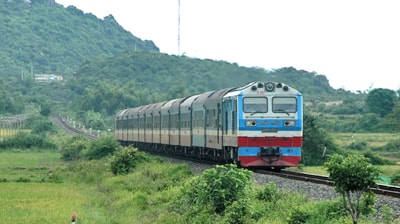
Trains traveling from North to South pass through Van Ninh district, Khanh Hoa province.
- Photo: TTD
After more than a year of field surveys, research, and calculations, Japanese railway experts and consultants in the JICA working group studying the high-speed railway project for the Hanoi-Vinh and Ho Chi Minh City-Nha Trang sections believe that by 2030, transportation demand on the North-South corridor will increase by approximately three times compared to the present. Therefore, if the current plan to upgrade the existing 1-meter gauge single-track railway continues, railway transportation will not be able to meet the demand by 2030.
The existing railway should be upgraded.
However, experts consider increasing train speeds to 200 km/h on the current 1m and 1.067m gauge single-track railways to be technically unfeasible. Even expanding the curve radius of the current railway line to 2,000m at 1,500 locations and installing grade-separated level crossings at more than 2,000 locations would not be sufficient to achieve the aforementioned speed.
According to Dr. Iwata Shizuo, head of the JICA research team, operating trains at 200 km/h on existing railway lines would require an investment equivalent to building a new line, as it necessitates a complete overhaul of the electrical, signaling, locomotive, and rolling stock systems. Therefore, Japanese experts proposed: firstly, maximizing the capacity of the current single-track railway during the 2020-2025 period and constructing double tracks for high-demand sections; and secondly, establishing a dedicated high-speed rail line with construction and commercial operation scheduled for completion by 2041.
Specifically, the research team recommended that from now until 2020, the North-South railway line should be upgraded and renovated to maintain the current speeds of passenger trains (90 km/hour) and freight trains (60 km/hour), but shorten the travel time to 24 hours and 24 minutes, and increase the train capacity from 32 trains to 50 trains per day. The total investment cost for this option is approximately 1.8 billion USD.
For high-demand sections, the JICA research team proposed constructing a double track with a 1m gauge and expanding the minimum curve radius from the current 100m to 800m to achieve a maximum speed of 120km/h. Alternatively, if the entire line were to be double-tracked to achieve a speed of 120km/h, shortening the travel time from Hanoi to Ho Chi Minh City to 15 hours and 36 minutes, the estimated investment cost would be approximately 14.5 billion USD.
High-speed rail: trial run of 70km.
Regarding the study of the two priority high-speed railway lines, Hanoi - Vinh (280km) and Ho Chi Minh City - Nha Trang (360km), according to the research team, these two lines will be economically feasible around 2030 with an economic internal rate of return (EIRR) of 12%. The investment cost for these two sections is approximately 21.4 billion USD (equivalent to 6.3% of Vietnam's GDP in 2030).
If these two sections are implemented, the consultants propose using Japanese locomotives and carriages to achieve a maximum train speed of 320 km/hour, which can be increased to 350 km/hour. Based on preliminary calculations, the research team believes that high-speed rail fares would be half the price of airfare and twice the price of bus fares.
According to the high-speed rail development plan, JICA consultants proposed building two trial sections: Ngoc Hoi - Phu Ly (approximately 40 km) and Thu Thiem - Long Thanh (approximately 30 km). The research team proposed a plan where the State would invest capital in infrastructure and technical systems, while private investors would be encouraged to invest in locomotives and carriages for operation and maintenance. This mechanism, according to Japanese experts, would minimize risks for the operating unit as it would eliminate the need for investment and debt from infrastructure development.
Proposed roadmap for high-speed rail development
● 2013: Submitted to the National Assembly for approval.
● 2014: Preparation of implementation plan, environmental impact assessment, design, and institutional development.
● 2017: Land reclamation began.
● 2018: Construction of the test track.
● 2023: Test runs commenced.
● 2031: Commercial operation of the priority section begins.
● 2041: Commercial operation of the entire line.
According to (tuoitre.vn) - LT


