
Hanoi, the Autumns
(Baonghean) - Looking back at the long history of Thang Long - Dong Do - Hanoi, it seems that major events related to the "heart" of the country often occur in the autumn. Hanoi is most beautiful in autumn; autumn has become a weather symbol of the capital, transcending historical boundaries while still retaining its gentle beauty. This year, Hanoi's autumn arrived late; it seems the autumn breeze lingered somewhere, not yet unleashing its cool winds and chilly gusts into the inner city. But along all the roads leading to Ho Guom Lake, the vibrant colors of flowers and leaves, the dazzling lights, and slogans... have already covered everything, stirring up excitement in people's hearts. This year, Hanoi celebrates the 60th anniversary of the Liberation of the Capital (October 10, 1954), marked by the troops entering through the city gates...
The first autumn in Thang Long was the autumn of the year Canh Tuat (1010). Ly Thai To (the founding king of the Ly dynasty) realized that Hoa Lu was cramped, surrounded by mountains on all sides, and unsuitable as a capital to establish a prosperous nation. The king considered moving the capital. Historical records of the time state: "Looking throughout Vietnam, only Dai La was a 'strategic location,' 'at the center of heaven and earth,' 'with the auspicious configuration of a dragon bowing and a tiger crouching, conveniently oriented in the South, North, East, and West, and conveniently situated with mountains and rivers in front and behind,' 'with a wide and flat surface, and a high and bright terrain.'" Ly Thai To then drafted the famous "Decree on Moving the Capital" to consult his ministers. The king and his ministers unanimously agreed, and decided to move the capital from Hoa Lu to Dai La.
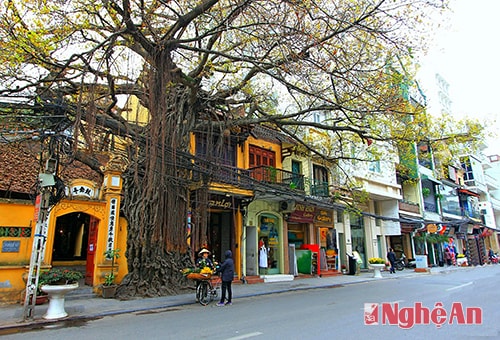 |
| A street corner in Hanoi. Photo: Ho Long |
In the autumn of 1010, the king's fleet, relocating the capital, arrived at Dai La Citadel. At that very moment, according to legend, the king saw a golden dragon rising, and upon seeing this, he renamed Dai La Citadel to Thang Long.
Establishing the capital in Thang Long, Ly Cong Uan renamed the former capital Hoa Lu to Trang An prefecture, renamed his hometown of Co Phap to Thien Duc prefecture, divided the country into 24 provinces, and called Hoan Chau and Ai Chau "camps".
In the autumn of 1945, Hanoi once again experienced glorious days. It was in Ba Dinh Square that President Ho Chi Minh read the Declaration of Independence, giving birth to the Democratic Republic of Vietnam. That autumn was the autumn of independence, of a new spirit in every person. That autumn welcomed the return of the leader and the entire army; that autumn the voices of the people from Nghe An province stirred up a sea of people in the square, their voices resounding in harmony.
I recall the autumn of Hanoi's liberation, a day when flags fluttered everywhere. The glorious history of the nation, recounted by eyewitnesses and preserved in photographs and films, still shows the last French soldiers silently withdrawing across the Long Bien Bridge. The Long Bien Bridge is not merely a vital transportation artery; it is also a historical witness to Hanoi. It was on this bridge, in 1947, after successfully holding back and depleting the enemy's forces, that our troops were ordered to withdraw from Hanoi to preserve their strength. One of our units chose the Long Bien Bridge, cleverly using the space beneath to reach Nghi Tam and cross the Red River. They left behind "the entire city engulfed in flames" (Chinh Huu's poem), their eyes filled with a promise to return someday. Many soldiers, before the moment of retreat, while preparing their belongings, busily wrote slogans on the walls: "O invaders, we will return!", "We will definitely return to liberate the capital!". Hanoi bid farewell to the soldiers departing, awaiting their return, but Hanoi could not forget the soldiers who fell in the battles in the capital. And how could Hanoi, the people of Hanoi, forget a squad from the Hong Ha Company tasked with supporting the Capital Regiment crossing the river? When the French discovered our unexpected retreat, they furiously pursued us. The squad bravely and courageously fought, and after eliminating 17 enemy soldiers and holding back the enemy for our troops to retreat, all the soldiers of that heroic squad also perished on the banks of the Red River.
Those losses and sacrifices merged with the losses and sacrifices of the entire nation, leading to the historic moment on October 10, 1954, when the City Military and Political Committee and the 308th Division, tasked with defending the capital, launched a historic march into Hanoi. The Capital Regiment led the troops, proudly raising the "Determined to Fight, Determined to Win" flag, returning to liberate the capital. The first infantry column passed through Kim Ma, along Hang Day, Hang Bong, Hang Gai, Hang Dao, Hang Ngang, and the East Gate into the city. The second infantry column passed through Cau Den via Hue Street, Hom Market, Hang Bai, and then into the Don Thuy area. The mechanized, artillery, and anti-aircraft units advanced from Bach Mai Airport through densely populated areas, past Hoan Kiem Lake, and through Dong Xuan Market into the North Gate.
200,000 Hanoi residents and hundreds of thousands of suburban farmers crowded the streets, waving national flags, joyfully welcoming the revolutionary government and the People's Army. People from working-class neighborhoods poured into the streets... The people of Hanoi waved flags and flowers, released doves, beat drums, played trumpets, performed lion dances, and set off firecrackers... in celebration. Portraits of President Ho Chi Minh were displayed in the most prominent places. Everyone chose their finest clothes to wear, joyfully waving or, overcome with emotion, rushing out into the streets to embrace the soldiers with overwhelming happiness. A great celebration after eight long years of waiting!
Hanoi in autumn is so beautiful, so enchanting. But through those autumns, the entire country and the entire nation have also witnessed irreparable suffering...
In the autumn of 1969, the heart of Uncle Ho – the Father of the Nation – stopped beating. Hanoi once again had to endure a heart-wrenching autumn. Journalist Phan Quang, in a memoir, recounted that painful moment in Hanoi: Before leaving for work earlier than usual, I told my grandson, who had just woken up: “Uncle Ho is gone, son.” He uttered two words: “Don’t even think about it!”, then angrily turned his back. He had never said those two words in front of adults before, only when shouting and joking with his friends. He turned back gently and said: “Uncle Ho is just sick.” – “Uncle Ho is really gone, son! The radio just reported it.” – “I don’t believe it,” he replied curtly.
How can children their age believe that Uncle Ho is no longer in this world!
When I got home at noon, I saw a neatly written note on my child's desk: "Uncle Ho passed away at 4:47 PM on September 3, 1969." My child said, "I wrote it down so I wouldn't forget."
And then, just a year ago, in another autumn, the scorching sun blazed down at the end of the day, and the crape myrtle trees on Dien Bien Phu Street suddenly shed their leaves. It was at this very moment that General Vo Nguyen Giap, the Commander-in-Chief of the Vietnam People's Army, the elder brother of the army, closed his eyes, bidding farewell to the autumn sky of Hanoi and to tens of millions of people who loved and respected him.
I still remember the long lines of people, forming a rectangle stretching along several streets, just to reach the entrance of house number 30 Hoang Dieu, where the General had stayed before being hospitalized with a serious illness. They followed familiar paths, entering the tree-shaded courtyard, sunlight filtering through the leaves onto the slow-moving crowd, suppressing their sobs. Autumn was like any other autumn, but the Hanoi autumn sky seemed bruised by tears...
Another autumn in Hanoi has witnessed a departure, a great loss. But no one will forget that autumn with its endless streams of people, with crowds filling the streets where the General's coffin passed on its way to his final resting place. Among them, the vast majority were people who had never met the General in person, who had never experienced the historical glory he created, yet his love, respect, character, and talent have been passed down through generations! I suddenly felt a pang of nostalgia for the poem by Anh Ngoc, a poet from Nghe An province, about the "Old General," whose real-life counterpart was General Vo Nguyen Giap: "One foot he has placed in history / One foot still lingers with autumn"...
Cam Son


