
Picking lucky branches in early spring
(Baonghean.vn) -The most important moment of the Lunar New Year is New Year's Eve. In Japan, from 11 pm until midnight, thousands of people flock to temples and shrines to visit, buy amulets and ancestral tablets, and pray for peace and prosperity in the new year. In Vietnam, the moment of New Year's Eve is also associated with customs and traditions such as preparing offerings, visiting relatives and friends to wish them a happy new year, and, of course, the custom of "picking lucky branches."
|
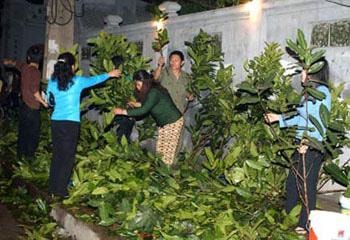
Seeking blessings is a human desire for fulfillment in terms of wealth, children, family, and good fortune. Throughout your life, you've undoubtedly reached out to seek blessings at some point to fulfill your wishes for good luck and success.
Yes! It's truly heartwarming to have a branch of fresh, vibrant green leaves, full of spring energy, and a wish for good fortune, during the transition from the old year to the new. The beauty and humanistic significance of the custom of picking auspicious branches are undeniable. Therefore, the custom of picking auspicious branches at the beginning of spring can take place anywhere. The question is where and how we pick them appropriately.
In the past, people usually picked lucky branches at home or sought blessings at temples. At home, after preparing the offerings for the New Year's Eve ceremony, the head of the household would go to the garden to pick a lucky branch and bring it inside for everyone to see. They would then respectfully place it in a vase hung on the wall or on the ancestral altar.
In many places, after picking a branch, people still try to predict their personal or family fortune by fortune-telling, meaning that if they get a beautiful branch, abundant fruit, or an unusual shape, they will have good luck and prosperity in the new year. In some cases, if a family doesn't have a garden, before New Year's Eve, the homeowner goes to the temple to pray and then asks for a young branch prepared by the temple, which they call a blessing from Buddha, to bring good fortune to their family.
However, to seek good fortune, people can make wishes (pick auspicious branches) anywhere. Young men and women, while enjoying the spring scenery at famous landmarks or in spring gardens, few can resist picking auspicious branches. Picking auspicious branches at the beginning of spring is an act of harmony between humanity, heaven, earth, and nature. In the universe, where the relationship between Heaven, Earth, and Humanity is central, picking auspicious branches not only expresses the harmony of the desire for fertility between humans and heaven and earth, but also serves as a conduit for the life force of heaven and earth to humans, enabling all things to flourish.
Therefore, the blessings here are only symbolic. This custom would be beautiful and meaningful if people understood its true nature. Whether you ask for blessings at home, at a temple, or at a scenic spot, remember that it's just a tiny branch of blessings carrying symbolic weight, not about its size.
Perhaps due to a misunderstanding, in recent years the custom of picking auspicious branches at the beginning of spring has actually transformed into deforestation, destroying trees and disrupting the ecological balance. Trees along streets, village roads, and in ecological gardens are often left withered and desolate. Especially young men and women, so handsome and beautiful, in the fresh spring air, carelessly break, chop, and even cut large branches and swagger around. They believe that the bigger the branch, the more luck they have. But they don't realize that their misinterpretation of the philosophical meaning of this custom has turned into an act of environmental destruction.
Hopefully, the custom of picking lucky branches at the beginning of spring will be understood in its true meaning, as a cultural tradition of the Vietnamese people.
Huu Dao


