
Trillions of dong are wasted on votive paper offerings every Vu Lan festival.
Many people spend millions, even tens of millions of dong, to buy votive paper to burn, resulting in a wasteful expenditure of trillions of dong.
The 15th day of the seventh lunar month, also known as the Mid-Autumn Festival or the Vu Lan Festival, is a time for families to prepare meals and burn incense to remember their deceased loved ones. With the belief that "what happens in the earthly world is reflected in the afterlife," many people spend millions, even tens of millions of dong, on paper offerings to burn, resulting in a wasteful expenditure of trillions of dong.
These days, it's not uncommon to see people burning votive paper offerings right in front of their houses, in residential areas, or on sidewalks... Many families spend an hour or more burning all their offerings.
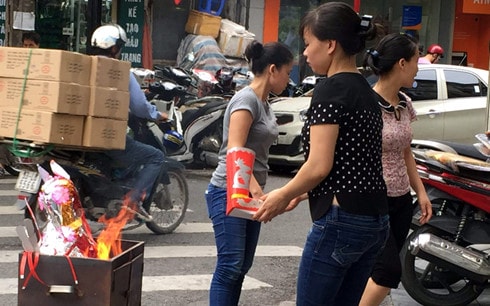 |
| Trillions of dong have been spent on buying and burning votive paper offerings. |
Ms. Dao Kim Dung, residing on Hang Bong Street, Hoan Kiem District, said that the 15th day of the 7th lunar month is an occasion to show filial piety to parents, grandparents, and ancestors. On this day, her family gathers children and grandchildren to prepare a feast. After the ceremony, they burn votive paper money, clothes, shoes, and other paper items for the deceased. This year, Ms. Dung bought more than a dozen sets of clothes along with a lot of paper money for about 500,000 dong.
“When grandparents pass away, we have to buy clothes for them; when uncles and aunts pass away, we have to buy clothes for them too; when our parents and in-laws pass away, we buy clothes for them as well. The Mid-Autumn Festival in the seventh lunar month is very solemn; every household has fruits, incense sticks, and remembers old memories, gathering children and grandchildren to release animals, burn paper money, and offer incense,” Ms. Dung said.
Ms. Pham Thu Nga, residing on Luong Van Can Street in Hoan Kiem District, believes that the custom of burning votive paper for the deceased has existed for generations. Although she doesn't fully understand the meaning of the "Day of Atonement for the Deceased," she follows the tradition by buying a large quantity of votive paper with the belief that the deceased will have everything they need throughout the year. Her sincere filial piety towards the deceased is expressed through the pile of votive paper offerings filling a corner of her house.
"I think that during these days, we should remember our parents and grandparents, light incense for them, and buy them clothes. Depending on how many deceased family members there are, we buy as many sets as we can to give to them, so they can go out and have fun. As long as we are sincere and remember our parents, we can do it," Ms. Nga said.
With the belief that "what happens in the earthly world is reflected in the afterlife," many families are "spending real money on fake money," readily spending millions of dong on various types of paper offerings. While previously these offerings only included clothes, hats, shoes, jewelry, and paper money, now they include household items, smartphones, cars, motorbikes, airplanes, and even paper maids. The prices of these offerings vary depending on the item, ranging from a few hundred thousand to several million dong. And during each Vu Lan festival, trillions of dong are spent nationwide on buying and burning these paper offerings.
According to Ms. Nguyen Thu Huong from Gia Lam, Hanoi, this amount of money could be used for many meaningful things such as helping children with serious illnesses, making charitable donations, and doing good deeds, which would certainly be much more practical.
"My view is that we should sincerely prepare vegetarian meals and fruits on ancestral worship days. We can go to the temple to offer prayers to the spirits, but we shouldn't have the idea of burning paper offerings. We should live well with our grandparents, parents, and siblings while they are alive. After they pass away, we should do charity work, release animals, and help the poor and suffering whenever we can. That is how we show filial piety to our grandparents and parents, and it's not necessary to burn paper offerings," Ms. Huong shared.
Due to a lack of understanding of the meaning of the Vu Lan festival and Buddhist teachings, many people still believe in and maintain the custom of burning votive paper on the 15th day of the seventh lunar month, considering it a way to show respect to their grandparents, parents, and ancestors.
Venerable Thich Duc Thien, Secretary General of the Executive Council of the Vietnam Buddhist Sangha, said that the Vu Lan Festival reminds everyone to remember the nurturing and upbringing of their parents, grandparents, and ancestors. In addition, the Vu Lan Festival helps us access the humane educational meaning of Buddhist philosophy, namely "compassion, loving-kindness, joy, and equanimity," and "remembering the source when drinking water"... To show filial piety to parents, grandparents, and ancestors, people must cultivate a charitable heart, be altruistic, and care for those around them. The custom of burning too much votive paper on the 15th day of the seventh lunar month also diminishes the beautiful meaning of the Vu Lan Festival.
“We must understand the true meaning of the Vu Lan Festival on the 15th day of the 7th lunar month and express it with our hearts and minds, through remembrance, not through thoughtless actions like buying excessive amounts of votive paper offerings and considering it an expression of affection for the deceased. We shouldn't waste money on burning too much votive paper; this custom is being misunderstood, transforming a beautiful cultural tradition into a form of superstition,” Venerable Thich Duc Thien expressed.
The Vu Lan Festival, a celebration of filial piety towards parents and ancestors, takes place on the 15th day of the 7th lunar month and is a beautiful and deeply humane traditional cultural practice. However, the increasing cost of burning votive paper offerings, driven by the belief that "wealth breeds extravagance," not only diminishes the meaning of the festival and causes environmental pollution but also poses a risk of fire and explosions, leading to unforeseen disasters.
According to VOV
| RELATED NEWS |
|---|


