
Hang Rú Ấm and the banyan tree in Làng Trù: Historical revolutionary relics.
Hang Rú Ấm (Nghĩa Đức commune) and Cây Đa làng Trù (Nghĩa Khánh commune) are two locations marking historical events of the Party Committee and people of Nghĩa Đàn district during the revolutionary period of 1930-1945. On August 20, 2012, the Provincial People's Committee issued a decision recognizing Cây Đa làng Trù and Hang Rú Ấm as revolutionary historical relics, fulfilling the long-held aspirations of the people of Nghĩa Đàn district in general, and the people of Nghĩa Khánh and Nghĩa Đức communes in particular. Hang Rú Ấm is the place where the first Party branch of Nghĩa Đàn district was established.
(Baonghean)Hang Rú Ấm (Nghĩa Đức commune) and Cây Đa Làng Trù (Nghĩa Khánh commune) are two sites that commemorate historical events of the Party Committee and people of Nghĩa Đàn district during the revolutionary period of 1930-1945. On August 20, 2012, the Provincial People's Committee issued a decision recognizing Cây Đa Làng Trù and Hang Rú Ấm as revolutionary historical relics, fulfilling the long-held aspirations of the people of Nghĩa Đàn district in general, and the people of Nghĩa Khánh and Nghĩa Đức communes in particular.
Hang Rú Ấm - the place where the first Party branch of Nghĩa Đàn district was established.
From late 1929 to early April 1930, fueled by the Nghệ Tĩnh Soviet movement in the lowland districts, the workers' and peasants' struggles in Nghĩa Đàn district intensified. In response, the Central Committee of the Party and the Central Vietnam Regional Committee directed the Nghệ An Provincial Party Committee to expand the Party's operational area to western Nghệ An. Implementing this policy, the Nghệ An Provincial Party Committee sent comrades Võ Nguyên Hiến and Võ Thược to Nghĩa Đàn district to establish a base. At that time, Nghĩa Khánh commune consisted of three villages: Vĩnh Lại village (Mét hamlet), Thọ Lộc village, and Cự Lâm village (Trù hamlet). These areas were home to numerous French colonial rubber and coffee plantations employing thousands of workers and laborers. Comrades Võ Nguyên Hiến and Võ Thược chose Nghĩa Khánh (now part of Nghĩa Đức commune, Nghĩa Đàn district) as the location for building and developing the Party organization. At that time, the Rú Ấm cave was a secluded location, surrounded by hills and dense forests. In particular, behind the cave was a large lake, which served as a water source for the local people, and in front of the cave was a temple dedicated to the local earth god, frequently visited by the locals for worship – all very favorable conditions for the organization's clandestine operations.
In mid-October 1930, a conference was held in the Rú Ấm cave to establish a combined Party branch comprising the two villages of Thọ Lộc and Cự Lâm. In addition to the above-mentioned agenda, the conference unanimously agreed to focus on propaganda and mass mobilization in all forms, thereby launching and leading the masses in the struggle against imperialism alongside the struggle against feudalism, implementing the land reform program, and emphasizing the recruitment of new Party members for the branch. From the Rú Ấm cave, several directives and resolutions of the Central Party Committee, the Central Vietnam Regional Party Committee, and the Nghệ An Provincial Party Committee were secretly disseminated by the Cự Lâm and Thọ Lộc Party branches to the communes throughout Nghĩa Đàn district.
To strengthen the Party's leadership role in the new era and implement directives from higher levels, in January 1931, comrades Phan Đình Lại and Võ Thược convened a secret meeting at Rú Ấm cave to split the Cự Lâm and Thọ Lộc Party branches into two separate branches, marking a new stage in the history of the district's struggle. This contributed to the formation of several other Party branches in the district, such as Yên Hòa, Tri Chỉ, Sen, Sẻ, etc., and the subsequent establishment of the Provisional District Party Committee of Nghĩa Đàn in February 1931.
On May 1st, 1939, International Labor Day, the Nghia Dan District Party Committee organized a rally at Ru Am Cave to demonstrate the revolutionary spirit of the peasants and working class in the Phu Quy region. This rally attracted a large number of people from neighboring areas such as Tho Loc, Cu Lam, Sen, Se, etc., who participated with banners and red flags bearing the hammer and sickle, demanding freedom, democracy, food, clothing, and peace.
The Banyan Tree in Tru Village - the place where the people of Nghia Dan rose up to seize power.
On May 19, 1945, the Viet Minh Inter-provincial Mobilization Committee of Nghe Tinh was established. Following its establishment, the inter-provincial Viet Minh Front called upon: “All citizens, regardless of class or religion, boldly join the ranks of the Viet Minh to eliminate the Japanese fascists, our country’s number one enemy at this time, and to thwart the French imperialists’ plot to restore their government…”. Responding to this call, under the direction of the Nghe An Provincial Party Committee, in mid-June 1945, in Bau hamlet, Nghia Khanh commune, the Nghia Dan District Viet Minh Front was established. It then issued a decision: To mobilize the masses to rise up against the Japanese and save the country, preparing to seize the opportunity for an uprising to take power.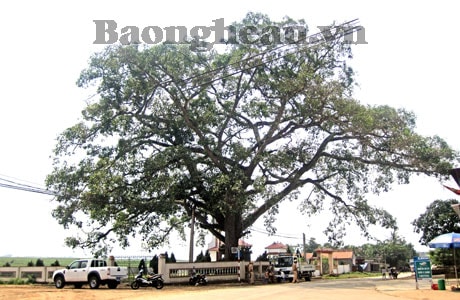
The banyan tree in Lang Tru village. Photo: Manh Ha
On August 15, 1945, the Viet Minh's inter-provincial insurrection order reached Nghia Dan district. The front immediately organized a conference to disseminate the insurrection order and establish the district insurrection committee. On the morning of August 22, 1945, under the leadership and organization of the Nghia Dan District Insurrection Committee, thousands of people from three ethnic groups—Kinh, Thai, and Tho—from the communes of Cu Lam, Ha Suu, Thach Khe, Nghia Hung, etc., and a large number of workers from rubber and coffee plantations in the Phu Quy area, carrying rudimentary weapons such as flintlock guns, sticks, hoes, shovels, spears, etc., gathered at the banyan tree in Lang Tru (Vinh Lai) to raise the red flag with a yellow star, shout revolutionary slogans, and vigorously organize a demonstration. They marched to the Nghia Dan district center to seize power for the people. Since then, August 22nd has become the traditional day of the Party Committee and people of Nghia Dan district, and the banyan tree in Tru village has become a typical historical relic of the Party Committee and people of Nghia Dan district.
To contribute to preserving revolutionary traditions, educating people about patriotism, and honoring those who have made contributions, since 2008, the Party Committee, government, and people of Nghia Khanh and Nghia Duc communes have designated August 22nd as their traditional day. The annual "Tru Village Banyan Tree and Ru Am Cave" festival attracts a large number of people from various ethnic groups in Nghia Khanh commune and surrounding areas, creating a vibrant and lively atmosphere. At this festival, with reverence, the Party Committee and people organize many meaningful and practical activities such as rallies, flower offerings, and incense offerings at the commune's martyrs' memorial, the Tru Village Banyan Tree, and Ru Am Cave. Besides cultural and spiritual activities, people also participate in recreational activities such as camping competitions, cultural performances, and sports.
Thanh Thuy


