
Boundless happiness
(Baonghean)Mr. Nguyen Xuan Dung (residing in Hamlet 6, Quynh Ngoc Commune, Quynh Luu District) has now reached the age of "seventy years old." Every time he remembers the events of the past, the blind man sheds tears of sorrow... But in return, his obedient and filial daughter, his priceless treasure, is the boundless happiness of this blind father...
Days of hardship
More than half a century has passed, yet Mr. Dung still cannot forget that dark day... In 1963, when he was a civil servant in the engineering design department of the State Farms under the Ministry of Agriculture, he and his colleagues were playing football when the ball hit him in the face, causing him to fall unconscious. He spent 5 months and 17 days at the Central Eye Hospital, experiencing both hope and disappointment, and was almost completely devastated when he learned he was permanently blind.
Then, as if by a twist of fate, during those miserable months in the hospital bed, the visually impaired young man coincidentally met a girl named Tran Thi Tuyen (from Trung Chau commune, Dan Phuong district, Hanoi), a relative of a patient in the same room. After visiting her relative and seeing the young man's early misfortune, Ms. Tuyen struck up a conversation. Gradually, their conversations became intimate, and their hearts began to flutter. That was also the moment when the young man from Nghe An and the girl from Hanoi began their journey of wandering!
After being discharged from the hospital, the blind young man was no longer able to return to his old job, so he had to go to Bac Giang to learn a trade for the visually impaired. But he soon realized that life there could only support himself, and who would his relatives back home rely on? Thinking this, he decided to pack his bags and return, starting to work to earn a living. "Those were the days of hardship for my whole family. My mother passed away when I was 23, my father was old and frail, and my three younger siblings were struggling, some with scabies, others with thrush," Mr. Dung recalled.
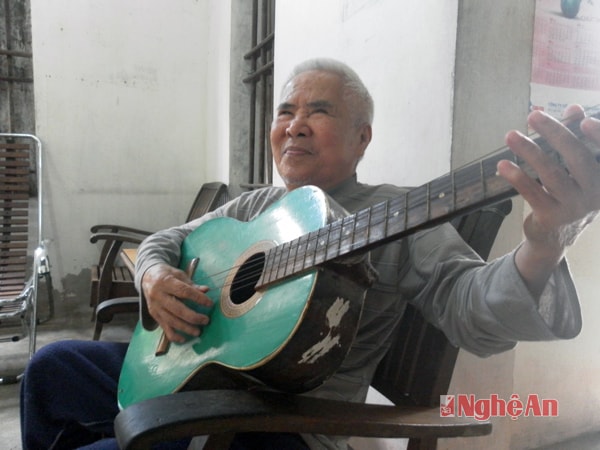 |
| Mr. Nguyen Xuan Dung's moment of relaxation. |
The blind man slowly recalled his old memories: “Back then, seeing people working on irrigation projects for the cooperative to earn work points, I followed along. They bailed water, I bailed water too. They had one end of the rope, I had the other, and we just dragged each other along. The hardest times were when we went to collect firewood in Nghia Dan, nearly sixty kilometers away, and all I could do was cling to the back of the Kien An truck and walk. People with sight could see and avoid the potholes, but I couldn't see anything, so I just kept plunging into the potholes, slipping and falling in the forest.” He didn't chop firewood but went along to guard the carts: "They brought a rope, tied all the carts together, and then tied it to my leg. If I encountered any thieves, and saw any movement, I could shout, and the people chopping firewood nearby would hear and come to my rescue. Luckily, that day I didn't encounter any thieves while guarding the carts for the firewood collectors. But sometimes, sitting there being tied up in the middle of the forest, if it suddenly started raining, I would get completely soaked. On the bright side, when I returned, not only did they pay me, but each person also gave me a few bundles of firewood."
Back then, he used to follow others, carrying firewood and oil to sell throughout the communes of Quỳnh Thọ, Quỳnh Thuận, Quỳnh Hải, and Quỳnh Long (Quỳnh Lưu)... During the off-season, he would collect toothpicks and incense sticks, groping his way through the village roads and alleys to sell them and earn money to buy rice. He said, "At that time, I was determined to support my younger siblings' education, so I didn't mind any kind of work."
In the 1970s, in Quynh Ngoc (Quynh Luu district), people could hardly forget the image of a blind man who, every morning and evening, carried a Chinese-made loudspeaker and went throughout the commune to spread propaganda. Whenever the commune had a policy or initiative that needed to be publicized, people would seek him out. After understanding the message, he would simply focus on the topic and speak. Without needing any written documents, he and the commune officials went to every village and alleyway to disseminate the Party and State's policies and guidelines.
The hardships of his family's life made the disabled young man indifferent to personal matters. Even in his 40s, Mr. Dung remained single until one day... In late 1979, following the call of love, Ms. Tuyen packed her bags and traveled from Hanoi to Nghe An. They rekindled their old romance and became husband and wife. Mr. Dung confided: “Actually, in 1965, I and a friend went to Hanoi to visit her. But I thought, perhaps she wouldn't have the courage to return to Nghe An with me. So I followed my friend to Hai Phong, then boarded a ship belonging to a fellow countryman to return to Quynh Luu. The war was fierce back then, so the ship had to stop frequently to avoid bombs. Fourteen years after we were separated, it was through letters that we were reunited.”
It seemed as though happiness had finally smiled upon the visually impaired young man, but alas... Just four days after their first daughter was born, Mrs. Tuyen was struck down by liver cancer. The unfortunate mother passed away in agony when her daughter was only one month and ten days old...
A rooster raising chicks
The blind father's greatest asset was his daughter, Nguyen Thi Gai. In his recollections, Mr. Dung clearly remembers: “On the fifth day of my illness, my wife still had milk for our child. But I heard my relatives discussing separating mother and child because she was very weak. I didn't know what to do, but luckily, my aunt had just given birth. So I took my child to leave her with them. After a few days, my aunt no longer had enough milk for both of them, and she had to go to work. I had to bring my child home and mix rice water instead of milk.”
Out of sympathy for the "single father raising his children," many mothers in the neighborhood with young children often visited, offering to breastfeed his baby. Mr. Dung's siblings, now grown up, were able to help him out to some extent. During the day, he would leave his children with others and go to work. After selling toothpicks and incense, he would collect firewood; transporting firewood and oil throughout the region to sell, earning a meager living and providing for his family. When night fell, he would return to his small house to care for his young child.
Back then, he suffered from nerve pain in his right leg, rheumatism in his left leg, and high blood pressure. But rain or shine, the blind father still toiled tirelessly to support his children. With love and the help of his two sisters, he fulfilled his responsibilities as both father and mother.
When his daughter was accepted into the Japanese language department at the University of Foreign Languages, Vietnam National University, Hanoi, he was so moved that he was speechless. The blind father's heart was filled with conflicting emotions. He had hoped his daughter would become a village school teacher so he could rely on her in his old age, but now her aspirations had taken a different path. And more importantly, where would the money come from to support her education? This kept him awake many nights. Once again, the blind father had to shoulder the burden of supporting his daughter's university education.
On that arduous journey, Mr. Dung never felt alone, because he was surrounded by family, friends, neighbors, and above all, the determination of his filial daughter. She had just started university and immediately began working part-time to help her father cover her tuition fees. Mr. Dung confided: "Many times, seeing my daughter rushing home from Hanoi after finishing her shift, exhausted and hungry, but with her bag still full of medicine and gifts for me, I felt sorry for her but also angry at her!"
Ms. Nguyen Thi Gai is now an employee of a company that exports labor to Japan, with a stable job and a decent income. Mr. Dung has also long since stopped selling toothpicks. The days of hardship are long gone…
Nguyen Thi Hoe
Quynh Luu


