
A 60-year journey to find the graves of fallen soldiers.
(Baonghean) - Even now, Mr. Nguyen Cong Kinh (born in 1948, Ben Thuy Ward, Vinh City, Nghe An Province) cannot forget the day more than 60 years ago when a soldier knocked on his door, bringing with him the last remaining belongings of his father, along with a death notice: "That afternoon, everyone was gathered preparing for dinner when the enemy ambushed and bombed unexpectedly. Everyone rushed to their positions, and Anh Con was hit by a bullet and died..."
Those words were etched into the memory of young Kình, who was only 5 years old at the time. From then on, his lifelong dream was to find his father, who was buried somewhere in Laos, and bring him back to his homeland.
The pain of war
In 1949, Mr. Nguyen Cong Con (born in 1926) - the father of Mr. Nguyen Cong Kinh, from Thanh Khai commune, Thanh Chuong district, Nghe An province - enlisted in the army. He was later assigned to the volunteer army, assisting Laos in its resistance against French colonialism, serving in Company 21, Regiment 81, Upper Laos.
“I was too young to understand everything then, but later my father’s former comrades recounted that in September 1953, the fighting was very intense and fierce. The Noọng Hét area in Xieng Khouang province, Upper Laos, saw many battles; the enemy continuously launched sweeps, while our troops focused on repelling them. On September 5, 1953, my father’s unit was assembled at Keo Ba Tu, Noọng Hét, preparing dinner when the enemy opened fire. My father, who was then a platoon leader commanding an attacking group, was hit by a bullet and died…”
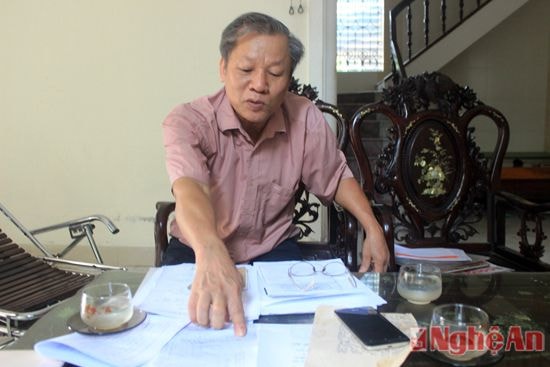 |
| Mr. Nguyen Cong Kinh recounts his search for his father's grave using a hand-drawn map. |
That year, Mr. Kinh's family received a death notice, along with a rough, hand-drawn map showing where his comrades had buried the soldier Nguyen Cong Con, who had died heroically. The fighting mission had to continue; the fallen soldier lay buried in foreign soil, marked by a large stone nearby, and then the unit marched on.
Little Kình stood behind the door, listening as the soldier arrived to deliver news of his father's death, and saw his mother silently weeping while holding his one-year-old sister. The war was far away, yet the pain was agonizing back home.
Two years later, on the 29th day of the 12th lunar month, Kình's mother went to cut the last bundle of grass for the buffaloes so she could rest peacefully during the three days of Tet (Lunar New Year), but her raft capsized and she drowned in the Lam River. That Tet was bitterly cold!
Having lost their father, and then suddenly their mother, Kình and his younger sister, then only 3 years old, lived relying on the love, care, and support of their grandparents and aunts and uncles. It was precisely this difficult childhood, devoid of parental presence, that motivated the two siblings to study hard, so they could become independent and stand on their own two feet amidst life's storms. Nguyễn Văn Kình's most heartfelt and greatest wish in life is to find his father's grave and bring him back to his ancestral homeland.
The journey to find my father.
He went searching for his father's former volunteer soldiers in Nong Het, Laos, to inquire about the place where his father had fought. He learned that in the battle on the afternoon of September 5, 1953, Nguyen Cong Con had died along with another comrade from Thanh Chuong, Nghe An province. “A comrade of my father's from Hung Tay commune, Hung Nguyen district, still remembers very clearly and recounted the battle of September 5th. Only my father and Mr. Mai Van Cuong died, and both were buried next to each other. He even said that when they went to exhume the remains, he would go along, and if needed, he would show them where to go.”
So Nguyen Cong Kinh returned to his hometown, went to Phong Thinh commune, Thanh Chuong district, and met the family of martyr Mai Van Cuong. However, the martyr's circumstances were quite special. As the eldest son, he went to fight shortly after getting married and died before having children. At home, his family insisted that his young wife find happiness elsewhere, lest she miss out on a fulfilling life. Years passed, his elderly parents passed away, and his siblings scattered, struggling to make ends meet. None of them had the opportunity to search for the grave of the young martyr who died so young.
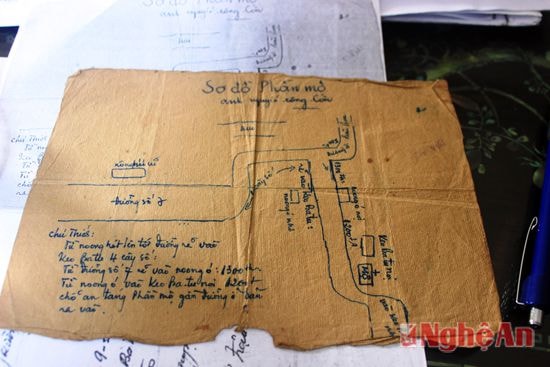 |
| Two burial site maps were sent to the families of the two fallen soldiers. |
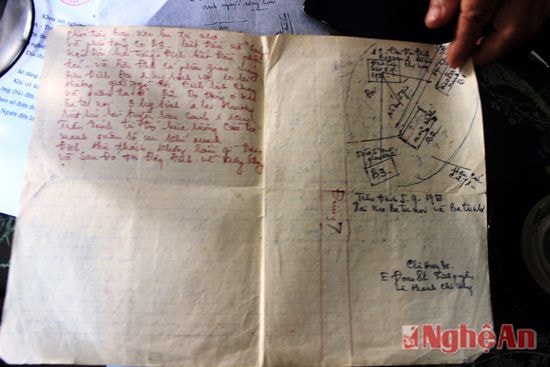 |
| Two burial site maps were sent to the families of the two fallen soldiers. |
The only thing is, the death certificate and the faded, hand-drawn map are still being carefully preserved. That map, showing the route, location, and landmarks, is exactly the same as the map of his father's grave that Mr. Kình keeps. The handwriting on it is also by the same person. So, the two soldiers are buried together, somewhere in neighboring Laos.
Mr. Kình took on the task of finding the graves of his father's comrades. He submitted the relevant documents to the Nghệ An Provincial Remains Collection Team and waited. In 1994, he learned that three remains of fallen soldiers had recently been collected and brought to the Anh Sơn Martyrs' Cemetery in Nghệ An, found in Keo Ba Tu Nhỡ village, Noọng Hét commune, Xiêng Khoảng province. The location matched, and he was secretly overjoyed. He asked permission from the Anh Sơn Cemetery Management Board to take three handfuls of soil home for worship. "I set up three incense burners and thought that even if there was a mistake, at least I was offering incense and remembering the heroic martyrs, my father's comrades," Mr. Kình confided.
He was convinced that one of the three graves belonged to his father, the martyr Nguyen Cong Con. “But recently, when the government allowed us to have a DNA test done, the results didn’t match.” This information devastated Mr. Kinh and his family. “Many times I felt hopeless and helpless, like I had been unfilial to my father. But when I looked through the documents, I discovered that in Noong Het there are two villages, Ba Keo Tu Noi and Ba Keo Tu Nho, and the three graves that were gathered there belong to Ba Keo Tu Nho. This time, I decided to go to the Nghe An Provincial Remains Collection Committee and ask to go with them to Xieng Khouang, Laos, to find my father’s grave,” Mr. Kinh recounted.
On Lao soil
So, the gray-haired son, nearly 70 years old, packed his bags and joined the soldiers of the team collecting the remains of fallen soldiers. It's true that there used to be a village called Keo Ba Tu Noi, but only about 20 families lived there; after the war, they all moved to Keo Ba Tu Nho.
Locals also said that about two decades ago, they unearthed the remains of three fallen soldiers, but there are still two more graves of soldiers who fought against the French. Vietnamese soldiers have come here many times to collect the remains of fallen soldiers, but have not yet found them.
“The Lao people there are so kind. The day we arrived coincided with the Lao New Year, and the village chief called all the villagers out to welcome us, which moved me beyond words. Even though it was a holiday, the chief said that if we needed anything, we should just say so, and the villagers would do their best to help.”
Mr. Kình then went to the oldest person in the village to inquire. The old man was 85 years old, frail, but still very sharp-minded. He affirmed, "I remember that battle very clearly. I was 14 or 15 years old then. Two Vietnamese soldiers were killed." According to the old man's account, the location where Mr. Kình's father and his friend were buried by their comrades matched what was drawn on the map.
The old man also wanted to join the search. People helped him onto the motorbike, some driving, others holding on behind. He reminisced, pointing out where the old road was, describing the battle, how the soldiers fought, and pointing to the area around the large rock that has now become a three-way intersection, saying, "There, there, those two Vietnamese soldiers are buried!"
Everyone started digging, carefully, step by step. “I went with four soldiers who were collecting the remains of fallen soldiers. They were truly experienced; if the families had to search on their own, they wouldn't have been able to find the remains of their fathers and brothers. Especially for soldiers who died during the resistance against the French. More than 60 years have passed, their blood and bones have dissolved into the earth; without experience and carefulness, it would be impossible to find the remains of fallen soldiers,” Mr. Kình recounted.
The soldiers dug while simultaneously contacting and inquiring with the remains recovery team that had previously searched the area. The soil was as hard as rock. In the old days, without the tools available today, the fallen soldiers could only have been buried in trenches. They continued digging and shoveling along the soft soil, expanding the trenches in a herringbone pattern… it took them half a day to dig down just one meter of soil, one trench after another.
Day after day, the soldiers ate instant noodles and drank stream water, yet patiently and cautiously continued digging, never giving up. In the case of Mr. Kinh's family, with a clear map and witness accounts, the search may be prolonged, but there is certainly hope.
On the fourth day, they dug a small hole, and everyone stopped, falling silent. Then, carefully, they cleared away the earth and rocks… They found it! “I can’t describe my feelings at that moment, my heart was pounding and my legs were unsteady. Tears just streamed down my face…”
Meanwhile, the men continued digging, thinking, "There's another grave, surely it's either on the left or the right." Beneath the hard, stony soil, they could still discern the positions of two people lying side by side, their heads facing east, as is customary in Vietnam when burying people...
The soldiers carefully carried out their duties, not forgetting to pick up handfuls of soil from the graves and wrap them together with the remains of the soldiers. These handfuls of soil, containing a part of their flesh and blood, had embraced, sheltered, and protected the fallen soldiers for over 60 years…
On May 9, 2015, the Do Luong Martyrs' Cemetery welcomed 29 martyrs returning from Laos in the second repatriation effort of the 2014-2015 dry season. The atmosphere was solemn and respectful. The remains of Mr. Kinh and the search and recovery team were also successfully returned on this day of reunion…
Mr. Nguyen Cong Kinh managed to inform the family of his father's comrade, Mai Van Cuong. Both families requested DNA testing, and the results confirmed the remains of fallen soldier Mai Van Cuong (born in 1933, Phong Thinh, Thanh Chuong, Nghe An). "My family is still waiting for the results, but I believe it will be my father. The most important thing is that my family can rest easy, because we did everything we could to find my father and bring his comrade home," Mr. Kinh said emotionally.
Ho Lai


