
The intriguing dish 'tó tàu' made from ground bee larvae by the Thai people of Nghe An.
(Baonghean.vn) - 'Tó tàu' is a dish made from ground bee larvae by the Thai ethnic group. In Con Cuong district, Nghe An province, this dish is popular among the locals, and this area has a large number of ground bees nesting there.
There are three types of bee larvae commonly used in the dish called "tó tàu": wasps, ground bees, and honey bees. However, the Thai people of Con Cuong still choose ground bees to prepare this dish.
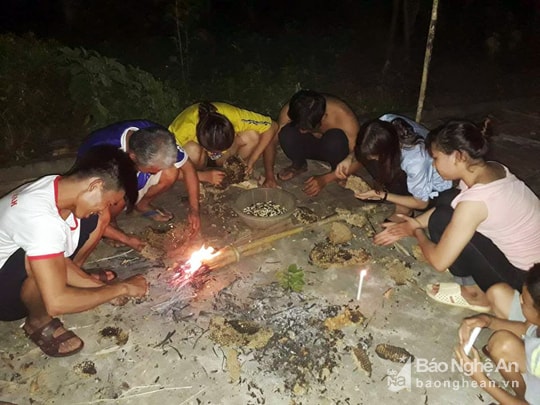 |
| During the nesting season of ground bees, from mid-August to September, the Thai ethnic people in Con Cuong gather in the forest to search for ground bee larvae. Photo: Tuong Vi |
Ground bees typically nest most frequently from June to September, building their nests in two locations: digging burrows in the ground and constructing nests in trees in areas with a high concentration of acacia trees. In Con Cuong district, communes such as Binh Chuan, Don Phuc, Cam Lam, Mau Duc, Thach Ngan, Bong Khe, and Chau Khe have a large population of ground bees.
Vi Van Quang, from Thanh Binh village, Thach Ngan commune, said: "I often go with the young people in the village to collect bee larvae. If we find a ground bee nest during the day, we can't take it right away, so we wait until night to avoid being stung."
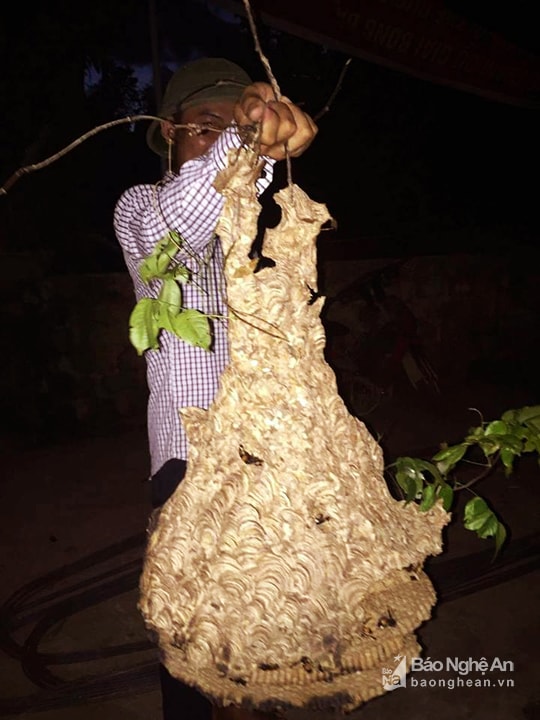 |
| A beehive was taken away by local people. Photo: Tuong Vi. |
A beehive usually has two entrances (a main entrance and a side entrance). When harvesting, you must identify these two entrances, then light a large fire and smoke the hive to drive the bees away. Some large beehives have five layers, equivalent to 3 kg of bee larvae. Bee larvae are also sold at the markets of some villages for 60,000-100,000 VND/kg."
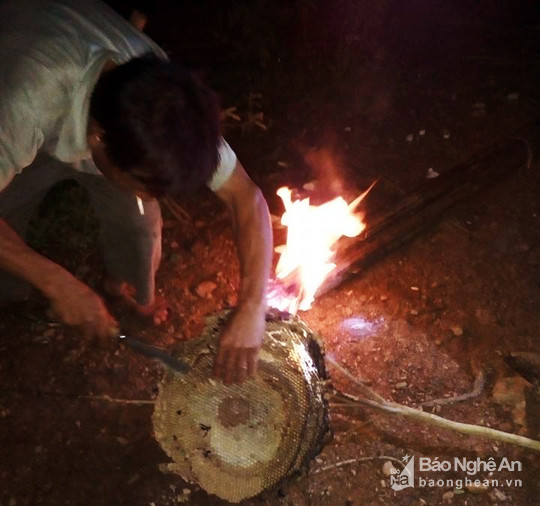 |
| The beehive is heated over a fire before the larvae are harvested. Photo: Tuong Vi |
The preparation of 'tó tàu' (a type of bee larvae) is also very elaborate: After bringing the hive back, the larvae must be roasted over a fire to make them firm and easier to remove. The larvae are then dipped in boiling water to make them chewy; washing them with cold water will make them mushy.
The bee pupae are soft and dissolve easily, so stir gently with chopsticks and adjust the heat to medium. After about ten minutes, the pan of bee pupae will be steaming and fragrant, then quickly stir well.
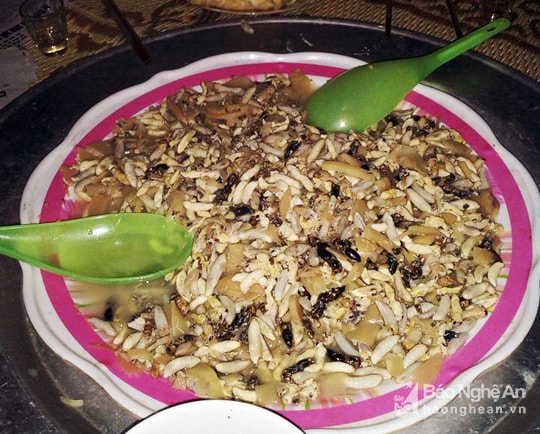 |
| The finished "tó tàu" dish. Photo: Tuong Vi |
To make a delicious stir-fried silkworm pupa dish, finely chopped lime leaves, some herbs, a few slices of wild chili peppers are essential, or it can be stir-fried with sour bamboo shoots or made into a salad. A truly delicious dish should not be mushy, the pupae should retain their original shape, and the aroma and rich, fatty flavor should be preserved. This dish can be eaten with rice or with grilled rice crackers.
Rose
| RELATED NEWS |
|---|


