
Post-Iran nuclear deal: "Builders and destroyers"?
(Baonghean) - The framework agreement reached between Iran and the P5+1 group in Lausanne (Switzerland) is considered a major turning point in the 12-year negotiations on Iran's nuclear program. However, world opinion remains concerned about the possibility of the parties reaching a final agreement by the end of June, especially as the agreement is facing strong attacks from within the US and Iran, as well as from Israel – a country that has always sought to disrupt any agreement on its neighbor's nuclear program.
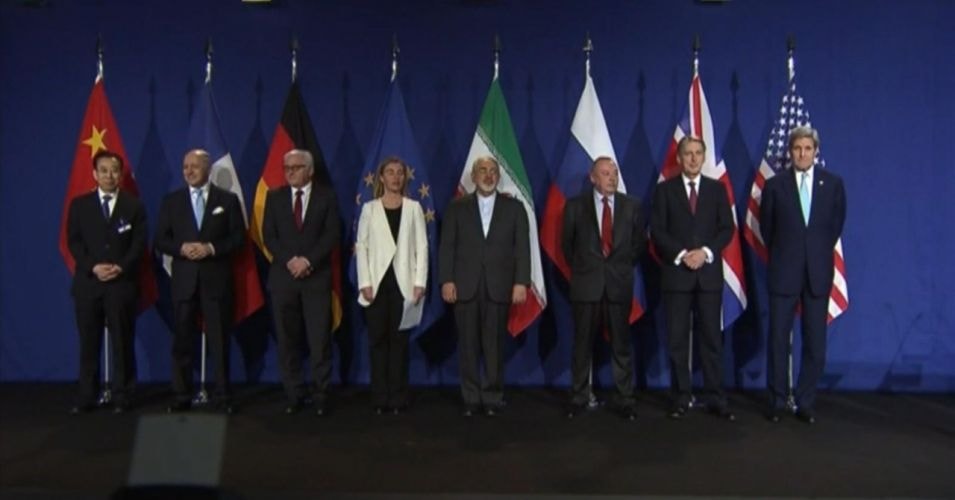 |
| Representatives from both sides negotiated after reaching an agreement in Lausanne, Switzerland. |
Internal power, external attack
According to the framework agreement reached in Lausanne, in addition to halting uranium enrichment activities at Fordo, Iran will reduce its operating uranium enrichment centrifuges by more than two-thirds to 5,060. Iran will also reduce its low-enriched uranium production from approximately 10 tons to 300 kg over 15 years, and during this time will not enrich uranium beyond 3.67%. The surplus uranium will be stored under the supervision of the International Atomic Energy Agency (IAEA). Furthermore, Iran will modify the design of the heavy water reactor under construction at the Arak nuclear facility to prevent the production of weapons-grade plutonium. In return, UN sanctions and individual sanctions unilaterally imposed by the United States and the European Union will be eased and gradually removed once the IAEA confirms Iran's compliance with the agreement. Immediately after leaving the negotiating table, those directly involved praised the agreement. US President Barack Obama enthusiastically called it a "historic deal," echoed by Secretary of State John Kerry, who declared April 2nd a "great day." German Chancellor Angela Merkel stated that the international community "has never been closer to an agreement to prevent Iran from producing nuclear weapons than now." Russia, looking further ahead, assessed that the agreement would have a positive impact on the tense political situation in the Middle East. Meanwhile, in Iran, a crowd of supporters of the country's nuclear program cheered and welcomed Foreign Minister Mohammad Javad Zarif and his team as they returned from Lausanne.
However, the good news from Lausanne (Switzerland) was not entirely welcomed in the United States, where many hardline Republican lawmakers have consistently sought to obstruct a nuclear deal with Iran. Lawmakers have expressed skepticism about the agreement and threatened to reverse it or impose further sanctions. In the latest development on April 5th, Republican senators continued to push the White House to allow Congress to have jurisdiction over a nuclear deal with Iran. Senator Bob Corker, Chairman of the Senate Foreign Relations Committee, stated that the Senate will bring the Iran-related bill to a vote on April 14th, arguing that the public and the legislature need the right to intervene in this crucial issue.
Given the clearly stated position of Republican lawmakers, it's easy to predict that if a mechanism requiring congressional approval is in place, the final agreement on Iran's nuclear program will either be ratified or rejected. Not only in the US, but also in Iran, there are many policy-makers expressing disappointment with the framework agreement. Hossein Shariatmadari, advisor to Iran's Supreme Leader Ayatollah Ali Khamenei, likened it to "handing over a saddled horse and receiving a horse with broken reins." Meanwhile, others expressed regret that Iran's underground nuclear facility, Fordo, will no longer be used for uranium enrichment, calling the framework agreement a "disaster for Fordo."
Opposition from within the US and Iran was further amplified by a very positive factor in all negotiations regarding Iran's nuclear program: Israel. Immediately after news broke of the P5+1 and Iran reaching an agreement, Israeli Prime Minister Benjamin Netanyahu used every channel to express his dissatisfaction. The Israeli leader argued that the framework agreement "threatens Israel's national security and very existence" and makes it easier for Iran to acquire nuclear weapons. Netanyahu's opposition was based on the argument that imposing restrictions on Iran's nuclear enrichment program was only temporary. But after a few years, Iran would have unlimited access, and that would truly be a "nightmare" for the entire region. Therefore, Netanyahu made no secret of his intention to continue his efforts to hinder the P5+1 and Iran from reaching a final agreement by June by urging US lawmakers "not to give Iran a smooth path to acquiring nuclear bombs," and that "there is still enough time to find a better deal and put pressure on Iran."
The arduous journey to the finish line.
Analysts unanimously agree that the framework agreement reached in Lausanne, Switzerland, is a historic milestone in the 12-year negotiations on the Iranian nuclear issue. However, the next steps in the negotiations to reach a final agreement in June remain highly unpredictable. The biggest obstacle is the coordinated effort between Israel and Republican lawmakers. After reaching the framework agreement, US President Barack Obama had to simultaneously pursue a two-pronged approach to overcome this hurdle. First, there were phone calls with four leaders in the US Congress, including House Speaker John Boehner, House Minority Leader Nancy Pelosi, Senate Majority Leader Mitch McConnell, and Senate President Harry Reid; and second, a phone call with Israeli Prime Minister Benjamin Netanyahu to reassure him that “there is no formula or option that can prevent Iran from acquiring nuclear weapons more effectively than the diplomatic initiatives and frameworks reached in Lausanne,” while also promising to stand with Israel if Israel were attacked by any country.
However, according to analysts, Republican lawmakers will certainly not relinquish their right to make decisions regarding the final agreement being negotiated, and no less certainty will be placed on Netanyahu's efforts – despite commitments from his US ally. And what will happen if all P5+1 countries agree on a range of issues, while the US Congress does not? Which side will US allies lean towards, the P5+1 or the US Congress? That is one of the reasons why public opinion remains uncertain about what the parties have achieved in Switzerland.
The uncertainty surrounding the framework agreement is not only evident in the terms reached by the opposing forces, but also in the content itself. Currently, the agreement remains precarious, lacking a specific timetable for Iran to comply with IAEA investigations, and failing to mention the easing of sanctions in response to Iran's compliance with its commitments. Furthermore, the cautious approach to announcing the results—a "wait-and-see" approach, along with adjustments—reveals significant unresolved issues among the negotiating parties. Therefore, it's understandable that the international community remains highly cautious about the prospects of reaching a final agreement on Iran's nuclear program.
Thuy Ngoc


