
Consequences of alluvial gold mining in Tuong Duong
Why is the Lam River murky all year round?
Why is the Lam River murky all year round?
During a recent work trip to Binh Chuan commune (Con Cuong district), because the road from the district center to Binh Chuan was under construction due to a lack of funds, we had to detour via Khe Bo to Nga My commune and then to Binh Chuan, passing through Yen Na and Yen Hoa communes, along the streams of Ngan (Yen Hoa commune), Puong (Yen Na commune), and Hoi Nguyen... and encountered numerous groups and individuals using Dong Phong (Chinese) suction pumps to illegally mine alluvial gold. Seeing the streams dug down to the bottom, leaving behind a jumble of pebbles, and watching the muddy, murky water slowly flowing into the Lam River, we finally understood why the Lam River, once clear and peaceful for thousands of years, providing drinking water for millions of people in Nghe An province, is now polluted year-round.
Although the Tuong Duong district authorities regularly organize task forces to crack down on and expel those illegally mining alluvial gold, the illegal mining has not decreased; on the contrary, the more they chase them away, the more they increase. When they are driven out of one place, they simply move to another to continue mining. A friend working in Tuong Duong said: Following the policy of maximizing alluvial gold extraction from the Ban Ve and Khe Bo hydroelectric power plants, there are more than 600 gold mining boats operating year-round in the communes, most notably in the Huoi Nguyen stream – a main branch flowing into the Lam River. The continuous digging and processing of tens of thousands of tons of mud and soil by hundreds of gold mining boats day and night keeps the Lam River perpetually murky.
Consequences of gold mining
Gold mining upstream of the Lam River in Tuong Duong not only makes the river water perpetually red but also adds mercury-based chemicals used in gold refining, causing severe water pollution that renders it unusable for daily life. While thousands of fish cages were found along the Lam River a few years ago, they have almost disappeared. Even in Con Cuong district, in Tan Hoa village, Bong Khe commune, hundreds of households used to raise fish in cages a few years ago, but now the cages are abandoned because the fish are not thriving. Many people have had to abandon their boats and nets to work as laborers to make a living.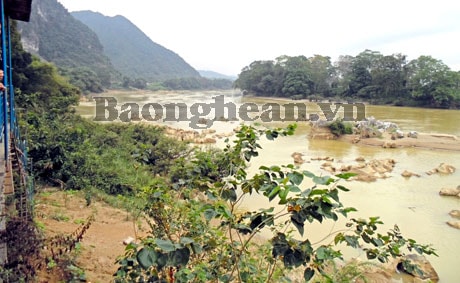
Due to the impact of gold mining upstream, the Lam River section flowing through Con Cuong town is murky all year round.
Previously, the Lam River was a refreshing place to swim in the summer, but for the past few years, no one has dared to swim there because the water is bitter and stinging. Even buffaloes and cows don't dare drink the river water anymore. The algae on the river, a valuable food source and specialty of the Thai ethnic people, have also died off due to water pollution. The fish population in the river has also lost its food source and is at risk of extinction. An old fisherman in Tan Hoa village (Bong Khe, Con Cuong) said: "In the past, the fishermen here used to catch a lot of fish. The saying goes, 'The sea is calm and cool, the waves are strong,' but now fish like carp, catfish, and other species are gone. I don't know if the income from gold will help the economy much, but the destruction of the river, the pollution and destruction of fish stocks and water sources is an irreparable loss."
Another negative consequence of alluvial gold mining is the moral decay of many young people. Drug abuse, alcoholism, and gambling are also increasing. In the border area between Tuong Duong and Con Cuong districts, the use, trafficking, and transportation of drugs by young people have been rampant in recent years. When we met with constituents in Binh Chuan, they presented a figure that surprised us: many young people in Nga My and Xieng My (Tuong Duong) and Binh Chuan (Con Cuong) have become addicted to drugs, the cause being their involvement in gold mining, which they used to fund their drug use and partying. Furthermore, theft, fighting, alcoholism, and gambling are also causing the younger generation here to suffer from moral decay, violate ethics, and, more dangerously, develop a mindset of living life in the fast lane, without dreams or ambitions. Their participation in youth organizations and associations is also neglected, or even lost completely.
If anyone has the opportunity to work in Tuong Duong, traveling along the communes of Yen Na, Yen Hoa, Yen Thang, and along the streams of Huoi Nguyen, Ngan, and Puong... where the State previously invested thousands of billions of dong to reclaim and restore land, creating many rice paddies that produced hundreds of tons of food, providing sustenance for the people and protecting the forests, now, due to gold mining, the rice paddies along the streams are gone, replaced by scattered rocks. Looking at the muddy, swirling stream, many people feel heartbroken.
While exploiting resources to increase budget revenue is necessary, exploitation must be linked to environmental protection and ensure the livelihoods of the community. Destructive exploitation like the one described above, which severely impacts lives and livelihoods and destroys the environment, is unacceptable. We earnestly hope that managers, policymakers, and relevant authorities will intervene and immediately stop this gold mining, restoring the river and its water supply to the people.
Integrity


