
Unveiling the mystery of an ancient tomb in Thanh Chuong that still contains a complete corpse.
(Baonghean.vn) -In recent days, the people of Thanh Chuong have been buzzing with discussions about the ancient tomb of the ancestor of the Tran Van family in Hamlet 10, Thanh Dong Commune – an ancient tomb with many special features.
Previously, on January 8th, the descendants of the Tran Van family, whose ancestral temple is located in the Ru Cuu area of Thanh Dong commune, along with a large number of local people, solemnly held a burial ceremony for their founding ancestor at Doi Mountain. To date, this ancestor has been buried at least three times.
According to the Tran Van clan council, the founding ancestor, Tran Khac Tuan, was originally from Trang village in Ha Tinh province. During the turbulent years of the mid-17th century, he settled in Thanh Dong commune and practiced traditional medicine. For hundreds of years, the descendants of the Tran Van clan – Ha village (11 generations) – have passed down the story of their ancestor's tomb on Mua Mon mountain (now part of Block 1, Dung town) being constructed with an "inner coffin and outer sarcophagus".
In 1982, the Tran family organized the reburial of their ancestral tomb to relocate the remains to the cemetery, but they could not find the tomb they were looking for.
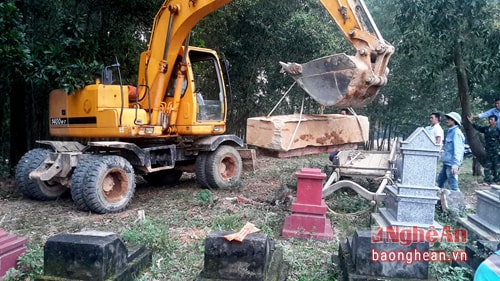 |
| When the grave was first discovered, since no one had claimed it yet, Mr. Toan had it hoisted onto an ox cart and transported to Con Trop cemetery. |
Unexpectedly, at 8:00 AM on December 7, 2016, while excavating soil in the Mửa mountain area for the construction of a project for Đại Yên parish, Mr. Nguyễn Đức Toàn from Hamlet 10 and his workers unexpectedly discovered this tomb with a coffin inside a sarcophagus.
Mr. Toan said that at first, he thought it was just a rock, but later learned it was a tomb. He contacted the Tran family about the discovery of the tomb. Before the descendants of the Tran family claimed the body, he and others took it to be buried in the parish cemetery in Con Trop area, Hamlet 9.
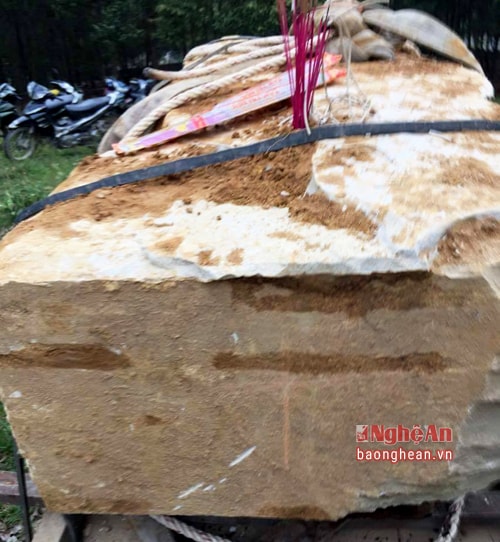 |
| The coffin in the ancient tomb resembled a solid block of stone. |
After confirming that it was indeed the ancestral tomb of their family, on January 8, 2017, the Tran Van family members held another burial ceremony for their ancestor, relocating the tomb from the Dai Yen parish cemetery in Con Trop to the Tran family cemetery at Doi Mountain, Hamlet 9.
Around 5:00 AM on January 8th, when the descendants of the Tran family gathered at Con Trop cemetery, they discovered that the tomb of their ancestor had been dug up by thieves during the night of January 7th. The tomb had been dug up, the earthen mound overturned, revealing the remains of their founding ancestor. The Tran family descendants and those present were extremely surprised to find that the remains, after nearly 350 years, were still intact.
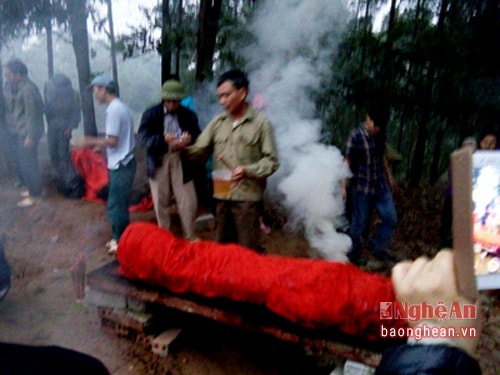 |
| The remains in the ancient tomb remain perfectly preserved after nearly 350 years. |
This tomb has a "coffin inside a sarcophagus" structure. The sarcophagus is a concrete-like compound encasing the coffin, approximately 2.2 meters long, 0.75 meters wide, and 0.8 meters high. According to knowledgeable family members, this compound is whitish-brown, quite smooth, and may be made from molasses, ground seashells, etc.
The coffin was likely made of mulberry wood, painted red inside, and the color was still bright. The sarcophagus and coffin were tightly joined together, but because the bottom of the sarcophagus was broken, the thieves tilted it and pried open the coffin's bottom panel.
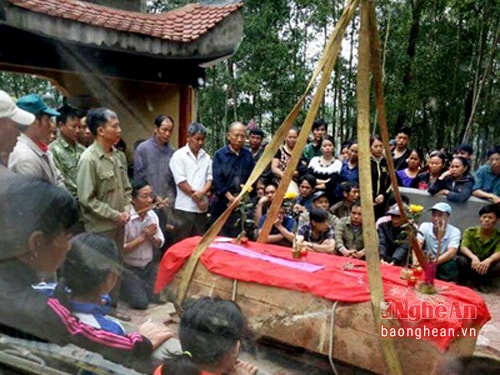 |
| The descendants of the Tran family buried their ancestor at Doi Mountain Cemetery. |
Mr. Tran Van Hung (34 years old), the town's militia leader and the 10th-generation descendant of the founding ancestor, said that the body was wrapped in a thick layer of cloth from head to toe. In the middle of this cloth, from the neck to the waist, many strings were tied together to form a diamond-shaped band resembling a row of buttons. Remarkably, despite being buried for over 350 years, the body remains perfectly preserved.
Inside the coffin were various black, crumbly materials, cotton wool, a brown cloth bag about 25 cm long and over 10 cm wide that had been cut open and was empty (suspected to have been cut open and its contents removed), and a wooden plank about 1 cm thick, broken in half, with seven evenly spaced circular holes about 2 cm in diameter. The contents of the coffin emitted a fragrant smell, like that of traditional Chinese medicine.
The discovery of an ancient tomb dating back several hundred years, with a coffin inside and a sarcophagus intact, is rare and unusual. Unfortunately, no specialized agency has yet had the opportunity to study and research this unique tomb. Therefore, discussions and questions about the tomb, such as its exact age, burial techniques, embalming methods, the "concrete" composition, and the scent, remain temporarily unanswered.
Huy Thu


