
The effectiveness of land consolidation and exchange.
(Baonghean) - Land consolidation has created larger and more rectangular plots of land in each field; the irrigation system and internal field transportation have been planned, upgraded, and improved. As a result, Nghe An has been able to introduce mechanization into the fields, reduce labor burden, and develop concentrated commodity production areas, leading to higher economic efficiency per unit area.
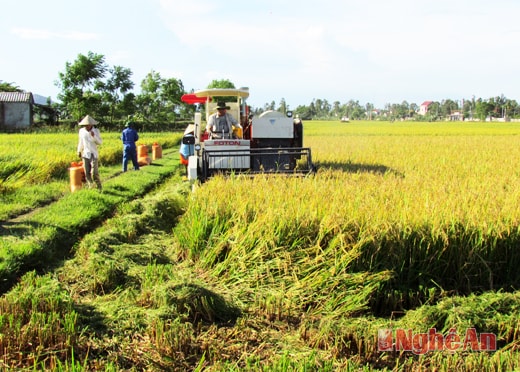 |
| Introducing mechanization into agricultural production in Hung Nguyen. |
| RELATED NEWS |
|---|
As the first locality in the province to complete land consolidation, all 38 communes and towns in Yen Thanh district have now finished the process. Mr. Nguyen Van Duong (Head of the District Agriculture Department) stated: After land consolidation, Yen Thanh now has nearly 20 combine harvesters, sufficient to serve nearly 70% of the district's rice cultivation area. Harvesting time has been reduced from 7-10 days to 2-3 days. Furthermore, most land preparation is done by machine, saving time and, more importantly, helping farmers to produce on time, especially during the summer-autumn season. From this, Yen Thanh has also collaborated with businesses to develop large-scale model fields, leading to higher economic efficiency.
Nghi Loc District has over 11,000 hectares of agricultural land. Implementing the land consolidation and exchange policy, Nghi Loc faces unique challenges compared to other localities. Besides the communes within the Southeast Economic Zone planning area, the district aims to complete land consolidation and exchange in 12-14 communes by 2015. Being adjacent to Vinh City and facing numerous projects and land compensation issues has resulted in high agricultural land prices. Furthermore, the land terrain is uneven, encompassing various types of land – highlands, lowlands, semi-mountainous areas, coastal sandy soils, etc. In response to these difficulties, and through intensified propaganda and mobilization efforts, Nghi Loc has focused on building a model project in Nghi Lam commune, serving as a basis for observation and learning for other communes. Building on this initial success, Nghi Loc is now continuing to implement land consolidation and exchange in several other communes such as Nghi Van, Nghi Kieu, Nghi Hoa, and Nghi Trung.
According to Mr. Nguyen Duc Tho, Head of the District's Agriculture Department, the most obvious benefit of successfully implementing land consolidation and exchange is that it has facilitated the reorganization of the internal field transportation network, ensuring convenient farming and settlement, and efficient irrigation. This has also led to the consolidation of concentrated commodity production areas, the reallocation of public land and land for irrigation and transportation, making land management more convenient and effective. In particular, the introduction of mechanization in agricultural production is extremely necessary; farming methods using machinery will help alleviate labor shortages, especially in suburban areas like Nghi Loc. Land consolidation and exchange has enabled localities that have completed the process to introduce mechanization into the fields, facilitate the arrangement of crops in each area, and create conditions for concentrated commodity production with higher economic efficiency.
Nghe An province has nearly 196,000 hectares of agricultural land, averaging 670 m2 per person. Before land consolidation, agricultural land was fragmented and scattered, and the internal irrigation and transportation systems were inadequate, hindering travel, transportation, and irrigation. Following decisive measures, in addition to localities that have performed very well such as Yen Thanh, Thanh Chuong, and Dien Chau, the remaining districts have also seen significant progress. According to the Director of the Department of Agriculture and Rural Development, Mr. Ho Ngoc Sy, land consolidation has created fundamental changes in the province's agricultural production. Previously, when land was fragmented and scattered, coupled with the poor organizational skills of farmers, each household independently managed their own land, resulting in haphazard seed selection, planting, and care. This led to situations where multiple crops, varieties, and harvests occurred simultaneously on a single field, resulting in varying yields for different households.
Following land consolidation, farmers have embraced the concept of large-scale model fields, focusing on concentrated commodity production. They are becoming more aware of the importance of accessing science and technology in agricultural production, and are increasingly expanding specialized, concentrated commodity production fields, creating large volumes of products to meet market demands. Since the spring of 2012, localities have collaborated with businesses to develop large-scale model fields on consolidated land. Currently, the province has 28 large-scale model fields with main crops being rice, corn, and peanuts, yielding at least 10-15% higher productivity, output, and efficiency than conventional production. 157 effective production models have been implemented...
However, despite the achievements, land consolidation still has some limitations. Mr. Ho Ngoc Sy, Director of the Department of Agriculture and Rural Development, stated: The goal of land consolidation is to rearrange and reorganize the crop structure into larger-scale commodity production areas, increasing income efficiency per field. However, in many localities, the restructuring of the crop structure has not been truly effective, and the added value after land consolidation has not been significant. The arrangement, organization, and direction of production on each specific field are still unclear and are still following the old crop structure. In addition, some localities have linked with some businesses to build large-scale commodity production areas after land consolidation, but during the implementation of contracts, many conflicts have arisen due to a lack of real convergence of interests between farmers and businesses.
To address these issues, along with guidance from the province and specialized departments, each locality must base its transformation plan on its specific situation to maximize the effectiveness of land consolidation and exchange. In implementing contracts between businesses and farmers, both sides must have a high degree of consensus and seriously fulfill the signed contracts. However, it is crucial that the State and government supervise and protect the legitimate interests of both parties, acting as intermediaries when necessary to resolve any arising issues or obstacles. After land consolidation and exchange, large-scale commodity production must be organized, with appropriate policies and mechanisms to attract investors to build agricultural product processing plants. Only then will agricultural products have a stable and long-term market, maximizing the effectiveness of land consolidation and exchange.
Phu Huong


