
The effectiveness of the improved SRI rice intensive farming model.
(Baonghean) - The improved SRI rice cultivation system is an ecological rice farming method. This model, implemented in four communes in two districts, Hung Nguyen and Dien Chau, with support from the Nghe An Agricultural Competitiveness Project, has shown increased productivity and output, reduced costs, and significantly improved efficiency. Currently, the SRI rice cultivation system is being applied in many places throughout the province...
Nghe An province has a large annual rice cultivation area (over 180,000 hectares). In recent years, the province has directed the implementation of many technical measures, especially the introduction of high-yield hybrid rice varieties for intensive cultivation, resulting in a significant increase in yield and production. Currently, the average rice yield throughout the province is 51.04 quintals/hectare and the total production is 934,216 tons. Although there has been a rapid increase in both yield and production compared to the past, it is still low compared to the potential. According to assessments by specialized agencies, the main reason for the low yield is the inconsistent application of cultivation methods. In some areas, hybrid rice is planted at excessively high densities, wasting seeds and labor, and becoming susceptible to pests and diseases due to dense, sun-deprived fields. Frequent flooding of the fields leads to anaerobic conditions, producing many toxic substances (methane, H2S, etc.), which hinders root development. Imbalanced fertilization of nitrogen, phosphorus, and potassium, or excessive nitrogen and insufficient potassium, results in soft, thin, and elongated rice leaves, a low percentage of effective panicles, a high percentage of sterile grains, and failure to effectively utilize the benefits of hybrid vigor.
Based on that, in the spring of 2011, with support from the World Bank, the Nghe An Agricultural Competitiveness Project built an improved SRI rice intensive farming model on a scale of 20 hectares in 4 communes: Hung Long, Hung Linh (Hung Nguyen) and Dien Tan, Dien Quang (Dien Chau).
Despite facing numerous challenges during implementation, such as fluctuating and sharply increasing prices of materials, prolonged severe cold spells, insufficient financial support for local people's training, diverse farming practices, and uneven levels of awareness among workers, the model was implemented quite effectively thanks to the close guidance of the project management board and the consulting unit.
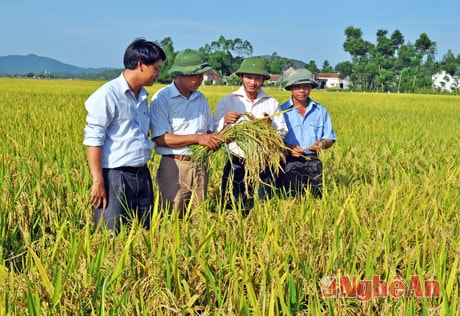 |
| The improved SRI (System of Rice Intensification) model for rice cultivation yields high productivity. |
Immediately after the plan was approved, the consulting unit organized training sessions on intensive farming techniques using improved methods, from land preparation, sowing seedlings, transplanting, fertilizing, caring for the plants, irrigation, and disease control. Accordingly, on the model area, farmers implemented the following techniques: sowing seedlings on the paddy field instead of on hard ground. The paddy field was plowed and harrowed thoroughly twice, and the surface was leveled before transplanting. After transplanting, water was introduced into the field, maintaining a water level of about 2-3 cm.
Planting density depends on the characteristics of the variety and soil type. For hybrid rice varieties, the planting density is 25 cm between rows and 22 cm between clumps, with 1-2 seedlings per clump. The amount of fertilizer required according to the technical procedure for the Khai Phong 1 hybrid rice variety (calculated per 500 m² Central Vietnam plot) is: 3.5-500 kg of manure, 10-10.5 kg of urea nitrogen fertilizer, 8 kg of superphosphate fertilizer, and 24-25 kg of lime powder. Application method: Apply 100% lime powder, manure, superphosphate, and 20% urea nitrogen as base fertilizer; Apply the first top dressing when the rice plants have rooted and turned green (approximately 12-20 days after transplanting, depending on weather conditions) with 50% nitrogen and 50% potassium chloride. Apply the remaining 50% of potassium chloride and 30% of nitrogen fertilizer at the panicle initiation stage under the supervision of a consultant (nitrogen application based on rice leaf color scale).
After the first topdressing (15 days after transplanting), gradually drain the water from the field, then refill the field with water to a level of 3-4 cm. Repeat this process twice during the vegetative growth stage. Drain the water completely after the second topdressing for about 4-5 days within a week, allowing the field surface to dry. During the panicle differentiation stage (50-55 days after transplanting), refill the field with water, maintaining a level of 4-5 cm until 15-20 days before harvest, then drain the water completely.
Weeding is done manually, using a rake or improved methods that do not use herbicides. Pest and disease control is carried out as in other rice paddies.
Observations show that, due to transplanting young seedlings with 3-3.5 leaves, the seedlings quickly take root and turn green. Transplanting into pre-positioned sieve holes using a hand-pulling tool, at a low density (approximately 20 clumps/m²), minimizes nutrient competition, resulting in concentrated tillering with thick tillers. The rice tillers are vigorous and concentrated, and the tillering period ends faster than in conventional rice production. The number of tillers per clump ranges from 18 to 26. The maximum tillering number of the Khai Phong I variety is higher than that of the Nhi Uu 986 variety. In Dien Tan and Dien Quang communes, the rice tillers are more vigorous than in Hung Long and Hung Linh communes. The early tillering period in the SRI model leads to earlier heading and faster flowering compared to conventional production.
Due to the planting density of 25 cm between rows and 22 cm between plants, the number of clumps per square meter is 20 clumps, resulting in a lower total number of panicles per square meter compared to conventional production. However, the effective tillering rate (% of panicles/maximum tillering tiller) was higher in most SRI model sites compared to conventional production. The high panicle formation rate, low number of ineffective tillers, and concentration of nutrients in effective tillers led to larger panicles with more plump grains.
In the post-transplanting stage, the rice plants are regularly irrigated at shallow levels, and the fields receive ample sunlight, creating favorable conditions for concentrated tillering in the models. The time to complete tillering is shorter than in conventional production, by about 5-7 days.
At the model sites, although the maximum number of tillers per clump was high, the number of clumps per square meter was lower than in the conventional model, resulting in a lower total maximum number of tillers per square meter and a higher panicle formation rate. The rice plants were sturdy, with thick stems, compact form, thick leaves, and good resistance to pests and diseases. Despite the low number of panicles per square meter, the number of filled grains per panicle in the SRI model was significantly higher, with plump grains and a high 1,000-grain weight, leading to significantly higher rice yields compared to the conventional model in all four models.
The yield results of the SRI model in Hung Long commune (Hung Nguyen district) reached 7.6 tons/ha, an increase of 12.5% compared to the control plots in mass production; Hung Linh commune (Hung Nguyen district) reached 7.3 tons/ha, an increase of 7.4% compared to the control plots in mass production; Dien Tan and Dien Quang communes (Dien Chau district) reached 8.0 tons/ha, an increase of 8.1% compared to the control plots in mass production.
Applying the SRI farming system in 4 communes resulted in a significant reduction in input costs. Specifically, seed usage decreased by 36.4-44%, sowing and transplanting labor was reduced, irrigation costs decreased by 50%, and pesticide and spraying costs were reduced by 1-2 applications. Fertilizer costs, however, increased due to adjustments to suit the hybrid rice cultivation process, such as the use of microbial organic fertilizer to replace the deficient amount of manure, and an increase in potassium requirements while nitrogen input decreased.
Based on the accounting of basic revenues and expenditures, in the spring crop of 2011, the model applying the improved SRI farming system at 4 cooperatives achieved a net profit of 23,841 thousand VND, an increase of 10,713 thousand VND (30.42%) compared to mass production. The improved SRI rice farming models were highly appreciated by officials and farmers. Besides bringing economic benefits (yield, production, added value), they also equipped people with knowledge of integrated rice intensive farming according to the SRI system, minimizing harmful environmental pollution. Therefore, immediately after the pilot model ended, the application of the SRI farming system was widely adopted by farmers in subsequent rice production seasons, contributing to achieving yields of over 70 tons/ha/spring crop in many districts of the province.
Text and photos: Hai Yen


