Learn more about the Full Moon Festival in the Seventh Month
(Baonghean)The fifteenth day of the seventh lunar month is also known as Tet, the Double Tenth Festival, the festival of all living beings, the festival of wandering and suffering souls. From the end of the sixth lunar month, shops are already overflowing with goods for the Double Tenth Festival. It's all gold and paper offerings. The custom of burning paper offerings originated in China.
In ancient times, people commonly used white jade for offerings. Later, white jade became rare and expensive, so people used money as a substitute. However, the money had to be thrown away after the offering, which was very wasteful. During the Tang Dynasty, Emperor Xuanzong ordered the use of paper instead of real money, and paper gold and silver ingots replaced real gold and silver. During the reign of Emperor Tang Shizu, Wang Yu, the chief priest in charge of sacrificial rites, came up with another idea: offering only paper money and then burning it. During the Five Dynasties period, people even offered clothes, hats, and personal items made entirely of bamboo and paper, which they had to burn completely so that the deceased in the afterlife could receive them all. Buying these offerings in advance wasn't much cheaper than buying them on the actual day, but to avoid forgetting, everyone bought them gradually, because it would be considered sinful to be missing something during the New Year.
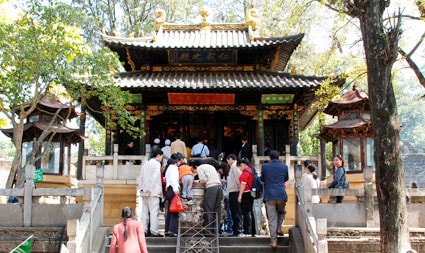
The 15th day of the seventh lunar month sees a large influx of people visiting temples. Photo: MT
According to Vietnamese belief, the 15th day of the seventh lunar month is considered the Day of Atonement for Deceased Souls. This means that all sinners in the underworld are forgiven on that day. Therefore, in the mortal world, every family prepares feasts to worship their ancestors, burning paper money in the hope that the souls of their ancestors will have one day to return to the earthly realm to enjoy the offerings of their descendants. Families who have recently lost a loved one also take this opportunity to invite monks and nuns to prepare vegetarian meals and chant prayers for the departed soul.
The offerings must be a mix of savory and savory dishes, with plenty of rice and soup. However, the soul of the offering ceremony is the bowl of porridge. Children remember this detail most vividly because the offerings are mostly everyday items that are rarely found in such abundance. The offering tray must be placed in front of the house. The offerings are placed on a tray. Even the poorest families must have a pot of rice porridge. This porridge is made from plain rice and must not be touched while cooking. There are also small balls of rice, boiled cassava and sweet potatoes cut in half or thirds, sugarcane cut into pieces, a few peanuts, boiled jackfruit seeds, puffed rice, various seasonal fruits, cakes and candies, betel nuts and leaves, and sometimes even sticky rice and sweet soup. Most abundant are incense, paper offerings, and paper effigies. These are usually clothes cut from various colored papers (blue, red, purple, yellow) in stacks. Measurements aren't necessary, and they don't have to be exactly like the real thing; people believe that when these offerings are sent to the afterlife, the spirits will know how to wear them.
Nowadays, people make all sorts of things like motorbikes, cars, multi-story houses, televisions, refrigerators, etc., to send to the deceased. During the rituals, everyone believes that the souls of those who died on the streets, in the marketplaces, orphans, and those who died young – in short, all the souls who have never received any offerings or memorial services throughout the year – will come and partake in this Day of Atonement for the Deceased.
At temples and pagodas, this day is also celebrated with porridge offerings for wandering souls who have no one to commemorate them. Of course, the scale is much larger and only vegetarian food is served. The monks will ladle the porridge into bowls placed on either side of the path, and there is also a large pot of porridge placed nearby.
Going to the temple on this day is a lot of fun. After the temple finishes its offerings, the poor flock to ask for porridge, and children jostle each other to grab the fruits and cakes, a custom called "grabbing porridge." The votive offerings are then burned. While burning them, the monks chant prayers for the salvation of the souls of those who have no heirs.
For Buddhists, the 15th day of the 7th lunar month is not simply the Day of Atonement for Deceased Souls. According to the Buddhist calendar, this day is the Vu Lan Festival. In short, the Vu Lan Festival is a ceremony where offerings are placed in a Vu Lan basin (a basin used to hold offerings) to the monks, with the aim of praying for the souls of deceased relatives to be freed from hell. The story of the Vu Lan Festival is very old and has several anecdotes. Generally, the story revolves around a group of disciples who accompanied the Buddha, including Mục Liên, a Venerable who had cultivated many magical powers. One day, he used his clairvoyance to see his mother in hell, suffering as a hungry ghost. He immediately used his magic to bring food down to hell for his mother, but unfortunately, every time his mother reached out to receive the food, it turned into a ball of fire, making it inedible. Mục Liên returned and pleaded with the Buddha. The Buddha taught that on the full moon of the seventh lunar month, when the monks have completed their rainy season retreat, one should prepare fragrant flowers and sweet fruits, place them in a Vu Lan flower pot, and offer them to the monks, seeking their virtuous influence to transform the karmic greed and delusion of the deceased, thus hoping to save them from hell. Mục Liên followed this advice and indeed saved his mother.
From then on, the Vu Lan festival, a prayer for liberation from hell, has been held annually. The most important role in the Vu Lan ritual is played by the monks, but there must also be a convenient time for the monks to perform their meritorious deeds: this is when the monks gather during the summer retreat, and after the retreat ends, that is, on the day of the Self-Serving Ceremony, when the monks joyfully distribute their merits. Therefore, the 15th day of the seventh lunar month is the most convenient day to hold the Vu Lan festival. In addition, the Vu Lan festival requires a steadfast heart from the devotees. The devotees offer gifts to the monks, and the monks offer them to the Buddha before distributing them; that is the monks' responsibility. The devotees only follow the Buddha's teachings and make offerings to the monks so that the monks may joyfully turn the wheel of Dharma to liberate the souls imprisoned in hell. If the offering is made by a monk lacking merit in his practice, the offering will be of no benefit and will only add to the monk's sin.
Peace