
Supporting gender equality in Chieng village.
(Baonghean) - Chieng village is a purely Thai ethnic minority village in Tri Le commune (Que Phong district). Due to difficult socio-economic conditions, many outdated customs and practices persist, such as child marriage, domestic violence, and the underestimation of women's roles. Since the implementation of the "Consultation and Support Service on Gender Equality" model, Chieng village has seen positive changes…
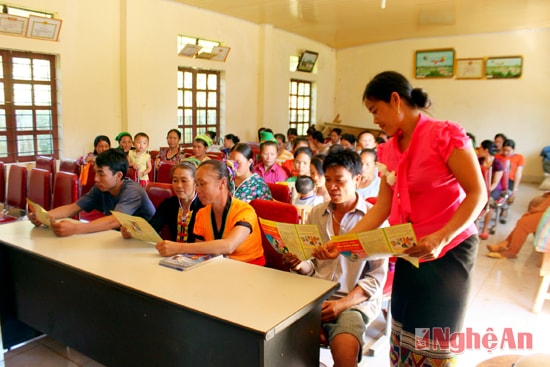 |
| Raising awareness about the Law on Gender Equality in Chieng village. |
We arrived in Chieng village just as the village women's association was holding a thematic discussion on gender equality in the family sphere. The hall was packed, with both women and men in attendance. The frank exchanges of opinions among the members created a lively atmosphere. All discussions revolved around ideas such as: the need to create more jobs for women to help men in the family develop economically; and the need for more cultural, artistic, and sports activities for women to participate in… demonstrating a strong shift in the awareness of the people here regarding gender equality. Present at the discussion, Mr. S, who used to be a heavy drinker and abusive towards his wife and children, but has now reformed and is working hard, said: “Before, I didn’t know what I was doing was wrong. Since electricity came, I’ve had access to media information, and participated in thematic talks on gender equality organized by the village, I’ve realized that what I was doing was against the law. I have to correct my mistakes because being reprimanded in front of the villagers is very embarrassing. Now I know how to love my wife and children.”
In a conversation with Ms. Lang Thi Huyen, head of the women's association in Chieng village, we learned that: Currently, Chieng village has 74 households/376 inhabitants, with women accounting for nearly half of the population. Previously, most women in the village toiled day and night, from farming to housework, and also had to shoulder heavy tasks such as gathering firewood and picking bamboo shoots in the forest… yet they were still treated with disrespect. They received little formal education, limiting their legal awareness and leading them to passively endure violence and abuse of power. Faced with this situation, Chieng village was selected by Tri Le commune to pilot the "Gender Equality Counseling and Support Service" model, organized by the Provincial Ethnic Affairs Committee in coordination with the Gender Equality Department (under the Department of Labor, War Invalids and Social Affairs) during the period 2013-2015. This initiative aimed to bring knowledge of gender equality closer to the people and promptly address their concerns regarding gender equality. After more than a year of piloting the program, Chiềng village no longer has child marriage or third births. Domestic violence has significantly decreased. 100% of the men in the village have taken on the task of going to the forest to collect firewood; they share household chores with their wives such as cooking, washing clothes, and taking children to school… This creates opportunities for women to participate in cultural and artistic activities organized by the village and commune. Women are actively engaged in production and developing their family economies, such as participating in a clean vegetable farming model earning 3-4 million VND per season, ensuring their children can attend school. When sick or pregnant, villagers now go to the health station for examination instead of calling traditional healers for rituals as before…”
To achieve these positive results, in addition to disseminating information about gender equality through the village's loudspeakers and during quarterly meetings of women's associations, cooperative members, and Party branches, content on the Marriage and Family Law and the Gender Equality Law was also integrated into the dissemination of information. For families showing signs of violations, the advisory team, consisting of the village head and women's association officials, promptly visited the homes to remind and correct them. Leaflets in ethnic languages were also prepared and distributed to the villagers. In particular, the advisory team promptly addressed questions and provided knowledge about gender equality to the people during talks…. Once women understood and recognized the equality between husband and wife, they boldly participated in community activities to enhance their roles in the family and society. With the encouragement and support of their husbands, three women in Chieng village have taken on leadership and deputy leadership roles in community organizations: Ms. Huyen; Ms. Ha Thi Chien – Vice-Chairwoman of the Women's Association and population collaborator; and Ms. Lo Thi Duyen – Chairwoman of the Farmers' Association. Currently, nearly 75 women in Tri Le commune hold important positions in social work, contributing to gradually raising the status of women to be equal with men in the family and in society.
Text and photos:Le Hoa


