
Supporting disadvantaged mountainous regions: Part 1 - "Bringing life" to difficult lands.
(Baonghean) - It can be said that, from transportation infrastructure to welfare facilities, from individual houses to crops and livestock, policies and support programs reaching the villages are like a refreshing breeze, transforming these impoverished areas. Many families and villages have been lifted out of poverty thanks to this assistance...
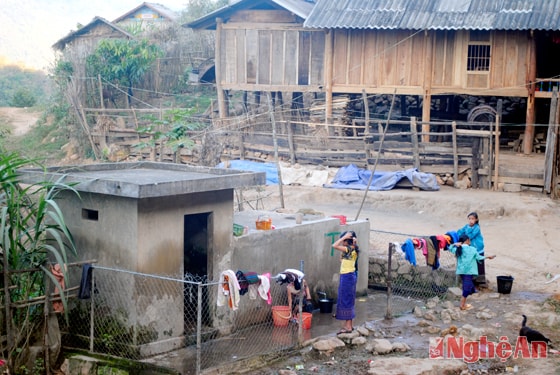 |
| The water supply project at Hat Ta Ven village was funded by the 135/CP program. |
Policies that are in line with public sentiment.
Over the past decade, the Party and Government have implemented numerous humane and people-friendly policies to support particularly disadvantaged areas, helping ethnic minority communities improve their living conditions both spiritually and materially. On July 20, 2004, the Government issued Decision No. 134 (referred to as Program 134/CP) on policies to support agricultural land, housing, and clean water for poor ethnic minority households facing difficult living conditions. The main objective of Program 134 is to ensure that each ethnic minority household has at least 0.5 hectares of upland rice land, or 0.25 hectares of single-crop paddy land, or 0.15 hectares of double-crop paddy land for agricultural production. It also aims to ensure that each rural ethnic minority household has at least 200 square meters of residential land; and to provide subsidies to poor ethnic minority households without housing or with temporary housing to help them build houses. The State provides a subsidy of 0.5 tons of cement to each ethnic minority household for building rainwater tanks, or 300,000 VND for digging wells or creating domestic water sources for ethnic minority households living scattered in highlands, mountainous areas, and areas with difficult access to clean water. For villages with 50% or more ethnic minority households, the Central Government will subsidize 100% of the cost of centralized domestic water supply projects. For villages with 20% to less than 50% ethnic minority households, 50% of the cost of constructing centralized domestic water supply projects will be subsidized...
At the end of 2007, the Government issued Decision No. 135/CP on supporting particularly disadvantaged communes in developing production, improving living standards for ethnic minority households, developing infrastructure and local public services: electricity, schools, health stations, clean water; and improving cultural life. Phase I of Program 135/CP was implemented from 1998 to 2006, Phase II from 2006 to 2010. Phase III is currently being implemented from 2012 to 2015.
Specifically, on December 12, 2008, the Government issued Decision No. 167/CP on housing support policies for poor households. Accordingly, poor households without housing, or those with housing that is too dilapidated, damaged, leaky, at risk of collapse, and unable to improve their housing themselves, will receive 6 million VND in support from the central government. In addition, local authorities are responsible for providing further support beyond the central government's budget and mobilizing community assistance to help these households build houses. Furthermore, these households can also borrow 8 million VND from banks at an interest rate of 3% per year (for a term of 10 years).
Editor's Note: Over the years, the Party and State of Vietnam have consistently paid attention to ethnic minority areas facing extreme difficulties, with the primary goal of helping them escape poverty. Thanks to these practical policies and assistance, the face of the highlands has undergone significant changes, and many households have risen out of poverty in a commendable way. However, alongside this, many households still harbor the mentality of relying on and depending on state policies to automatically benefit, striving to be classified as... poor. In some exceptional cases, localities even try to "secure" themselves as poor villages or communes to benefit from state investment and support. How to ensure that support policies for disadvantaged areas truly have a positive and humane effect is a question that needs an answer soon. |
Most recently, on December 27, 2008, the Government issued Resolution 30a on supporting rapid and sustainable poverty reduction for 62 poor districts nationwide, including three districts in Nghe An province: Tuong Duong, Ky Son, and Que Phong. This is a major and consistent policy of the Party and State, mobilizing social resources to exploit the potential of each locality in the fields of agriculture and forestry, aiming for commodity-oriented development and sustainable poverty reduction. It aims to create faster improvements in the material and spiritual lives of the poor and ethnic minorities in these poor districts, ensuring they are on par with other districts in the region by 2020. It also aims to build economic and social infrastructure suitable to the characteristics of each district, transform the economic structure and production organization effectively according to the plan, and build a stable rural society rich in national cultural identity. The people's intellectual level is raised, the ecological environment is protected, and national security and defense are firmly ensured...
The village is constantly innovating.
State-funded investment and support programs over the past period have contributed to changing the face of villages and hamlets in remote, mountainous, and border areas. The lives of ethnic minorities have gradually improved, and the poverty rate has decreased annually. The level of education and the management and operational capacity of the political system at all levels, especially at the commune level, have been enhanced. The production practices and techniques of ethnic minorities have shifted towards commodity production. Welfare facilities in villages and hamlets have been invested in and built to meet the needs of people for medical care and education for their children. The unity of ethnic minorities has been strengthened, and political security and social order have been maintained. It can be seen that policies and programs directly investing in mountainous, remote, and border areas are the "backbone" for ethnic minorities, poverty reduction, and population stability.
The border village of Hat Ta Ven, Keng Du commune (Ky Son district), is home to nearly 121 households (573 people) of the Khmu ethnic minority. In recent years, the lives of the Khmu people in Hat Ta Ven have improved significantly in socio-economic development, and the village's appearance has become much more vibrant. Most households in the village have had their roofs replaced with corrugated iron or cement sheets, largely thanks to investment and support through government policies (Programs 167 and 135/CP). The villagers are united and help each other when a family builds a new house. From laying the foundation and transporting materials to constructing and roofing the house, the villagers help each other with labor. Hat Ta Ven village also received investment from Program 135/CP to build a community water supply system, which has been highly effective in meeting the water needs of the villagers for many years. Recently, with funding from Program 135/CP, the road connecting the commune center to the village has been expanded by more than 5 km, facilitating travel, cultural exchange, and economic development for the people. The economy is stable, and socio-cultural development is progressing in a positive and healthy direction. Outdated customs, superstitions, and social evils have been eradicated by the people of Ta Ven Hamlet.
The Thai ethnic minority people in the Dinh village area, comprising Lien Dinh, Trung Dinh, and Nam Dinh villages in Chi Khe commune (Con Cuong district), are very excited about the 5 billion VND investment from the government, sourced from Program 135/CP and the national target program for building new rural areas, to construct an inter-village road with a total length of 2,045m and a width of 8m. Since the road was completed, one family in Lien Dinh village has purchased a truck to serve the needs of the villagers. The poverty rate in Nam Dinh village has decreased significantly in the last two years. Currently, out of 120 households in the village, only 6 remain poor.
In this area, there is a clean water project that was invested in more than 10 years ago. During its operation, with the attention of the local government, the project continues to be effective. In recent years, through Program 167/CP, dozens of families have replaced their thatched houses with sturdy ones. In 2012, the village received investment to build a relatively solid cultural center with fairly complete audiovisual equipment, giving the villagers more peace of mind when holding village meetings.
Submit an application to withdraw from the list of impoverished households.
The government's support policies have promptly encouraged and assisted the poor and impoverished households, providing them with a "foundation" to escape poverty. This can be seen as a show of care and sharing, but it also serves as a "stimulus" to encourage people to strive for a better life after receiving government assistance. Many households, having risen from poverty to a relatively comfortable level, have voluntarily submitted applications to be removed from the list of impoverished households. Thach Ngan commune, Con Cuong district, is a prime example. The first person to apply to be removed from the list of impoverished households was Mr. Luu Dinh An from Thach Tien village. Mr. An suffered from bladder cancer and was voted a poor household by the villagers at the end of 2011. By March 2012, after recovering from his critical condition, he discussed it with his wife and submitted an application to be removed from the list of impoverished households, as his difficulties had lessened. Mr. An is a disabled veteran (category 2/3) and a war invalid (category 4/4), suffering from the effects of Agent Orange. He has three children, the eldest and youngest of whom also suffer from the effects of dioxin.
Next is Ms. Lo Thi Huong, from Dong Tam village, Thach Ngan commune, who submitted a request to be removed from the list of impoverished households on November 7, 2012. At the beginning of 2012, Ms. Huong was elected by the villagers as a poor household according to the established criteria. After 10 months of hard work, with the help of the Women's Association, her family's life became increasingly stable, and she voluntarily submitted a request to be removed from the list of impoverished households. What is admirable is that after her husband passed away, she single-handedly raised four children. In addition to her four acres of rice fields, she also raises pigs for meat, producing two batches per year and selling 1.2 tons of pork.
In Dong Tam village, besides Ms. Huong, several other families also applied to be removed from the list of impoverished households in 2012. For a commune considered one of the poorest in Con Cuong district, where people's lives are fraught with hardship, this "unbelievable story" is a rare occurrence. For them, a very commendable thought is that there are many households in the village that are much more disadvantaged and struggling than themselves. They are young and healthy, and remaining on the list of impoverished households would be undignified. They cannot continue to wait and rely on the government forever. Their thoughts and actions need encouragement and support from all levels of government!
It can be said that the government's programs and resolutions on supporting disadvantaged mountainous regions over the years have acted as a "lever" for ethnic minority communities to stabilize their lives, rise out of poverty sustainably, and transform the appearance of their villages. However, there are still many families who take advantage of the state's support and assistance, refusing to strive to escape poverty and passively benefiting from the policies!
X. Hoang - Vi Chong


