
Lakes and valleys, and the vitality of a rural area.
Vuc Mau Lake is one of the largest irrigation reservoirs in Nghe An province, born from the bold decision of Comrade Nguyen Huu Doi, Secretary of the Quynh Luu District Party Committee, and the nearly ten years of arduous effort, with just "a handful of rice and a few vegetables," that "transformed the land" for the people of Quynh Luu... "Transforming the land, transforming the land."
(Baonghean)Vuc Mau Lake is one of the largest irrigation reservoirs in Nghe An province, born from the bold decision of Comrade Nguyen Huu Doi, Secretary of the Quynh Luu District Party Committee, and the nearly ten-year effort and hard work of the people of Quynh Luu, who, with just a meager meal, "transformed the land"...
"Changing heaven and earth"
The construction of Vuc Mau Reservoir began in 1978. During those years, the country had just emerged from war, facing numerous difficulties, hardships, and shortages. Quynh Luu District was also preoccupied with relocating people to mountainous areas, reclaiming farmland, and constructing irrigation projects. In this context, the decision of the Secretary of the Quynh Luu District Party Committee, Mr. Nguyen Huu Doi, to dam the Vuc Mau Reservoir (covering approximately one-third of the district's total area) was truly a bold one. With limited machinery, the project relied primarily on human labor, with people digging ditches and excavating earth, working tirelessly on every meter of the construction site for nearly a decade. Thus, the Party Committee and people of Quynh Luu created the miracle of Vuc Mau Reservoir.
The purpose of building the Vuc Mau reservoir was to bring water to serve the production and daily lives of the people in 10 communes in the Hoang Mai area. This is a desolate, impoverished, and arid land, where people often say, "dogs eat rocks, chickens eat pebbles," consisting only of towering limestone cliffs, with no greenery to be found. Even the pine forests are faded by the dust from the rocks. It is too far to draw water from the Do Luong dam, and the two dams, Ba Tuy and Doi Tuong, have very low water reserves.
Laborers were mobilized in waves to build dams, embankments, and irrigation canals. The slogan "Changing heaven and earth, rearranging the country/ A bowl of rice, a few vegetables, and a communist heart" reflected the spirit of the youth of Quynh Luu at that time. Mr. Tran Dinh Khue (born in 1946) recounted the years he led the laborers of Quynh Hong commune in building the Vuc Mau reservoir: "Back then, building the Vuc Mau reservoir involved mobilizing all the youth in the district, taking turns, and dividing the work into sections. Dredging, straightening the river, and building dams were done with machinery, but digging irrigation canals to the communes was mainly done by human labor. It was difficult, arduous, and protracted; each commune that went brought along carrying baskets, hoes, shovels, and rice."
"The atmosphere was always vibrant." Decades have passed, but it's not difficult to find people who participated in the Vuc Mau reservoir labor force in any commune of Quynh Luu district. They still vividly remember those days of walking barefoot on the scorching sand and gravel, remembering the dry, barren ground where the hoe blades bent. They dug and filled nearly 75 million cubic meters of earth, mostly by hand, shoulder, and ox cart...
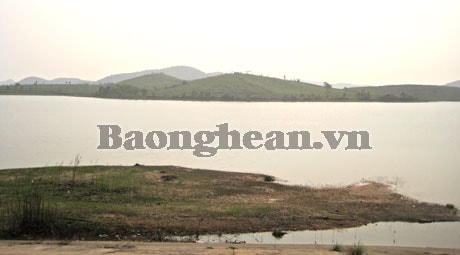
Vuc Mau Lake is located in Quynh Trang commune, Quynh Luu district.
The reservoir covers an area of over 1,000 hectares, stretching nearly 1km from Quynh Thang and Tan Thang down to Quynh Trang, with a capacity of over 40 million cubic meters. This doesn't even include the system of canals connecting the communes and supplying water to individual fields and villages. The project provides water to 10 communes in the Hoang Mai area: Quynh Trang, Quynh Tan, Quynh Xuan, Quynh Hoa, Quynh Van, Quynh Di, Mai Hung, and Hoang Mai… No other irrigation reservoir in Quynh Luu is as large, requiring such a significant amount of community effort, and taking nearly a decade to build. It has become a source of pride for the people of the district, and the people of Hoang Mai still feel a deep sense of gratitude to this day.
With the water, life flourishes.
Traveling through the communes of Quynh Hoa, Quynh Van… to Quynh Trang on an April afternoon, a gentle breeze blows across the lush green rice fields. The clear water of Vuc Mau flows down the canal. Who would have thought that just over a decade ago, this was the poorest area in Quynh Luu district?
The elderly vividly remember the day the water arrived, filled with anticipation and joy. The Vuc Mau Reservoir, now operational, ensures a constant water supply for irrigation, transforming a once desolate area into a prosperous village. In the past, life was extremely difficult and precarious. Rice cultivation depended solely on rain. In years with favorable weather, the people were relieved of some of their worries about hunger. Farmers prioritized "water, fertilizer, diligence, and seeds." The summer-autumn crop was the most productive, but in this remote area, the soil evaporated during the summer without water, making it impossible for the rice to bloom. People in the communes of Quynh Trang, Quynh Tan, Quynh Xuan, and others still cannot forget the drought years when the rice plants withered and died in the fields. It was heartbreaking to see the rice wasted, but they had to cut it down to feed the buffaloes and cows. With the water from the Vuc Mau Reservoir, agricultural production has become more independent and has flourished. The cultivated area has increased, and yields have been high. Previously, rice yields in the communes of Hoang Mai district were very low, but now they have caught up with the central communes, averaging about 60 quintals/hectare. The long droughts that caused the fields to crack and dry up every dry season are no longer a haunting memory. Green has now covered the fields and gardens.
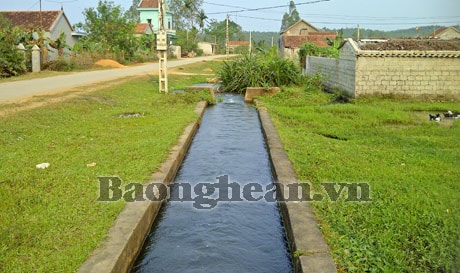
Water flows through the canals to the fields and gardens.
Mr. Tran Van Tuan, Vice Chairman of the People's Committee of Quynh Trang commune, said: "Not only Quynh Trang commune, but all 10 communes in the Hoang Mai area could not have achieved what they have today without Vuc Mau Lake." This project has also created a thriving fishing industry for residents of the surrounding communes (Quynh Trang, Quynh Tan, Quynh Thang, etc.), with an annual output of thousands of tons. From the moment the lake was completed, people started fishing. Initially, due to a lack of management, the fishing was haphazard and uncontrolled, using electricity and explosives, leading to the depletion of aquatic life in the lake. Many fishermen abandoned the profession and went fishing elsewhere. However, the establishment of the Vuc Mau Lake Aquaculture Company brought about a change in organization and discipline in the business. The company is responsible for protecting the lake and releasing fish fry. Fishermen are allowed to fish in designated areas and must return a portion of their income to the company. Previously, it was every man for himself, but now people know how to both fish and protect the environment, resulting in higher, more sustainable, and safer profits, while also preserving the landscape and environment.
Currently, Vuc Mau Reservoir has been upgraded, with 5 spillway gates and a total catchment area of 215 km2, a designed storage capacity of 75 million m3 of water; ensuring water for the daily life of people in the region and Hoang Mai Industrial Park, water treatment plants, and Quynh Lap Central Leprosy and Dermatology Hospital; providing irrigation water for more than 4600 hectares of cultivated land; supplying domestic water to nearly 40,000 households in Hoang Mai urban area and Quynh Luu district; and supplying 11.388 million m3/year for industry. It also supports aquaculture in the reservoir and creates a water source for aquaculture in the area covering 400 hectares, while simultaneously reducing flooding downstream. In the future, the reservoir will continue to be upgraded and developed to serve the production and daily life of the people.
Mr. Nguyen Xuan Dinh, Head of the Agriculture Department of Quynh Luu District, said: “Vuc Mau Lake is a key irrigation project of Quynh Luu District. Thanks to the water from the lake, agricultural production and aquaculture activities are more stable and sustainable. In addition, the exploitation of aquatic resources in the lake has also developed, and there is now a plan to combine fishing and regeneration. Truly, since the construction of Vuc Mau Lake, it has greatly changed the face of life for the people in the 10 communes in the Northwest of Quynh Luu District.”
Returning to the topic of Vuc Mau Lake, a fish farming company has been established, headed by Mr. Nguyen Quoc Huu (from Quynh Thang commune). Previously, Mr. Huu himself was a notorious fisherman in the lake. However, after "draining" the fish stocks from one lake to another, he realized that each location only provided temporary exploitation, leaving his life uncertain and unpredictable. He reconsidered his approach and decided to establish a fish farming company right on Vuc Mau Lake. This change in business practices proved effective, and Mr. Huu encouraged other local residents to contribute capital and shares to develop and manage the lake's aquatic resources in a planned manner.
Running along the sturdy concrete embankment of Vuc Mau Lake, one gazes across to the vast expanse of water reflecting a brilliant golden hue in the afternoon sun, with distant hills appearing and disappearing. This area is currently being developed into an eco-tourism and resort destination due to its beauty and expansive landscape. It's gratifying to see this region rapidly developing, becoming a new industrial zone for the province, and poised to grow into a town in the near future.
The waters of Vuc Mau Lake have flowed here for almost 30 years. That's how long it's been for the people who once yearned for fresh water to witness the rebirth of their homeland. That's how long it's been for the canal to become familiar, a peaceful feature of the countryside; for countless children to be born and enjoy the refreshing coolness of swimming in it. And that's how long it's been for not only the land, but also the water to become ingrained in the very being, an integral part of the soul of the gentle, simple people of this place.
Ho Lai


