
Harmful chemicals in designer children's clothing.
According to a recently published report by Greenpeace, many "branded" products for children contain chemical compounds that can be harmful to health and the environment.
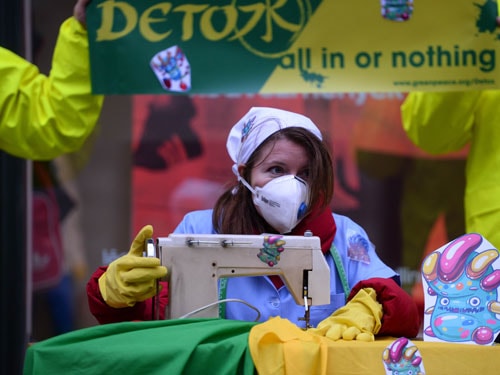 |
| Members of Greenpeace disguised themselves as garment workers in Budapest, Hungary, to investigate the contamination of many children's clothing products - Photo: AFP |
The report presents the results of an analysis of 82 children's clothing and footwear products from 12 well-known brands, including Adidas, American Apparel, Burberry, C&A, Disney, GAP, H&M, Lining, Nike, Primark, Puma, and Uniqlo. These products were purchased by Greenpeace from "official" stores in 25 countries and territories around the world: the US, Spain, Switzerland, the UK, Germany, Russia, Japan, etc. The majority of the products were manufactured in Asia, including China (29 items) and Thailand (8 items).
Accordingly, all 12 brands mentioned above had products contaminated with at least one of the following toxic compounds: nonylphenol ethoxylates (NPE), phthalates, organotins, per/poly-fluorinated chemicals (PFC), etc. Specifically, 50 out of 82 items tested were contaminated with NPE at levels ranging from 1 mg/kg to 17,000 mg/kg. All brands had products containing this compound, notably Disney (4 out of 5 products), H&M (6 out of 7), Lining (3 out of 4), Puma (5 out of 6), Primark (5 out of 6), and American Apparel (3 out of 4). Among these, some products from C&A, Disney, and American Apparel had the highest NPE levels (over 1,000 mg/kg).
NPE, a derivative of nonylphenol (NP), is a detergent that can disrupt the endocrine system, affecting growth and reproduction. Although less harmful than NP, when released into the environment, NPE will eventually be converted back into NP, which is many times more toxic. Bioaccumulation further exacerbates the risks from NP. When NP is released into water sources, it is absorbed by algae, which are then eaten by fish, and the NP is stored in their fat. The food chain continues until it reaches humans. Greenpeace emphasizes that the presence of NPE in products indicates its use in the manufacturing process and its potential to contaminate the environment through wastewater.
Since 2005, the industrial use of NPE has been strictly restricted and controlled in the EU and North America. Currently, products on the European market containing this substance must clearly state "risk of affecting fertility," "may affect pregnant women," and "highly toxic to aquatic organisms, may have long-term environmental impacts."
The report also revealed that 33 out of 35 samples tested were contaminated with phthalates, a substance used in plastic production. Notably, two products from Primark (purchased in Germany) and American Apparel (purchased in the US) had significantly higher levels of this substance, at 11% and 0.6% respectively. The permissible limit for phthalates in toys or children's products in the EU is 0.1%. Phthalates can affect fetal and infant development, as well as human reproductive capacity. Other compounds that can harm health and the environment, such as organotins (used to kill bacteria and fungi) and PFCs, were also detected in many products, most notably in footwear and clothing from Adidas, Nike, Puma, and Uniqlo.
For over two years, Greenpeace has conducted a series of studies and reports as part of its Detox campaign, advising major players in various industries to minimize the use of compounds in their production processes that could harm health and the environment. In this report, Greenpeace specifically warns that these chemical compounds, which are already harmful to adults, are even more dangerous for children because their bodies are more sensitive and easily affected.
Recommendations for domestic consumers
Regarding reports of children's clothing from well-known fashion brands being contaminated with harmful chemicals, Dr. Nguyen Van Thong, Director of the Textile Institute, stated that these chemicals are used in textile production to increase surface activity, provide waterproofing and stain resistance, improve solubility, create good emulsions, and facilitate dyeing. Concerning health risks, Mr. Lam Quoc Hung, Head of the Poison Control Department, Food Safety Administration (Ministry of Health), said that nonylphenol ethoxylate (NPE) is an organic chemical used in industrial cleaning and bleaching products such as soap, helping to whiten and brighten. While there is limited in-depth research on its effects on human health, NPE is structurally similar to female sex hormones and has a strong competitive effect. Therefore, when it enters the body, it confuses the body's cells, causing them to accept the substance and inhibit the body's production of hormones. Therefore, it affects the development of girls and women.
According to MSc. Pham Duc Duong, Director of the Center for Textile, Garment, Leather and Footwear Materials (Hanoi University of Science and Technology), any textile product, including children's clothing, skin-contact clothing, outerwear, and decorative accessories, exported to European and American countries must undergo customs inspections for ecological standards. Children's clothing, in particular, has strict regulations requiring it to be free of NPEs (Non-Plastic and Anti-Carcinogenic Substances), or if present, to be within permissible limits, as these substances pose a risk of cancer.
Regarding textiles imported into Vietnam, according to Mr. Pham Duc Duong, products only need to be tested for formaldehyde content, azo dyes, heavy metals, and pH levels at three centers: the General Department of Standards, Metrology and Quality (Ministry of Science and Technology); the Textile Institute (Ministry of Industry and Trade); and the Ho Chi Minh City branch of the Textile Institute. Dr. Nguyen Van Thong confirmed that currently, Vietnam only has regulations prohibiting formaldehyde, azo dyes, and heavy metals for individual products, but there are no regulations prohibiting the toxic substance NPE.
MSc. Pham Duc Duong suggested that technical standards for banned substances like NPE should be quickly issued. This would allow inspection and testing agencies to evaluate and warn consumers. “With products clearly labeled with their origin, consumers can have some peace of mind. We especially recommend that when buying new clothes, they should be washed thoroughly before wearing because new products always contain harmful preservatives, especially sweaters and shirts,” Mr. Duong advised.
According to Thanh Nien newspaper


