
The United States will soon become Vietnam's number one market.
With import and export turnover increasing from $2.89 billion in 2002 to $35 billion in 2014, the United States will soon become Vietnam's number one market.
According to the Ministry of Industry and Trade, the United States continues to be Vietnam's largest export market, accounting for 19.7% of exports. Of more than 20 product categories, seven have export values exceeding $1 billion per year, with textiles, footwear, wood products, and seafood being the highest-valued.
Exports increased dramatically.
While Vietnam's exports to this market only reached $800 million in 2000, by 2014, export turnover had reached $29.4 billion, a 13-fold increase.
Vietnam currently ranks 10th among 234 countries and territories that have trade relations with the United States. Vietnamese goods account for 22% of the total ASEAN region's exports to this market.
With the signing of the Trans-Pacific Partnership (TPP) agreement, Vietnam's exports to the US market will increase significantly. With a market size of approximately $1.8 trillion, the US is considered Vietnam's number one key market in the coming years.
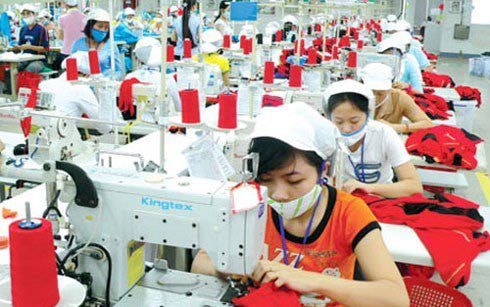 |
| Vietnam's textile and garment industry expects to increase exports to the US after the TPP agreement is signed. |
One of the product categories that benefits most from this agreement is textiles. Textile exports to the US market could reach $22 billion in 2020 and are likely to increase by nearly 46% in the following five years.
In particular, Vietnam's exports to the United States have grown continuously over the past 15 years. From a modest 1% of ASEAN's total export value to the US in 2000, by the end of 2014, Vietnam had reached 22% of the region's total export value to this market (an increase of nearly 36 times). This also marked the first time Vietnam surpassed its regional competitors to become the largest exporter in the region to the US market.
According to economic experts, Vietnam's exports to the United States will continue to increase sharply in the coming years. By 2020, Vietnam's exports to the United States are expected to reach approximately $57 billion, accounting for 34.1% of the total value of ASEAN exports to this market.
Besides trade relations, the United States is also one of Vietnam's major investment partners. As of February this year, the United States had 729 investment projects in Vietnam with a total capital of approximately $11 billion, ranking 7th among 101 countries and territories investing directly in Vietnam.
Economic experts predict that bilateral trade between Vietnam and the United States in 2015 will far exceed the $35 billion figure of 2014. This is due to Vietnam's increasingly effective reforms in administrative procedures, technological advancements, and improved quality of exported goods. Furthermore, a significant wave of investment from US investors into Vietnam is expected in the near future. 2015 is considered a breakthrough year and a good opportunity to strongly promote Vietnam-US relations, especially in the areas of trade and investment.
Driving forces behind the expansion of Vietnam-US trade.
During his recent visit to the United States, General Secretary Nguyen Phu Trong and the high-level Vietnamese delegation participated in a roundtable discussion with representatives from several major US businesses. At this discussion, the General Secretary pledged to create favorable conditions to promote economic development and further strengthen economic, trade, and investment cooperation between Vietnam and the United States.
The General Secretary affirmed that Vietnam will continue its efforts to innovate and accelerate administrative reforms, especially the strong reform of a series of tax, customs, social insurance, and business start-up procedures... in order to create an attractive investment environment for foreign businesses.
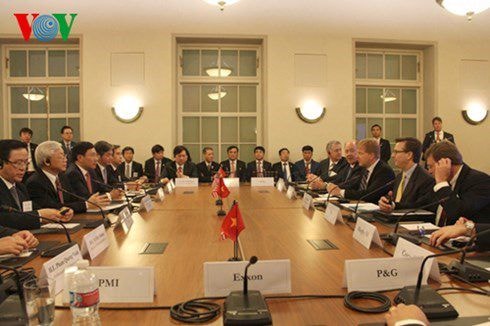 |
General Secretary Nguyen Phu Trong attended a roundtable discussion with US businesses.
Representatives of US corporations spoke, expressing high confidence in Vietnam's human and resource potential, as well as the prospects for Vietnam-US cooperation, especially in the economic, trade, and investment sectors. US businesses highly appreciated General Secretary Nguyen Phu Trong's visit and believed it would open a new chapter in relations between the two countries.
Major US businesses also praised Vietnam's newly amended Investment Law for significantly reducing the number of sectors restricted to foreign investment, while also offering several suggestions to improve the investment environment in Vietnam.
The US-Vietnam Joint Vision Statement, presented during General Secretary Nguyen Phu Trong's recent visit, clearly states that the two countries expect to develop a long-term partnership based on economic, trade, and investment relations, and prioritize cooperation in science and technology, education and training, environment, and law enforcement.
Vietnam and the United States are currently working closely together to conclude TPP negotiations as soon as possible, in order to benefit the people of both countries as well as other nations participating in the Agreement.
A report by the Congressional Research Service (CRS) indicates that Vietnam-U.S. trade has grown rapidly over the past decade. This increase is partly due to changes in the official trade relationship between Vietnam and the United States. In 2001, the United States re-established normal trade relations with Vietnam, and these were elevated to permanent normal status in 2006 when Vietnam joined the World Trade Organization (WTO).
The United States' trade relationship with Vietnam has grown in both exports and imports, with imports increasing faster than exports. Vietnam's exports to the US market largely consist of labor-intensive goods and garments. Vietnam's imports from the US are primarily high-tech goods, including machinery and transportation equipment.
However, CRS notes that one of the issues in trade relations between Vietnam and the United States is the US's continued designation of Vietnam as a "non-market economy" and the imposition of restrictions on Vietnam's fisheries sector. While Vietnam has made significant strides in economic liberalization and is a member of the WTO, it still faces criticism regarding labor standards, intellectual property, and corruption.
CRS also stated that Vietnam remains on the US list of countries under surveillance for intellectual property rights, partly due to the continued widespread consumption of counterfeit and pirated products in the market.
According to VOV.VN


