
Osmanthus flowers (Osmanthus flowers) are used to treat fever and bad breath.
From late summer onwards, the tree produces many flowers, their fragrance intoxicating. I am very curious to know, besides being ornamental, can cinnamon trees be used as medicine?
I have two osmanthus trees planted in front of my house. From the end of summer, they bloom profusely, their fragrant scent filling the whole house and creating a very pleasant atmosphere. I really want to know, besides being ornamental, can osmanthus trees be used as medicine? If so, what diseases can they treat?
(Le Chien Thang, Tay Ho District, Hanoi)
There are two types of cinnamon trees: one whose bark and branches are harvested for medicinal purposes, and another that is grown as an ornamental plant for enjoyment.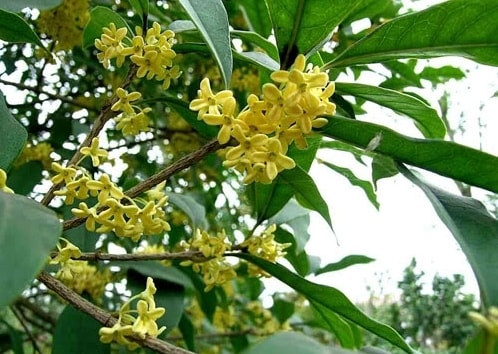
The first tree yields two main medicinal ingredients: one is a tonic called "cinnamon bark" (quục quế), and the other is a remedy for colds called "cinnamon twigs" (quế chi). "Cinnamon bark" is a precious herb, considered one of the four most valuable herbs in ancient times: ginseng, deer antler, cinnamon bark, and aconite. In Vietnam, there are many good varieties of cinnamon, but Thanh Hoa cinnamon (Cinnamomum loureirii Nees), commonly known as "Thanh Hoa cinnamon," is considered the best.
The second tree is mainly grown for ornamental purposes. In the past, wealthy people often planted pagoda trees and cinnamon trees in front of their houses. According to old beliefs, planting a pagoda tree in front of the house would bring success to their children, enabling them to become high-ranking officials; while cinnamon trees helped to keep the family united and prevent separation. The "cinnamon courtyard" in the line "A pagoda tree, a courtyard of cinnamon and pagoda trees," at the end of The Tale of Kieu, is the cinnamon tree you mentioned. This tree is also called "mộc tê," "hoa mộc," "quế hoa," "cửu lý hương" (fragrance that travels nine miles), ... its scientific name is Osmanthus fragrans (Thumb.) Lour., belonging to the Oleaceae family.
Osmanthus is a small, evergreen shrub, usually 2-3m tall, sometimes reaching 7m. Its bark is thin, grayish-white, non-pungent, and not medicinally used like the Thanh Hoa cinnamon tree mentioned above. Young branches are flattened and swollen at the nodes. Leaves are slender, 5-12cm long and 2-4cm wide, thick, hairless, with short petioles; the leaf margins are smooth or have small serrations, with many secondary veins. The flower clusters are short, growing in the leaf axils; the stalks are 1.7cm long and slender. The flowers are white, yellow, or red, and very fragrant; the white variety is called "silver osmanthus," the yellow variety "golden osmanthus," and the red variety "red osmanthus." The calyx is 1mm high, and the corolla has a short tube. The fruit is an oval drupe, green, containing one seed. Flowering and fruiting season: July-October.
The osmanthus tree can also be used as medicine. The flowers and roots are primarily used. The flowers are harvested in the autumn and used fresh or dried. The roots can be harvested year-round, but the best time is September-October. Mature roots are dug up, or the bark is peeled off; the soil and sand are removed, the roots are dried, and they are chopped into small pieces. In some places, the fruit is also used: ripe fruits are picked, soaked in boiling water, and then dried.
According to Traditional Chinese Medicine, osmanthus flowers have a pungent taste and warm nature. Brewing them into tea helps dispel cold, break up stagnation, dissolve phlegm, and generate bodily fluids.treat sore throat,It is used to treat coughs with phlegm, asthma, toothaches, and bad breath; it is also used to treat amenorrhea in women causing abdominal pain; and to nourish and fragrance hair.
Dosage and method of use: 1.5-3g per day; brewed as a tea, steeped in alcohol and drunk, decocted for gargling, or distilled from the flowers.
The fruit has a spicy, sweet taste and a warming nature; it has the effect of dispelling cold, calming the liver, and benefiting the kidneys. It is used to treat deficiency cold, stomach pain, liver pain, and kidney pain caused by cold. The daily dose is 10-12g, decocted and drunk.
The roots have a sweet, slightly astringent taste and are neutral in nature; they have the effect of dispelling wind and relieving pain. They are used to treat rheumatism, muscle and bone aches, kidney deficiency, and toothache. The daily dose is 9-15g of dried herbs or 30-90g of fresh herbs, decocted in water or soaked in alcohol for drinking.
Some traditional remedies use osmanthus flowers:
- Mouth ulcers (canker sores): Pick cinnamon flowers, dry them in the shade, and grind them into a fine powder. Sprinkle the powder on the ulcerated area; 2-3 times a day.
- Toothache: Use 9g of cinnamon root, 3g of Asarum sieboldii, and 15g of Rehmannia glutinosa bark; decoct them in water, gargle with the liquid, and then swallow gradually.
- Treat stomach pain, liver and kidney pain caused by cold infection: (1) Use 6g of cinnamon flower, 5g of galangal, 3g of fennel; decoct and drink throughout the day. (2) Or use 6g of cinnamon flower fruit, 9g of cyperus, 6g of cardamom, 9g of galangal; decoct and drink.
- For beauty enhancement: Often used to infuse tea, the flowers are believed to promote the production of bodily fluids, improve eyesight, enhance complexion, and darken hair and beard.
- Hair conditioning and fragrance: Boil osmanthus flowers with sesame oil. Simmer over low heat until the active ingredients from the flowers dissolve completely into the oil. This will create a very effective homemade hair oil. Using it to comb your hair will give it a pleasant fragrance and stimulate hair growth.
According to Tien Phong - NT


