
Nostalgia for Phan Thiet
(Baonghean.vn) -Phan Thiet is at its most beautiful in early spring when the rows of red bougainvillea flowers blaze like fire against the clear blue sky, and many other flowers are budding, hiding a hint of dreaminess before the abundant golden sunlight.
Amidst the vast white sand dunes and the gentle lapping of the sea, visitors flock to the "Hamu Lithít" region (Phan Thiết - the name used by the ancient Cham people) not only to relax at famous tourist destinations like Mũi Né and Hòn Rơm, but also to wander and explore Lầu Ông Hoàng and the Pô Sah Inư Cham Tower – discovering the unique culture of the Cham people and reminiscing about the past…
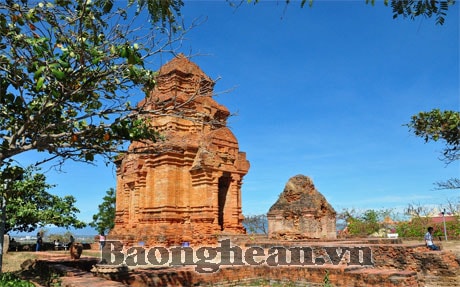
Tower ComplexPo Sah Inu
"Anyone who comes to Binh Thuan, my hometown, should see Mui Ne, Hon Ba, Doi Duong, the beloved Hon Rom and Bau Trang, the Ong Hoang Palace, Ganh Son, and the Cham Towers..."Following the simple, inviting folk songs, and blending in with the leisurely crowds, tourists from all over are flocking to Phan Thiet in ever-increasing numbers. Along the emerald-green coastline, the rustling casuarina trees beckon the wind, and the fine sand still holds the footprints of wise men... This is Truong Duc Thanh School – the starting point of the journey across five continents and four seas of the teacher Nguyen Tat Thanh, seeking a path for the entire nation. And there is the rocky slope leading up to Lau Ong Hoang – the place where the passionate and talented poet resided.Han Mac Tueachdatingtogether with the museMong Cam, a place that witnessed a hopeless love affair under the moonlit nights…
Leaving behind the bustling city streets, traveling about 7 km northeast of the outskirts, past traditional fish sauce villages and ancient fishing villages, the summit of Bai Nai Hill rises atop a nearly 100-meter-high slope, jutting out into the ocean. From there, the Ong Hoang Pavilion and the Po Sah Inu Cham Tower stand strong and courageous, like island soldiers; enduring jungle rains, sea storms, and the accumulated ravages of time, they seem to stand in contemplation, half waiting, half beckoning.
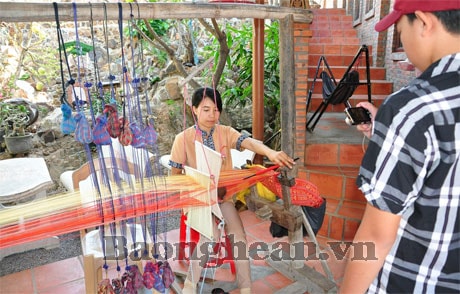
Recreating the weaving process of the people
Lầu Ông Hoàng (The Royal Mansion) was the name given by the people of Phan Thiet in the 1920s to a modern villa with 13 rooms, covering 536 square meters, considered the most luxurious in Binh Thuan at that time (built in 1911 by the French Duke De Montpensier, grandson of King Louis-Philippe I). The mansion has a very beautiful location: From above, the entire young city of Phan Thiet is clearly visible in the deep valley below, with the East Sea in front, waves like children rolling onto the motherland, and behind, the hazy purple mountains of the Bao Loc - Lam Dong plateau. Legend has it that this is where Han Mac Tu wrote his famous poem "Phan Thiet Phan Thiet," with its strange verses and poignant meaning: Han compared himself to a bird.PhoenixFollowing the seven stars to find a virtuous woman… Han Mac Tu inscribed his calligraphy on the stone tablet at the Tower; it seems that it was also at this Tower of the Emperor that the poet Bich Khe from Phan Thiet discovered the “moonlight… rippling waves,” a delicate, gentle, and pearly hue… It is unclear whether those mystical, novel moonlit seasons and haunting poetic imagery amidst the mysterious universe of yesteryear have any connection to the fact that in 1995, tens of thousands of people from all over the world flocked to the Tower of the Emperor to observe and study the total solar eclipse.
To control the Phan Thiet town area, the French colonialists transformed the Ong Hoang Mansion into a system of fortified outposts with many sturdy reinforced concrete bunkers, and the mansion itself was almost completely destroyed. Today, most of the Ong Hoang Mansion has disappeared, leaving only the foundations, underground bunkers, and a vertical, box-shaped bunker with loopholes; in the memory of the people of Phan Thiet, the atrocities of the foreign invaders and the resounding victory at Ong Hoang Mansion by a squad from the Hoang Hoa Tham unit in 1947 are still vividly remembered.
Symmetrically opposite and only 100 meters south of the Ong Hoang Tower is the Po Sah Inu Cham Tower (commonly known by the locals as...).Cham Tower in Pho HaiButthe remaining relics of the KingAncient Champa kingdom. The tower complex consists of 3 buildings, with the Hoa Lai architectural style – one of the most distinctive styles.ancient art of Champadating back to the 7th centuryAlthough only of moderate and small size, the complex encapsulates the essence of ancient Cham architectural techniques and decorative art, creating an aura of majesty and mystery. The Po Sah Inu temple complex is one of the relatively well-preserved Cham tower complexes. Around the late 8th and early 9th centuries, the Cham built this complex to worship Shiva, the god of destruction and creation – one of the most revered and respected deities in Hinduism. In the 15th century, several more temples with simpler architecture were built to worship Princess Po Sah Inu (daughter of King Para Chanh), a woman of exceptional beauty and talent. She taught the Champa people proper conduct, fishing, pottery, and weaving (this building has now disappeared, only its brick foundation remains). The name Po Sah Inu also originates from this. Currently, the Po Sah Inu complex consists of three main towers: the outer tower, dedicated to the Fire God, is 5 meters high; the auxiliary tower is 12 meters high; and the main tower is 15 meters high. Previously, during the transportation of materials for the construction of the villa area, the French damaged the wall in front of the main entrance. The tower still houses the Cham fertility symbols "Linga" and "Yoni".
The setting sun casts its light upon the powerful, time-worn carvings of the bricks and stones, the sunlight dancing here and there. In the twilight, the desolate, ruined Po Sah Inu evokes memories of days gone by: somewhere, the sound of the Rabap instrument resonates...The Saranai lamp, the Paranung drum, the Ghinang drum, the flickering firelight, the graceful figures of slender-waisted Cham dancers, their breasts rising and falling...The dance performance is depicted on the tower wall…Between 1992 and 1995, archaeological excavations at the site uncovered numerous foundations of collapsed temples that had been buried for hundreds of years, along with bricks, tiles, and some artifacts within the temple structures dating back to the 15th century. It is unknown what the search at the courthouse entailed.These three towers, one tall and one short, clustered together, reveal the footprints of the graceful queen, the shards of mirror reflecting the deeply sorrowful, homesick eyes of Queen Paramecvari.Princess Huyền Trân was married to the Champa king Chế Mân; this political marriage helped Đại Đại.Vietnam reclaimed Chau O and Ly – sacred lands of the ancient Vietnamese people since the time of the Hung Kings – after more than 10 centuries under the rule of the Champa kings in 1306. Looking at the terracotta bricks clinging tightly together, one suddenly thinks about the historical changes and dynasties, the wondrous and mysterious Champa culture....
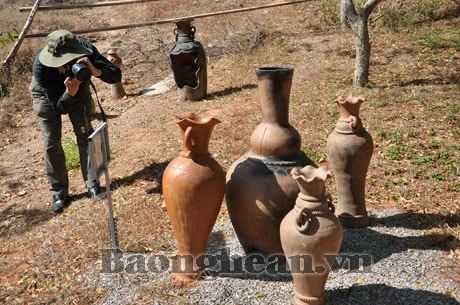
Cham pottery has long been renowned for its exquisite craftsmanship.
BThe fertility symbols of the Cham people: "Linga" and "Yoni".
Inrasara, a researcher of Cham ethnic culture, stated: "The traditional family values of the Cham people are as enduring as the bricks building a tower. Alongside the common foundations of the Vietnamese people, the Cham have their own unique characteristics: With a matriarchal system, the position of women is more important, and therefore mothers are always respected by everyone in the family. When a couple gets married, the Cham do not have a wedding procession; instead, they welcome the groom. The Cham follow a monogamous marriage system. To come together, couples usually have a matchmaker and go through a long period of courtship, enduring many hardships and challenges, thus strengthening the bond between the young couple. When the wife is pregnant, she hardly has to do any strenuous work. At that time, the husband, in addition to farming, is responsible for finding medicinal roots for his wife during childbirth." As the wife's due date approaches, the husband must also prepare a ceremony to worship the goddess Inư Nưgar to pray for a safe delivery for both mother and child… these rituals and customs of the Cham people act as invisible bonds, helping to strengthen the relationships between family members.
In the life of the Cham people,Traditional characteristics are still preserved; including many customs containing unique cultural values, aiming to ensure the development of the Cham community. These include festivals: Cham festivals are numerous, such as the Rija Nuga festival (meaning "festival of the land"), which from a traditional perspective is a major festival, arguably the largest of the Cham people, alongside two other folk festivals: Katê and Bbơng muk kei (Ramadan or Ramưwan), Poh Mbăng Yang… also known as the Cham rain and peace prayer festival…
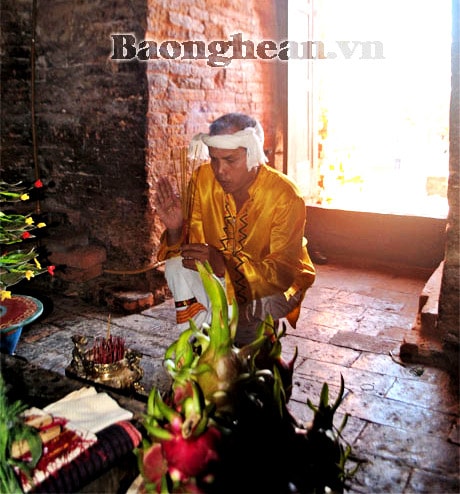
The Cham people talk to their ancient ancestors.
Duc Thanh School is where teacher Nguyen Tat Thanh once taught.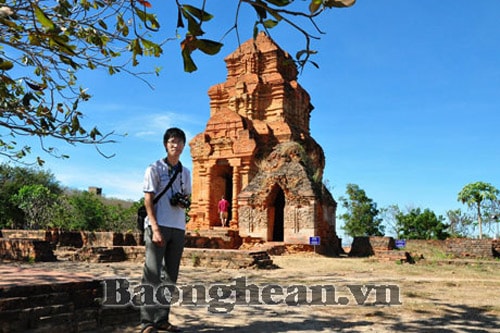
A reporter from Nghe An Newspaper on top of Bai Nai mountain.
DanceApsara in thedrum soundParanung, the sound of the trumpetSaranainext to the ancient tower.
When the crape myrtle tree blooms with purple flowers (on July 1st according to the Cham calendar, approximately late September or early October in the Gregorian calendar),at the time when the harvest was completeThis is also the time when the Cham people in Binh Thuan are bustling with the Katê festival, an occasion to commemorate the heroic martyrs, ancestors, and give thanks to the deities for bringing favorable weather, abundant harvests, and for relatives and friends to visit each other.Drum soundParanunglively and harmonious with the sound of the trumpets.SaranaiThe melodious sounds create a range of pitches and tones amidst the mountains and hills.At the Po Sah Inu tower, thousands of Cham people gather to reenact an ancient Katê ritual, bringing treasures of the Cham royal family such as crowns and robes to the ancient mausoleum to offer to the gods. They carry the robes of the kings, sing songs praising the virtues of the kings and other heroes, and offer gifts including chicken eggs, betel nuts, wine, cakes, and fruit. At the tower, the shamans perform a ritual to the god Siva, allowing the tower's doors to be opened. People dance with gongs, play the bamboo flute, and Cham dancers perform.ApsaraThe monks perform the purification ritual, bathing the statues and dressing the divine king in dragon robes... The sacred festivals of the Cham people always include...The atmosphere was solemn and vibrant, imbued with spiritual colors.
Po Sah InuAlong with the Ông Hoàng Tower, it stands as a historical witness possessing "dual" value, both tangible and intangible. To preserve it for future generations, from 1990 to 2000, this monument was restored and renovated by Binh Thuan province, and in 1991, the State classified it as a national monument.Po Sah InuIt has become a national-level architectural and artistic heritage site...Po Sah InuOver 1000 years old, the Ông Hoàng Pavilion has stood for nearly 100 years. Tomorrow, the sun will rise again, and it will remain the same for a thousand years to come.Po Sah InuAnd the Ong Hoang Tower has become an integral part of our national culture; surely these structures will continue to welcome the dawn… Bai Nai Peak still has much to discover.
Text: Thanh Chung - Photos: Minh Thong



;)
;)
;)