
Private pharmaceutical business operations - Many violations still exist.
(Baonghean) - Medicine is a special commodity, directly serving human health and life, so the business of selling medicine must meet specific conditions. In recent years, in our province, the trade of medicine has been developing rapidly in both quantity and scale of services, increasingly meeting the healthcare needs of the people. However, alongside the businesses that operate well, there are still companies and enterprises that violate the law… From counters, agencies, to pharmacies.
(Baonghean) - Medicine is a special commodity, directly serving human health and life, so the business of selling medicine must meet specific conditions. In recent years, in our province, the trade of medicine has been developing rapidly in both quantity and scale of services, increasingly meeting the healthcare needs of the people. However, alongside businesses that operate well, there are still companies and enterprises that violate the law…
From counters, agencies, pharmacies
Nghe An is one of the provinces with the highest number of private pharmaceutical establishments in the country. According to statistics from the Nghe An Department of Health, the province currently has 1,524 private medical and pharmaceutical establishments, including 1,159 pharmaceutical establishments (62 pharmaceutical companies and branches, 167 pharmacies, and 930 other types of establishments). However, it must be said that "a large number doesn't necessarily mean a strong one." In reality, in our province, the practice of pharmacies renting or borrowing licenses and professional certificates still persists.
Furthermore, many pharmacies and drugstores do not meet the standards stipulated for good pharmacy practice (pharmacy owners must have a pharmaceutical practice certificate and be present at the store during operating hours. Some medications must be sold only with a doctor's prescription. Employees directly selling medications must have a professional pharmaceutical qualification. The sales area must have a minimum area of 10m2, with handwashing facilities for both sellers and buyers, and sufficient equipment to protect medications from adverse effects of light, temperature, humidity, pollution, and insect infestation. For medications sold without packaging, the following information must be clearly stated: drug name, dosage form, concentration, and dosage; if no prescription is included, the dosage, frequency of use, and method of use must also be indicated...). Therefore, inspections and audits are being carried out regularly by relevant authorities.
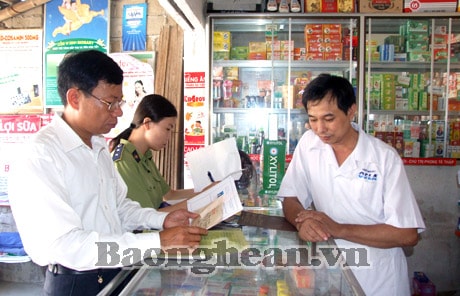
Inspecting a pharmacy on Phong Dinh Cang Street (Vinh City). Photo: Tu Thanh
For example, during an inspection of private medical and pharmaceutical practices at the end of 2012, the provincial inter-agency inspection team discovered many pharmacies and drug stores in Thanh Chuong district that were in violation of regulations. The main violations included pharmacies and drug stores lacking sufficient space and facilities; failure to classify and store drugs by group; lack of drug tracking logs; poor hygiene; mixing functional foods with pharmaceutical products; incomplete drug price listing; failure to list prices per product unit; and lack of professional practice qualifications.
This inspection uncovered typical violations at two Thành An Pharmaceutical Company drug outlets: the outlet in Rộ Market area, Võ Liệt commune, run by Ms. Nguyễn Thị Nga, violated regulations regarding area, storage, and failed to present a pharmaceutical practice certificate and a certificate of eligibility to conduct pharmaceutical business (violating Articles 9, 12, 13, and 25 of the Pharmaceutical Law); the outlet run by Ms. Nguyễn Thị Thúy on the Ho Chi Minh Trail, Thanh Thủy commune, violated regulations regarding facilities, and Ms. Thúy herself had only graduated from a vocational school in medicine and pharmacy less than a year ago (violating Article 13 of the Pharmaceutical Law, which stipulates that sellers must have completed two years of practical training at a legally licensed pharmaceutical establishment).
The inter-agency team documented the violations and requested the health sector and local authorities to take strict action against the violators… It was thought that the aforementioned pharmacies and drug stores with serious violations would be “closed down” as stipulated by law. But after more than half a year, upon returning, these pharmacies were still operating normally as if nothing had happened.
When discussing this issue with Mr. Nguyen Viet Kien, Head of the Health Department of Thanh Chuong District, it was learned that: Regarding the agency run by Ms. Nguyen Thi Nga, the district inspection team has drawn up a report and requested temporary closure for rectification, and requested Vo Liet commune to supervise and enforce the regulations. However, the commune has been lax. As for the agency run by Ms. Nguyen Thi Thuy, the district cannot take action because the Department of Health had previously issued her a pharmaceutical practice certificate and a certificate of eligibility to conduct pharmaceutical business (while Ms. Thuy did not yet meet the requirements for a pharmaceutical practice certificate)...
According to Mr. Kien, in 2013, Thanh Chuong district developed and implemented Plan 660, requiring communes to participate in inspections with the district's inspection team. Through two inspection rounds, 173 medical and pharmaceutical establishments were reviewed (over 120 of which were pharmacies), of which 153 had licenses and 18 were found to be operating without licenses. The district aims to eliminate all unlicensed establishments within the year through inspection and awareness campaigns, rather than imposing penalties.
Mr. Kien also pointed out the difficulties in managing pharmaceutical business activities in the area: “The health department currently has two people, but only one has the expertise to conduct inspections; there is a phenomenon where drug stores and distributors are aware of the inspection team's arrival and close down beforehand; it is easy to fine pharmaceutical company distributors, but the sellers are often local residents, while the owners of the pharmaceutical companies or their representatives are very difficult to contact, let alone prosecute…”
According to our investigation: Not only in Thanh Chuong district but also in many localities throughout the province, the concept of GPP (Good Pharmacy Practices) pharmacies is still a distant dream; the phenomenon of pharmaceutical companies opening substandard dealerships is very common. Evidence of this is the result of a health sector inspection in early 2013: out of 57 randomly inspected pharmaceutical establishments, fewer than 20 complied with the regulations of the Pharmaceutical Law. The majority of violating establishments were dealerships of pharmaceutical companies.
Visit the "mobile" clinics of companies.
If the current business strategy of pharmaceutical companies and businesses to expand their reach is to hire local people who do not meet the required skills and qualifications, then legitimize their degrees, certificates, and licenses to act as substandard agents, endangering public health; then the strategy of companies selling functional foods and machinery is to "hide the truth and deceive the public."
Also in Thanh Chuong district, in March 2013, Thang Long International Pharmaceutical Joint Stock Company approached the district's Health Department to request permission to organize a product introduction seminar, presenting two documents: one from the Provincial Food Safety and Hygiene Sub-Department and one from the Nghe An Provincial Department of Health. The District Health Department issued a document approving the introduction of the functional food product in communes and towns. Armed with this "secret weapon," Thang Long International Pharmaceutical Joint Stock Company went to the communes and acted in a deceptive manner – instead of organizing a product introduction seminar, they offered free medical examinations and treatment. Only those who purchased the functional food (which at this time had been falsely advertised as a miracle cure) received free ultrasounds and diagnoses from doctors. Naturally, the price of this "miracle" functional food was inflated to exorbitant levels (according to investigations, each person spent nearly 1 million VND).
Over a period of 35 days (March 13th - April 18th, 2013), Thang Long International Pharmaceutical Joint Stock Company conducted inspections in 10 communes. Although the health stations were aware that the company had violated the Pharmaceutical Law and the Law on Medical Examination and Treatment, none reported it to higher authorities. It was only upon reaching Hanh Lam commune that the company was reported by the local people. The Health Department requested a suspension of operations, which Thang Long International Pharmaceutical Joint Stock Company accepted, thus no official document was issued.
Many people in the province have been deceived by companies selling dietary supplements and health and detoxification equipment. Ms. Nguyen Thi Loan, from Huy Tap ward, Vinh City, said: “I heard from the loudspeaker that a team of central doctors and medical staff were coming to provide health check-ups and consultations, so I went. When I arrived, I listened to them talk, did ultrasounds, examined, and introduced medicines and machines that were good for my health, so I bought them. The medicine didn't help, and the ozone machine or massage didn't seem to have any effect. My ward has received 3-4 such teams already, and I've lost 5-6 million dong. But what can I do? When you're sick, you try everything…” Regarding the widespread violations mentioned above, Mr. Le Hong Linh, Head of the Pharmaceutical Practice Management Department of the Nghe An Provincial Department of Health, stated generally: “State management of private medical and pharmaceutical practices is facing many difficulties – especially the team of specialized inspectors is still small and cannot meet the requirements of the task.”
On the other hand, coordination among sectors, levels, and local authorities is not yet tight; state management of the pharmaceutical sector is sometimes overlapping, with multiple sectors (Health, Industry and Trade, etc.) conducting inspections and audits; the advisory role of health departments and the management of medical and pharmaceutical practices in localities are not regular, decisive, or effective; many regulations on administrative penalties are not applicable, especially to small-scale establishments. Meanwhile, Mr. Ho Son, Chief Inspector of the Nghe An Provincial Department of Health, stated: "Following the Provincial Party Committee's directive on rectifying the management of private medical and pharmaceutical practices, the provincial health sector has only directed district-level health departments to conduct inspections since the beginning of the year, while the Provincial Department of Health has not yet organized any inspection campaigns. From now until the end of the year, the sector will organize an inter-sectoral inspection to review and rectify violations."
Clearly, the primary responsibility for the illegal practices of pharmaceutical companies and the fraudulent sales of dietary supplements and medical equipment lies with the health authorities. To end this situation, it is essential that the health sector prioritizes inspection alongside licensing. After inspections, lessons should be learned, and violations should be dealt with severely to deter future offenses and avoid leniency. Local authorities need to clearly understand their responsibility in managing pharmaceutical and drug sales activities according to their assigned responsibilities. If local authorities do not actively and thoroughly participate, it will be impossible to control all private pharmaceutical businesses. Furthermore, it is crucial for the public to actively report violations, as ultimately, the consequences will fall on the people.
Zen Thanh


