
High school students will only study 4 compulsory subjects.
According to the latest draft of the general education curriculum, instead of having to study 13 subjects as currently, junior high school students will only have to study 7-8 compulsory subjects, and high school students will only have to study 4 subjects.
The latest draft of the comprehensive general education program has just been revised and completed by the Ministry of Education and Training. According to this draft, instead of students having to study 13 subjects as currently, the number of compulsory subjects will be reduced to only 7-8 subjects for lower secondary school and 4 subjects for upper secondary school.
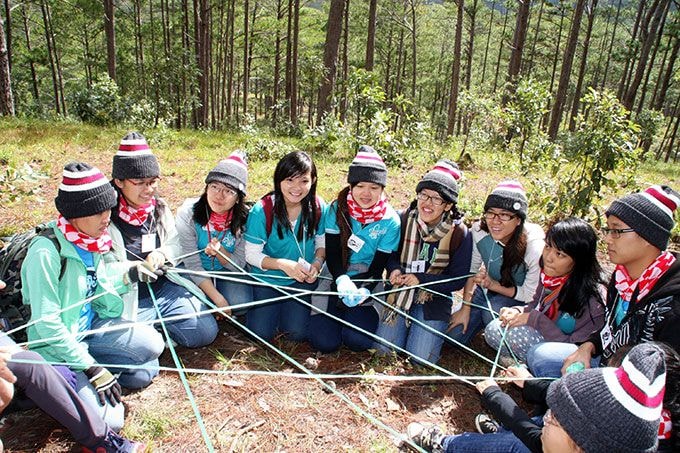 |
| Students from several junior and senior high schools in Lam Dong province participate in a field trip amidst the green forest. According to the draft of the new general education program, the Ministry of Education and Training places great emphasis on creative and experiential activities for students. - Photo: Phan Thanh |
According to the draft, new subjects will be integrated from traditional subjects, or their names will be changed to reflect the changes in content, nature, and educational significance.
Based on the content and learning objectives of the general education curriculum, schools are allowed to develop or request the development of their own educational plans in a flexible and adaptable manner, suitable to the specific conditions and circumstances of the locality. This is also appropriate in the context of multiple sets of textbooks – the main materials used in the future.
The elective course content increases progressively.
Speaking to Tuoi Tre newspaper, Deputy Minister of Education and Training Nguyen Vinh Hien said: “The system of subjects in the overall general education program is designed to ensure a balanced content across educational fields, suitable for each grade level and class, consistent between preceding and subsequent grades, strongly integrated in lower grades, and gradually differentiated in higher grades. The system of subjects has also been adjusted to be compatible with many countries around the world.”
According to the draft design, there are eight educational areas spanning three levels of education: language and literature, mathematics, ethics and citizenship, physical education, arts, social sciences, natural sciences, and technology and information technology.
Each field will have core subjects that are adjusted according to grade and level. For example, the science education field in grades 1, 2, and 3 will have a subject called "Life Around Us," and by grades 4 and 5, it will be separated into two subjects: "Understanding Society" and "Understanding Nature," corresponding to two subjects: social science (integrating content from traditional subjects like history and geography) and natural science (integrating content from traditional subjects like physics, chemistry, and biology).
While in basic education (primary and lower secondary school) many traditional subjects are integrated into new subjects, at the upper secondary level, some traditional subjects such as physics, chemistry, biology, history, and geography are brought back, alongside many new study topics with a strong career orientation.
A new feature compared to many previous drafts is that at all three educational levels, the subject system is divided into compulsory and elective subjects. The elective group also includes various types: elective subjects that students can choose or not choose; subjects where students are required to select one or more subjects from the group; and content that students can choose within a subject... This elective content will gradually increase from lower to higher grades.
At the secondary level, instead of students having to study 13 subjects as currently, the number of compulsory subjects will be significantly reduced to only 7-8 subjects for junior high school and only 4 subjects for high school. Literature, mathematics, civics, and a first foreign language (chosen by the school) will be the four compulsory subjects for high school students. In addition, high school students can choose subjects or groups of subjects with learning content that suits their strengths and career aspirations.
“Throughout high school, students can change elective subjects and study topics to suit their aspirations. However, students must complete the minimum number of subjects and study topics as prescribed by the curriculum. The program will allocate a certain amount of time to facilitate these changes for students,” said Deputy Minister Nguyen Vinh Hien.
Emphasizing creative experiences.
With a focus on developing students' qualities and competencies, the Ministry of Education and Training has set specific requirements for curriculum development, emphasizing teaching methods, focusing on practicality in teaching content and student experiential activities, and adapting curricula to suit the needs of students at each educational level and the specific characteristics of each subject.
For example, in the subject of literature, the teaching method is based on the main principle of learning through activity, aiming to encourage and create opportunities for students to read, write, speak, and listen, thereby developing their thinking skills, literary appreciation, and Vietnamese language proficiency; encouraging independent and creative thinking, and limiting rote memorization...
One of the notable new features in this new general education curriculum is the inclusion of creative experiential activities and scientific and technical research. These creative experiential activities are designed for students from grades 1 to 12.
This is how one applies their knowledge, skills, and experience to solve practical problems in life, thereby developing general and specific competencies (organization, life management, orientation, career choice, etc.), and fostering each individual's unique talents.
Creative experiences are emphasized in each subject, and are designed as separate activities to comprehensively apply various fields of knowledge and skills, with diverse organizational forms and methods of operation suitable for different objectives.
"While in the basic education stage, creative experiential activities focus on forming qualities, personality, habits, and life skills, in the career orientation stage, creative experiential activities place more emphasis on requirements related to future careers, giving students the opportunity to experience different professions in many diverse forms," Deputy Minister Hien explained.
Scientific and technical research and the implementation of specialized study topics are also stipulated in the overall general education program. This is also a form of experience, a way for students to apply a synthesis of knowledge from many subjects to create practical products or solve situations and problems in real life, linking learning with practice.
Organizing learning through thematic studies, learning projects, and scientific research helps students develop self-learning and research skills, teamwork abilities, and become familiar with discussion, critical thinking, presentation, and persuasion.
According to Deputy Minister Nguyen Vinh Hien, the highlights of the overall general education program and the orientation of this subject program all stem from educational science research, practical experience summaries, and experimental implementation in schools within the current general education program.
Examples include teaching integrated thematic subjects; organizing science and technology competitions and interdisciplinary knowledge application competitions; implementing autonomous school education planning by proactively designing teaching projects for teachers and students; innovating student assessment methods; and reforming classroom organization and management towards student initiative, creativity, and self-management (a new school model implemented in primary and secondary schools)...
Guest lecturers are invited.
The organization of elective courses is based on student needs and the conditions of each school. Schools are allowed to invite guest lecturers or send students to study at neighboring schools, groups/classes to increase their ability to meet student needs.
According to Deputy Minister Nguyen Vinh Hien, to ensure the program's stability and development, after its official promulgation, it will continue to receive feedback and suggestions from administrators, teachers, schools, educational management agencies, and interested parties during its implementation. Annually, the Ministry of Education and Training will conduct evaluations, review and adjust the program if necessary, and provide guidance on implementing any adjustments.
Implemented in a phased manner starting in 2018.
School year 2018-2019: implementation of the new textbook program in grades 1, 6, and 10.
School year 2019-2020: implementation in grades 2, 7, and 11.
School year 2020-2021: implementation in grades 3, 8, and 12.
School year 2021-2022: implementation in grades 4 and 9.
School year 2022-2023: implementation in grade 5.
Throughout the history of Vietnamese education, there have been numerous reforms and innovations in the curriculum and textbooks for general education:
The 1950 education reform.
The 1956 reforms.
In 1981, the education reform program marked the unification of the general education system nationwide with a single curriculum and textbooks.
The pilot program for subject specialization in high schools was first implemented in the 1989-1992 school year, and the second in the 1993-1994 school year.
In 2000-2001, the education sector implemented a reform of the general education curriculum and textbooks. In 2002, this curriculum and textbooks were widely implemented nationwide and have continued to this day.
*Mr. Ha Huu Thach (Principal of Giong Ong To High School, District 2, Ho Chi Minh City): Students can easily acquire the knowledge needed for their future careers.
In my opinion, reducing the number of compulsory subjects from the current 13 to 4 at the high school level and 7-8 at the lower secondary level, as stated in the draft of the overall general education program, is a significant shift and a commendable step forward by the Ministry of Education and Training. Everyone understands that reducing the number of compulsory subjects will alleviate the burden on students in general education.
 |
| Mr. Ha Huu Thach |
Retaining the four compulsory subjects at the high school level—Vietnamese Literature, Mathematics, Civics, and Foreign Language 1—is quite consistent with the orientation of the national high school graduation exam. Students can also easily identify and register for elective subjects to serve their future careers.
However, I still wonder whether the subject "Citizenship and the Fatherland" is truly a subject of ethics and civic education. My opinion is that this subject needs to integrate historical knowledge to meet the educational requirements of the current era of integration.
* Mr. Nguyen Quang Minh (teacher at Nguyen Cong Tru High School, Ho Chi Minh City): Reduce academic and theoretical content; increase application and practical skills.
I am concerned about the proposed content of "only 4 compulsory subjects at the high school level." At first glance, it seems that reducing the number of subjects will ease the burden on students. However, in reality, the overload stems from the current education program being too academic, heavily theoretical, and cramming too much knowledge. If the goal is truly to reduce the burden, it needs to lessen the academic and theoretical aspects and increase the application and practical skills... so that students see the usefulness of each subject in their lives. This way, they will learn more easily, comfortably, and enjoyably.
 |
| Mr. Nguyen Quang Minh |
If the regulations only stipulate four compulsory subjects in high school, it could easily lead to students focusing on only one subject, with some subjects they will never learn, even though they are essential for life. For example, history and geography are very important subjects, but why aren't they included in the list of compulsory subjects or integrated into one of the four compulsory subjects as proposed in the draft? One might ask, what kind of people will engineers or doctors become without knowing national history or regional geography?
* Professor Dinh Quang Bao (former principal of Hanoi Pedagogical University): Pedagogical universities must get involved.
To effectively implement the new general education program, a key issue to consider from the program's inception is the reform of teacher training. One of the new features of the program is integrated teaching (interdisciplinary and within individual subjects), whereas previously teachers were only trained in single subjects. Therefore, teacher training colleges must adapt their training methods to provide a new pool of teachers to meet this requirement.
 |
| Mr. Dinh Quang Bao |
The shift from primarily imparting knowledge to developing students' competencies and qualities means that teachers also need to be equipped with a broad knowledge base, receive more training in teaching methods and skills, and understand educational psychology. These are issues that teacher training colleges must address in order to effectively train teachers to meet the human resource requirements of the new general education program.
* Mr. Le Ngoc Diep (former head of primary education department, Ho Chi Minh City Department of Education and Training): Modernity and national identity
The overall general education program is a program that is both modern and reflects national identity. For example, the current primary school education goals also focus on developing qualities and competencies and emphasize "primarily orienting towards family, lineage, and homeland values, and essential habits in learning and daily life."
The direction for developing qualities and competencies at each educational level is also very clear and specific. These include qualities such as loving-kindness, self-reliance, responsibility, and competencies such as self-learning, problem-solving and creativity, communication, and the use of information and communication technology... These are the qualities and competencies of modern Vietnamese people.
According to Tuoi Tre newspaper


