
Learning from President Ho Chi Minh's responses to press interviews.
Today, in an "open society" both domestically and internationally, contact with the press has become a daily activity. However, reading and listening to many people's interview responses reveals much room for improvement to enhance the depth of content and the vividness of expression. The best approach is to reread and reflect upon, and learn from, the way President Ho Chi Minh once answered press interviews.
Today, in an "open society" both domestically and internationally, contact with the press has become a daily activity. However, reading and listening to many people's interview responses reveals much room for improvement to enhance the depth of content and the vividness of expression. The best approach is to reread and reflect upon, and learn from, the way President Ho Chi Minh once answered press interviews.
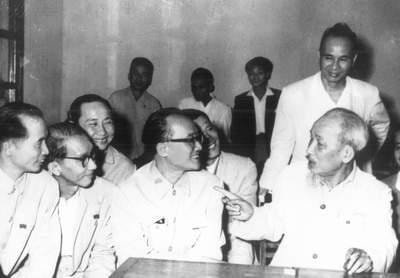
President Ho Chi Minh had a friendly conversation with intellectuals in the medical field. Photo: Archival material.
This immediately tells us that we should not avoid but actively and proactively answer press interviews because this is a very effective channel for making the world understand the situation as well as the policies and guidelines of our Party and State, gaining sympathy and support for the revolutionary cause of our people, combating false narratives, and in many cases sending necessary messages and signals to serve the diplomatic struggle.
Uncle Ho's responses were incredibly rich and covered a wide range of issues: from domestic to international affairs, from domestic policy to foreign policy, from politics to socio-economics, from security to defense, and even his personal life… In nearly 100 interviews, Uncle Ho's responses contained countless profound thoughts and philosophies that this article cannot fully address.
Despite the vast scope of the content, President Ho Chi Minh's interviews always demonstrated a spirit of "conciseness and depth," never speaking at length, often just a few sentences, and never using vague or ambiguous language. He expressed the same idea in many forms, flexibly and adaptably, being both resolute and flexible. For example, in 1945-1946, when various internal and external enemies threatened the independence, sovereignty, and unity of the country, in 11 interviews, he consistently emphasized his determination to fight for independence and unity: He would affirm, "We are not against all of France, all of the French people. If there are French people who want to come here to negotiate peacefully…the fundamental condition…is that the French must recognize Vietnam's independence."
In interviews, Uncle Ho always went straight to the point, without beating around the bush, while maintaining a proactive and assertive attitude, sometimes humorously mocking the tactics of some journalists who tried to find fault. At a press conference on December 26, 1945, concerning the reconciliation agreement between the Viet Minh, the Vietnam Revolutionary Alliance, and the Vietnam Nationalist Party, a journalist asked if the 14 points of the agreement published in the newspaper "Vietnam" (the official mouthpiece of the Vietnam Nationalist Party) were correct. Uncle Ho immediately countered: "Yes, but one more point should be added: both sides have agreed on it, so it shouldn't be published. I don't understand why the newspaper 'Viet'..."
In his responses, Uncle Ho never shied away from difficult or sensitive questions, while skillfully handling the situation in a way that implied: "Yes, but it can be understood as no; no, but it can be understood as yes."
When our country's revolution had just succeeded, due to the circumstances at the time, our Party declared its "self-dissolution," but continued to operate under the form of the Association for the Study of Marxism. Many foreign journalists tried every means to get Uncle Ho to affirm himself as a "communist" in order to divide our country from other countries and to mislead some domestic groups about communism.
Once, a journalist asked: "I heard that you declared you have communist leanings, but do you think Vietnam cannot be communistized within 50 years?" He replied: "Everyone has the right to study an ideology. As for me, I have studied Marxism. Two thousand years ago, Jesus Christ said that we must love our enemies. That has not yet been achieved."
As for when Marxism will be realized, I cannot answer. For communism to be realized, there must be industry, agriculture, and everyone must be able to develop their full potential. In our country, those conditions are not yet sufficient" [4].
In many cases, Uncle Ho answered very briefly, decisively, and clearly. In an interview with the newspaper Frères D'Armes in 1948, when asked what he hated most, Uncle Ho answered "Evil"; and what he loved most, he replied "Good"; regarding what he desired most, he affirmed: The independence of my country and of all countries in the world; and regarding what he feared most, he clearly stated: I fear nothing. A patriot fears nothing and absolutely must not fear anything! [5]
When communicating with the press, as well as when speaking, Uncle Ho often used folk proverbs full of imagery and easy to remember. Answering a question about diplomacy, Uncle Ho emphasized: “We must rely on strength. If strength is strong, diplomacy will be successful. Strength is the gong and diplomacy is the sound. The bigger the gong, the louder the sound” [7].
Here, I would like to share a few impressions I've gained from rereading President Ho Chi Minh's interview responses. I wish that journalists and everyone who interacts with the press would diligently study and learn from President Ho Chi Minh, avoiding avoiding the press, refraining from rambling speeches, unclear ideas, and unskillful responses that are detrimental to the country's image. Connecting this to the "Studying and Following the Moral Example of Ho Chi Minh" campaign is perhaps not unreasonable. In the long run, if someone were to dedicate more time to researching, in greater depth and comprehensively, both the content and methods of President Ho Chi Minh's interactions with the press, it would be truly commendable.
1. Ho Chi Minh, Complete Works, National Political Publishing House, Vol. 4, p. 85
2. As above, p. 213
3. As above, p. 145
4. As above, p. 315
5. As above, Volume 5, p. 522
6. As above, Volume 4, p. 85
7. As above, p. 147
Vu Khoan - According to QĐND-M



;)
;)