
Reviving a 30,000-year-old ancient virus.
French scientists are being very cautious in their attempt to revive a prehistoric virus that was frozen in Siberia.
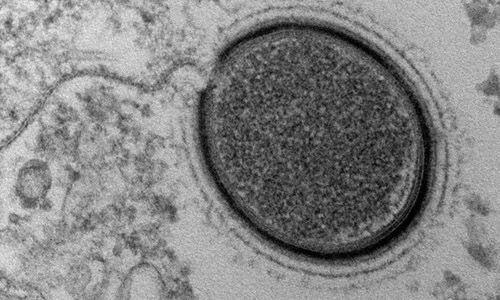 |
| Giant virus Mollivirus sibericum. Photo: AFP |
According to RT, this virus, named Mollivirus sibericum, is about 0.6 microns in size, more than one thousandth of a millimeter, comparable to bacteria, and visible under a light microscope, hence its nickname "giant virus". Furthermore, this virus can pose a potentially deadly threat, carrying up to 523 genetic proteins. A common influenza virus only has 11 genes.
This virus was found in ice samples taken from a depth of 30 meters beneath Chukotka, eastern Siberia, along with another giant prehistoric virus, Pithovirus sibericum. Mollivirus sibericum is the second virus discovered by French scientists, and the fourth giant prehistoric virus found since 2003.
Scientists are preparing to "reawaken" this virus, but are also being very cautious to ensure that it will not endanger humans and animals. They decided to "lure" the virus back to life by placing it together with a single-celled amoeba – which acts as the virus's host. Scientists used this method to awaken Pithovirus sibericum last year.
"This discovery shows that giant viruses are not rare and are very diverse. It also shows that the ability to survive under permafrost for extended periods is not limited to just a few types of viruses, but perhaps exists in entire strains with different replication strategies, and therefore different infection mechanisms," said the French National Centre for Scientific Research (CNRS).
Researchers often "resurrect" ancient viruses to learn more about them. In 2004, American scientists revived the infamous Spanish flu virus, which killed tens of millions of people at the beginning of the last century.
According to VnExpress


