
The Soul of Driftwood from Luong
(Baonghean) - The unique and captivating aspect of handcrafted driftwood products lies in the fact that each viewer will have different feelings about a single piece. The beauty of the driftwood is a combination of nature and human imagination, which is why the art of collecting driftwood is called the art of sight and imagination. I gained this understanding from my experience working with driftwood in Do Luong - the ancient Luong region...
(Baonghean) - The unique and captivating aspect of handcrafted driftwood products lies in the fact that each viewer will have different feelings about a single piece. The beauty of the driftwood is a combination of nature and human imagination, which is why the art of collecting driftwood is called the art of sight and imagination. I gained this understanding from my experience working with driftwood in Do Luong - the ancient Luong region...
At the Ornamental Plants Exhibition celebrating the 1000th anniversary of Thang Long - Hanoi, many domestic and international visitors stopped to admire the display of driftwood artworks by artisan Hoang Van Hoa (from Hamlet 6, Dong Son Commune - Do Luong District). Visitors were very pleased and highly appreciated his art of "breathing life" into driftwood with works that express humanistic values, history, folk legends, people, and the universe... For example, the work "Returning to Heaven" vividly depicts the scene of Soc Mountain with the image of Saint Giong riding an iron horse in a flying posture towards heaven; the work "Family Reunion" is a simulation of a clump of bamboo with five branches of varying heights, the tallest branch nearly 3 meters high symbolizing the father, the pillar of the family. Or consider a set of tables and chairs with tabletops featuring intricate details that encompass a variety of imagery depending on the viewer's imagination: a swimming fish, or perhaps a hippopotamus; the table legs also come in many forms, such as a dragon or a leopard pouncing on its prey; even the four chairs are incredibly varied, one resembling a horse's head, another a deer's head...
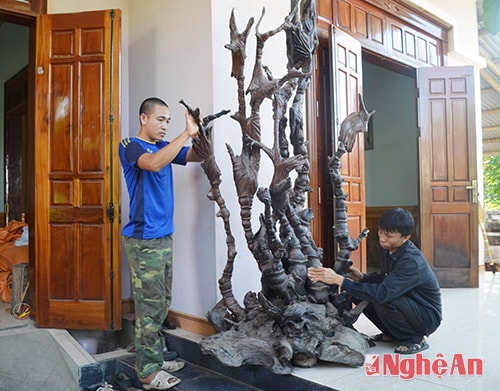 |
| The driftwood artwork "Family Reunion" by Mr. Hoang Van Hoa in Hamlet 6, Dong Son Commune (Do Luong District). |
From lifeless tree trunks, through Mr. Hoa's skillful hands, unique works of art are created, earning him praise from customers. With his talented hands and mind, his driftwood booth received an Outstanding Booth Award at the 2007 Da Lat Flower Festival; in 2008, he received an award from the Central Association of Ornamental Plants; won first prize for his "Driftwood of Affection" artwork at the 2012 Bac Ninh Ornamental Plants Exhibition; and received a Silver Cup at the Ho Chi Minh City Ornamental Plants Fair… Since the beginning of 2014, he has taken 20 artworks to Ornamental Plants Fairs in Bac Ninh and Ninh Binh provinces, and all have sold out.
With nearly 15 years of experience in driftwood carving and participation in over 20 festivals and ornamental plant fairs nationwide, Mr. Hoang Van Hoa shared: “Those in this profession always prefer to leave the raw material intact, only intervening when necessary, because the spontaneous beauty and uniqueness are what give it high artistic value… Carving driftwood is a job that requires patience and passion. First of all, the artist needs creativity and a rich imagination to be able to recognize vivid images from sometimes ugly, dry tree roots. In addition, some knowledge of forestry is needed to know which tree roots are driftwood. For example, teak and rosewood must be over 100 years old, jackfruit wood must be 70-80 years old, and mahogany must be over 60 years old. For fresh roots, it takes 1-2 months to dry and reduce the sap, then the outer bark and the soft part close to the bark are skillfully carved away, leaving only the core of the tree to create driftwood. From the driftwood, one begins…” The process begins with shaping the product. At this stage, the artisan must carefully consider and contemplate to choose the shape and form that is as close to the original as possible. Driftwood is very hard, and crafting it requires patience and meticulousness with each stroke of the knife and each carving. The artisan meticulously carves and polishes, sometimes spending several days just to refine the tail of a snake coiled around a tree trunk, or to carve the fierce, gaping mouth of a lion... Therefore, the price of the product does not depend on its size but on its artistic value and the collector's enthusiasm for it. As a result, some pieces are priced at a few hundred thousand dong, some at hundreds of millions of dong, and some are priceless. "When I have free time, I work at my own pace. When preparing to participate in a fair, I need 3-4 more artisans to focus on crafting. Now, if a province organizes a fair, the organizers send direct invitations to participate, so I always have to have products ready to bring along." Currently, a set of driftwood furniture costs from 40 to 50 million VND/set, while driftwood paintings, sculptures, and couplets average from 500,000 to 3,000,000 VND/set. The busiest market for driftwood products is new house construction projects and members of ornamental plant associations in other provinces; after deducting the cost of raw materials and labor, my family earns over 100 million VND per year from this profession..." - Mr. Hoa added.
There are three types of driftwood: driftwood buried deep in the ground, driftwood submerged in mud and water, and driftwood formed by rain and wind. Each type has its own characteristics: driftwood buried underground retains its original wood color; driftwood soaked in mud has a color like ebony or horn; and driftwood exposed to the wind is the rarest type because it has beautiful wavy patterns. Mr. Nguyen Thanh, a renowned driftwood artist and craftsman in Do Luong Town, said: “A beautiful piece of driftwood is one that is intact, not assembled or cut, but must retain its inner core. The older the tree trunk, the more unique and unusual its shape, the more valuable it is. Based on the existing shape and lines, professionals only need to exploit the details to make the work lively and meaningful. That is each artist's unique way of 'breathing life' into driftwood. There are also driftwood pieces that don't need any further intervention because the 'artwork' created by nature is already so perfect...”
From a passion for collecting driftwood, people in Dong Son commune have formed a Bonsai and Driftwood Club, combining business with the pursuit of beauty. According to Mr. Nguyen Danh Ke, Chairman of the Dong Son Driftwood Club: “Previously, most club members worked on a small scale, producing simple products with limited scope. Recognizing this as a potential economic opportunity, and with the support of the District Ornamental Plants Association, we focused on mobilizing and encouraging like-minded individuals to form an association for easier interaction and exchange of experiences, thus developing the driftwood craft. Most of the raw materials are harvested by local people from the forests of Tan Ky, Anh Son, Con Cuong, and Thanh Chuong districts, who bring them here to sell.”
The driftwood carving craft in Do Luong district has been developing for over 15 years. Initially, this craft originated from a few individuals who enjoyed collecting bonsai trees and happened to visit and meet driftwood artisans in the northern provinces. From this initial interest, the demand for driftwood gradually increased. Many customers from distant provinces sought out carving workshops in Do Luong to order driftwood products. Particularly since 1998, when the Do Luong District Ornamental Plants Association participated in festivals and fairs across the country, Do Luong's driftwood art products won high awards, gaining even more recognition. Currently, there are approximately 15 establishments in the district specializing in the production and carving of driftwood. Although the craftsmen and producers of driftwood may not be highly experienced, their works are not yet exquisitely crafted, but they evoke a high level of imagination due to minimal intervention. The inherent conventions of the artworks themselves give the Do Luong driftwood style a unique character. A "school" of driftwood is emerging and could potentially become a distinct craft village with its own unique style...
Discussing the challenges of the driftwood craft, Mr. Hoang Van Hoa added: “Based on our experience participating in the Ornamental Plant Festivals and Fairs organized by various provinces and cities over the years, we've noticed that while the volume of products is often very large, their value only reaches 50-70% compared to other provinces. From this, we've learned that to make our products affordable and meet consumer demand, we need to choose higher-quality raw materials and create innovative and unique designs to attract the market. Furthermore, while the driftwood craft receives support from the District Ornamental Plant Association, it hasn't received the same level of investment from the Provincial Ornamental Plant Association. In reality, we have to contribute 5-7% of the total product value to participate in the fairs. This poses a significant challenge for households engaged in this craft, given the current fragmented nature of production.”
Currently, driftwood is not widely available on the market; to purchase an artistic piece of driftwood, one must seek out connoisseurs of ornamental plants and trees. Unlike other art forms, driftwood art requires skillful harvesting while respecting its natural form. With their skillful hands, artisans breathe life into inanimate objects, creating priceless tangible works of art. The driftwood products from Do Luong are no exception, contributing to the richness of the province's unique art forms.
Text and photos:Ngoc Anh


