
Hong Kong - China: "Sleeping in the same bed but dreaming different dreams"
(Baonghean) - Starting on September 27th and 28th, the "umbrella riots" brought tens of thousands of Hong Kong protesters to the streets. This protest, in the name of democracy, aimed to oppose Beijing's interference in the amendment of the electoral mechanism for the Chief Executive of the Special Administrative Region. It represents an unprecedented political, economic, and social crisis in Hong Kong since 1997.
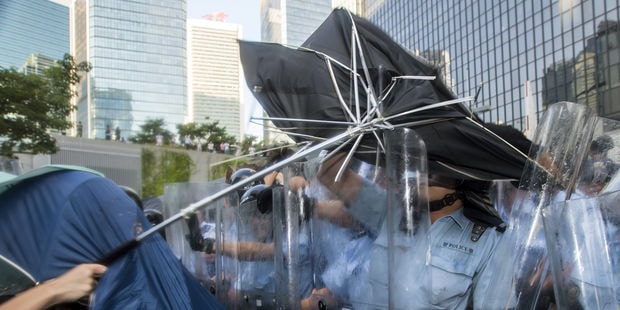 |
| The umbrella – a symbol of the revolution and also a weapon against the police. |
| RELATED NEWS |
|---|
On July 1st, commemorating the 1997 handover of Hong Kong to China, 510,000 people marched through the city center. Following this, the protesters sat down in the commercial district overnight, following a call from the Occupy Central with Love and Peace (OCLP) movement. This civil disobedience group threatened to paralyze the city's financial center if the election of the new chief executive did not adhere to international democratic standards. As soon as details of the new election procedures decided by Beijing were released, on September 1st, the OCLP created a Facebook page to provide information to international media, titled "The Age of Disobedience." The organization also planned a large protest on October 1st, coinciding with the 65th anniversary of the People's Republic of China. Alongside the OCLP's activities, students and schoolchildren also organized strikes starting on September 22nd, sometimes even supported by their teachers. Alain Le Pichon, a university lecturer, linguist, and author of "The Origins of Hong Kong" (L'Harmattan, 1999), commented: "The young people's interest in democracy and their enthusiastic participation were completely unexpected." Following the developments of this civil disobedience movement, he believes that the OCLP's move to bolster the movement by joining forces with the student movement was a shrewd strategy: "Finally, they calculated their actions to put urgent pressure on the Hong Kong government." With this combined effort, the movement reached an unprecedented scale, gathering tens of thousands of people with the umbrella as their symbol – a "weapon" against police tear gas. They gathered in the largest numbers in central Hong Kong and in front of government buildings, to the point of paralyzing city traffic.
To date, Beijing has not directly intervened in the crisis in the special administrative region. Of course, the People's Republic of China has affirmed its support for the Hong Kong government through the Home Affairs Council's statement: "The Central Government strongly opposes all illegal acts that could harm the rule of law and social order" – reported by Xinhua News Agency. China could, of course, deploy troops to Hong Kong – an autonomous region under Chinese rule similar to Macau. Alain Le Bichon confirms this possibility: "China still has troops stationed on the Stanley Peninsula; however, since 1997, these forces haven't really been used."
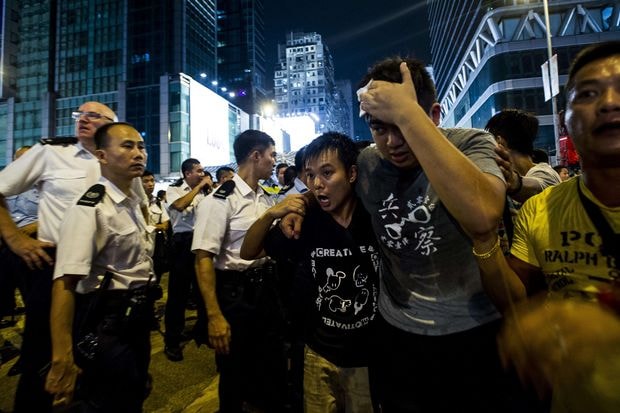 |
| An injured person is helped away from a clash between protesters and counter-protesters. |
The hypothesis of a Tiananmen Square massacre at sea is still premature at this point, but the memory of the two months of protests that paralyzed China from April to June 1989 clearly still weighs heavily on the minds of many. At that time, a range of social strata stood alongside students and intellectuals in a mass protest against the most hardline leaders for refusing to negotiate. This powerful movement, which included some Party officials, was ultimately suppressed by the mysterious massacre in Tiananmen Square on June 4, 1989. Recalling this event as a deterrent is how pro-Beijing factions are acting: They are spreading rumors that China will send tanks to Hong Kong if the movement continues to spread. However, this is unlikely to happen in reality, as the political price would be enormous. Tiananmen Square – a taboo subject in mainland China – is commemorated and taught in the Hong Kong Special Administrative Region. It's a vivid and deeply ingrained memory in the minds of Hong Kongers, strongly influencing their political thinking, especially for those born in the 1990s. Therefore, China likely doesn't want to create a second generation of post-Tiananmen Square activists with increasingly deep-seated resentment towards the mainland government.
The reason Hong Kong people reacted so strongly to the Tiananmen Square events is that, in their minds, Hong Kong is a frontier of Chinese democracy. Having experienced over 20 years under a multi-party political system, with the habit of universal suffrage even for positions lower than Chief Executive, a free mass media, and an independent judiciary, Hong Kong enjoys far greater political freedom than the rest of China. Furthermore, the Communist Party doesn't have a direct presence or a network at any level in Hong Kong; it only intervenes through "proxies"—authorized representatives, such as the DAB (Democratic Alliance for the Betterment and Progress of Hong Kong).
Therefore, for now, we must wait for further developments in the "Umbrella Revolution" movement before we can confirm what decisive action the Hong Kong and Beijing authorities will take. Chief Executive Leung Chun-ying appeared firm, perhaps thanks to Beijing's outward support, declaring that he would maintain his stance on the protesters' acts of disrupting public order. However, when asked about measures to deal with future protests, the Hong Kong Police Chief stated that he had received "extremely strict instructions regarding the use of force" and that "We will only use force when necessary, and ensure that it is minimized." More than anyone else, the Hong Kong and Beijing authorities know that suppressing the protesting crowds with force would be a pretext against them in the name of democracy.
| On Friday, October 3rd, clashes erupted in Hong Kong between protesters and pro-Beijing factions. The situation escalated into chaos when several individuals believed to be members of the Triads – a Chinese mafia organization – vandalized protesters' tents, causing at least three sexual assaults and injuring at least 12 people. On Saturday, October 4th, Hong Kong police made 19 arrests, while clashes continued into the morning. Protesters accused the government of hiring these mafia members to disperse the crowd, an accusation denied by security forces. The peaceful movement is now facing a potential shift, as residents in occupied neighborhoods like Mong Kok have voiced their opposition to the pro-democracy movement: "Give us back Mong Kok! We need to earn a living! Go home!" The immediate reaction from pro-democracy movement leaders was to cancel negotiations with the government as agreed on Thursday evening, October 2nd. |
Reishi Mushroom


