
Hung Nguyen: Bitter chili season?
(Baonghean) - Whether in the fields or on the open plains, the model of growing chili peppers commercially once held great hope for farmers in Hung Nguyen district. However, at this moment, that hope is very fragile...
For farmers, there are always a few chili plants in the garden. Whether spicy or sweet, chili peppers are nothing new to farmers in Hung Nguyen, but the collaboration with businesses to cultivate chili peppers commercially on concentrated areas is a novel crop transformation, and its success or risk is still unpredictable. In 2013, Asia Corporation collaborated with the district to develop commercial chili pepper cultivation models in four communes (Hung Thong 10 ha, Hung Xa 2.5 ha, Hung Long 2 ha, and Hung Tay 1.5 ha); accordingly, Asia Corporation supplied seeds (50%, the district 30%, and the communes 20%), technical assistance, loans for pesticides and fertilizers, and committed to purchasing the harvested product.
According to projections, if planted and cared for properly, with favorable weather conditions and effective pest and disease control, each plot of chili peppers, after about five to six months, will yield a total of 800 kg to 1 ton of fresh fruit per plot per crop. With the company's current purchase price of 6,000 VND/kg, farmers will earn 4.8 - 6 million VND per plot per chili crop, far exceeding that of growing pumpkins, corn, peanuts, etc. We visited a chili pepper cultivation model in the Ben Soi floodplain, Hung Long commune. On a concentrated area of 2 hectares, chili peppers are thriving alongside corn and pumpkins. Mr. Pham Minh Tung, the chairman of the Hung Long Agricultural Service Cooperative, is quite passionate about commercial chili pepper cultivation. In 2012, he conducted a trial planting in the Long Hoa pagoda floodplain, but experienced failure due to drought and unsuitable soil conditions. Undeterred, in 2013, when the district directed the continued development of chili pepper cultivation, he and technical staff from Asia Corporation surveyed and selected the Ben Soi alluvial land to plant a variety of large-fruited sweet chili peppers, the "downward-hanging" variety (fruits hanging down to the ground). Chili peppers are water-loving plants, and learning from previous failures, Mr. Tung mobilized cooperative members to invest 43 million VND to bring electricity to the land, drill 12 irrigation wells, and plant concrete posts surrounded by barbed wire for protection. Planted from December last year to April this year, the chili peppers were lush and abundant, bringing immense joy. However, pests and diseases then emerged, and prevention and control proved extremely difficult…
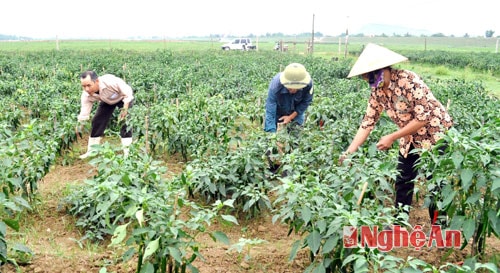 |
| Harvesting chili peppers in Hung Long commune. |
Twelve farming households participating in the commercial chili pepper cultivation model in Hung Long have just finished harvesting their fourth crop, with an estimated yield of 1.4 quintals per sao (approximately 140 kg per 1000 square meters) over four harvests. However, in reality, on the chili pepper beds that have just been weeded, green and ripe peppers are attacked by fruit-boring insects, falling in layers and scattered haphazardly – a heartbreaking sight! Project leader Pham Minh Tung, looking dejected, examined each pepper plant and said: “We have implemented pest control measures as recommended by the company, but we are still not certain we can control the pests and diseases. The only certainty is… the highest yield will only reach about 70-80% of the projected amount.”
It must be said that due to high expectations, the Hung Long Agricultural Service Cooperative has put a great deal of effort into promoting and encouraging people to invest in commercial chili cultivation; for example, this is also the first model in Hung Nguyen where cooperative members themselves invested in bringing electricity to the fields and seriously organized the construction of a commercial crop cultivation model according to the cooperative's directives. Pham Van Thang, a 51-year-old villager from hamlet 7b, a thin man, was seen wading through his chili fields watering them. He said, "Whenever I have free time, I go out to the field. If you neglect watering and caring for this chili variety, you'll regret it. If you're slow to water, the whole plant, leaves, and fruit stalks wither. Weeds just sprout up after a few days of inactivity. As for pests and diseases, we spray them constantly, but in the morning, we see some chili peppers with rotting stems and others with thick layers of fallen fruit at the base of the plants. My wife and I actively cultivate 3 sao (approximately 0.3 hectares). At first, we weren't used to it, and our chili plants were smaller than others. Later, we boldly added more fertilizer and took good care of them, and the chili plants grew much better."
"At the beginning of the season, the green chili plants were thriving and bearing abundant fruit. After harvesting a few crops from the first few plots, we got a few dozen kilograms and received cash on hand, which was great. But I don't know how the cooperative and the company will calculate it; I'm very worried... To be honest, it's hard work, but if the harvest is like that, I'd rather spend my energy on construction, earning two hundred thousand dong a day is normal!" According to Chairman Tung, member Thang is a very hardworking farmer. His wife and he are thin and frail, but besides raising livestock and working as bricklayers, they also cultivate 8 plots of rice paddies, 3 plots of chili peppers, 1 plot of pumpkins, and 1.5 plots of peanuts. They grow everything well and with high yields. His current discouragement with chili peppers shows a serious psychological burden. That's why, when we asked about the cooperative's plans to expand the chili pepper cultivation area, Chairman Tung said it depends on the weather, pest and disease conditions, and the solutions offered by the partner company.
Meeting with Ms. Hoang Thi Dung, a farmer working alone on one plot of land because she also has to do sanitation work at the commune's market, she quickly dropped her bicycle at the edge of the field and rushed down to check on her chili crop. Sighing regretfully, Ms. Dung picked up the fallen ripe chilies and put them in her hat, saying, "I've harvested about 250 kg in four batches. I sell them to the company right away and get paid immediately. If you come around, you'll see the bustling atmosphere of harvesting and buying. But now, as you can see, there are pests and diseases! Growing chilies isn't hard work, but it requires diligence and time. And as you know, we farmers put our effort into any crop, and when we see something uncertain, we worry and feel heartbroken. Even with all this proper work, we still have to rely on fate?"
Just then, Mr. Vo Cong Nam, an official from the district's Plant Protection Station, came to the Hung Long fields to inspect the pest and disease situation. I asked him, "With the chili peppers infested with pests and diseases like this, what do you think?" He shook his head vigorously, saying he couldn't say anything, only that he was inspecting pumpkins, corn, peanuts, etc. (?). Why is that? The cooperative officials are understandably worried, but they haven't made any definitive decisions about the chili pepper pests and diseases; and the district officials haven't offered any opinions either, so what can the farmers rely on, and how can they encourage the next season to continue planting and expand the area?
Chairman Tung was very careful; right next to the chili pepper model, he planted pumpkins. This was also the first time the villagers here had planted pumpkins on the riverside land, some families planting a few square meters, others a whole sao (approximately 1000 square meters). The pumpkins yielded abundant fruit, and now they are waiting for the bloom to appear before harvesting and selling. Recently, traders came to inquire about purchasing them, but they offered 2,500 VND/kg, which Mr. Tung hasn't agreed to yet. He said he will find buyers and will only sell when the price reaches 4,000-5,000 VND/kg. Standing next to him, cooperative member Thang glared and said, "I'll wait until the price reaches 6,000 VND/kg like last year's market price! I estimate that if my plot of pumpkins sells at that price, I'll earn about 20 million VND." We hope Mr. Thang gets the same, but the pumpkins are grown by the cooperative members themselves, and securing a market depends on the market and intense competition with other vegetable and fruit growing regions…
Leaving Hung Long, we went to Hung Thong, a chili pepper farming area. Eagerly leading us to the chili fields, the head of the commune's Agriculture Department, Cao Van Tu, said: “The district directed Hung Thong to plant 10 hectares of chili peppers, but only managed to encourage people to plant 7 hectares, converting from peanuts, carried out by 165 households. The commune has dredged canals and pumped water to serve irrigation. On hot days, the company sends pumps to run, connecting from the canals to the chili fields, both to irrigate the plants and to help kill pest eggs, but it's not very effective.”
In reality, the field near the hospital was covered with vast fields of chili peppers (medium-sized). The green peppers grew lushly, reaching chest height, but were severely affected by pests. Green and ripe peppers lay scattered at the base of the plants; upon inspection, most of the fruits had rotted at the stem, and many rows were overgrown with weeds that reached ankle height. Across the entire field, spanning several hectares, only Ms. Phan Thi Hoa from Hamlet 11 was quietly picking peppers. She complained, "Everyone's discouraged! We harvest five or six dozen kilograms, but only manage to select seven or eight kilograms that meet the company's standards for purchase. We barely get any money before the company immediately deducts it from our loan for supplies (fertilizers, pesticides). I feel so bad, so today I rushed out to harvest, and out of a whole basket of chili peppers, I only managed to pick a few healthy ones to eat! My family cultivates one and a half acres, and it looks like we'll lose everything. I recently asked the technical staff at Asia Company, and they said they're helpless against pests and diseases. As for irrigation, the fields slope towards the ditch, and even with all the watering, it's only enough for the outer areas."
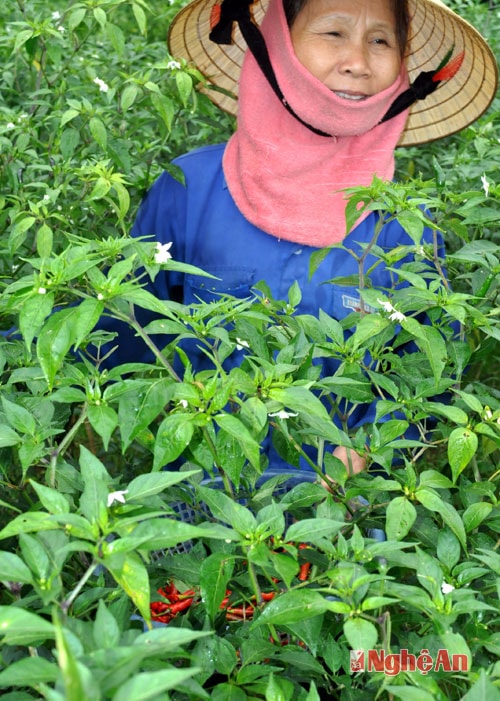 |
| Ms. Phan Thi Hoa from Hamlet 11, Hung Thong commune, said that out of a basket of ripe chili peppers, only about 30 are good. |
Glancing at the Head of the Four-Party Committee, I saw him nod in confirmation, so I asked further: "So, the company doesn't have any solutions to stabilize the people's morale at this time?" Ms. Hoa immediately chimed in: "The company's officials said that if we pick and select the chili peppers now, we'll buy them for 10,000 VND/kg, and if we dry them, we'll buy them for 15,000 VND/kg. But selecting them is pointless; and drying them in this weather will only take a few days before the chilies rot and won't dry properly!" As if to make me understand the difficult reality, the Head of the Four-Party Committee then confirmed that the chili pepper yield in Hung Thong this season will decrease by 70-80%, and persuading the people to plant a next crop will be very difficult!
Thus, at least at this time, the first commercial chili crop introduced to Hung Nguyen is facing difficulties from the government, businesses, and farmers alike. Besides Hung Tay, which has a small area of chili cultivation, Hung Xa has a 2.5-hectare model of both bird's eye and ground chili, but this model is implemented on the farm of Mr. Nguyen Van Hong, who has experience in commercial farming and has previously collaborated with many businesses, so the situation is somewhat better (Mr. Hong previously collaborated with Asia Corporation to grow stevia, and his farm always has a reliable water supply for irrigation).
Bringing concerns from Hung Thong and Hung Long to the agricultural department of Hung Nguyen district, we learned that the pests affecting chili peppers are gray cutworms and green fruit borers, but their life cycle will end in about a week. Farmers should closely monitor their fields and wait for the next crop of flowers to bloom, then care for the plants to continue harvesting. If that's the case, why not promptly go down and inform the farmers? The answer: We have already informed and advised them, but some farmers are still not reassured. – So, if the district and the enterprise are certain that the pest cycle will end and the situation will improve, why not make a new, more suitable commitment to restore the farmers' trust? But that's a difficult question to answer.
Nevertheless, sharing the sentiment with Hung Nguyen chili farmers, everyone is placing their hopes on the newly bloomed flowers and the renewed enthusiasm of the farmers participating in the commercial chili farming model, despite the "difficult beginnings" situation...
Dinh Vu


