
Hung Nguyen expands the model of using trash bins in rice fields.
(Baonghean) - Every year, farmers in Hung Nguyen district use approximately 32,000 kg of pesticides to spray over 8,000 hectares of rice and other crops. The empty pesticide containers are often carelessly discarded on the edges of rice fields, causing environmental pollution. To address this problem, the district has implemented a pilot project using waste bins along the edges of rice fields, which has proven effective.
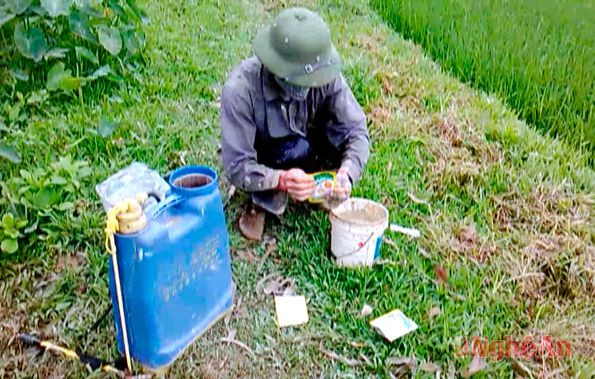 |
| Empty pesticide containers are scattered haphazardly on the edges of rice fields. |
Pesticides play a crucial role in controlling pests and diseases, protecting production, and ensuring food security. However, the practice of people discarding empty pesticide containers directly in the fields has caused serious environmental pollution.
This situation is quite common in rice and crop fields in Hung Nguyen district. Ms. Nguyen Thi Nhu, from Hamlet 7, Hung Thong commune, has 8 sao (approximately 0.8 hectares) of rice fields, producing two rice crops per year. She uses many different types of pesticides to spray her rice from planting until it starts to flower. On average, each sao of rice field uses at least 200 grams of pesticides per year. Therefore, her family sprays an average of 1.6 kg of pesticides annually. She throws all the empty pesticide containers on the field edges and in the irrigation ditches. “I know that throwing pesticide containers in the fields will pollute the environment, but other households throw them in the fields, so I do too. Wherever I spray, I just throw the containers at the edge of the field,” Ms. Nhu said nonchalantly. Sharing the same mindset, farmers in Hung Tan commune have never collected empty pesticide containers either.
In Hung Nguyen district, the indiscriminate dumping of pesticide packaging by farmers across the fields, causing environmental and water pollution, is a problem in almost all communes. The town of Hung Nguyen has also conducted awareness campaigns and guided farmers to collect used pesticide containers and dispose of them properly, but this seems to have had little effect.
Mr. Nguyen Quoc Hue, Chairman of the Hung Nguyen Town Agricultural Service Cooperative, explained: "When pumping water to irrigate the fields, empty pesticide containers drift along the irrigation ditches. In some places, these empty pesticide containers, along with bottles and other garbage, have clogged the sluice gates, so the cooperative has to send people to collect them."
Due to habit, after using pesticides, farmers often discard the packaging, bottles, and containers directly in the fields or into canals and on rural roads without proper collection and disposal. The amount of pesticide residue in the bottles and packaging is a cause of water pollution, affecting the ecosystem and human health.
“Given this situation, through training sessions, the district's Plant Protection Station has guided farmers on how to use pesticides, integrating propaganda and advising them to collect pesticide packaging and bottles to reduce environmental pollution. The Hung Nguyen district Plant Protection Station is coordinating with the Nghe An Plant Protection Sub-Department to build pilot models of placing concrete bins in the fields for people to collect empty pesticide containers themselves,” said Mr. Le Viet Hung, Head of the Hung Nguyen district Plant Protection Station.
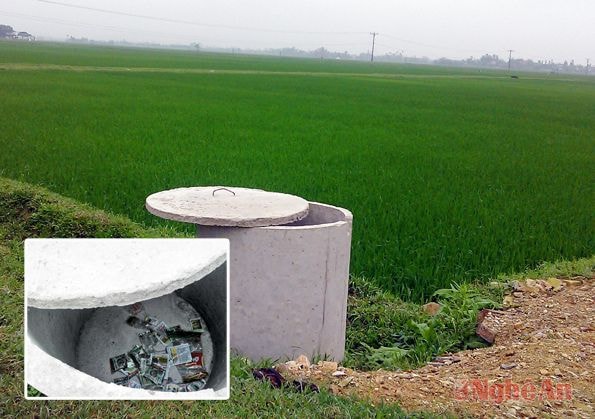 |
| Cement tanks for collecting pesticide packaging are being placed in the fields in Hung Nguyen. |
The model of constructing waste bins for discarded pesticide bottles and packaging directly in the fields has been implemented in four hamlets across three communes: Hamlet 7, Hung Thong; Hamlet 4, Hung Tien; and Hamlets 6 and 12 in Hung Trung commune. Mr. Nguyen Van Vuong, Head of the Agriculture Department of Hung Trung commune, stated: “Two concrete bins were placed in Hamlet 6 in 2013, and to date, all households have voluntarily collected and disposed of pesticide packaging. The concrete bins in the fields of Hamlet 12 were only placed at the beginning of the spring 2015 crop season, but some households have already started to consciously collect waste.” In Hung Thong, starting from the spring 2015 crop season, immediately after the commune completed land consolidation and exchange, the pilot model of placing two concrete bins to collect pesticide packaging was implemented in the model field of Hamlet 7.
Mr. Pham Viet Nam, Secretary of the Party Committee of Hung Thong commune, said: “Since placing concrete bins in the fields, the roads within the fields, field edges, and ditches near the bins are no longer littered with discarded pesticide packaging and containers as before. Based on the successful model in Hamlet 7, in the coming time, the commune will continue to direct other hamlets to implement the placement of pesticide packaging bins in the fields, so that people have a place to collect their waste…”
Pesticides are typically stored in silver-coated polyethylene bags or plastic bottles, which, when released into the environment, do not decompose naturally and cause pollution. Therefore, collecting and disposing of pesticide packaging is an urgent task to protect the environment in production areas and meet the requirements of clean and sustainable production. The model of field waste bins is a good practice in some localities in the province. However, the implementation of this model is still limited; even in Hung Nguyen district, which started in 2013, only 8 bins have been installed so far. This is far too few compared to the actual needs, especially during the current widespread rice blast disease outbreak, when localities are focusing on directing farmers to spray pesticides. Therefore, it is necessary to expand the model, install more waste bins, and intensify propaganda to encourage people to collect pesticide bottles and bags and put them in the bins, instead of littering in the fields and causing environmental pollution.
Thanh Tam
| RELATED NEWS |
|---|


