
Fragrance of the Northwest Forest
On the morning of July 25th, after days of torrential rain, Thanh Vinh suddenly saw sunshine. The meeting hall of the Diplomatic Guest House was filled with laughter, conversation, and greetings from delegates attending the Conference to Commend Outstanding and Influential Individuals from the five Northwestern provinces (Yen Bai, Phu Tho, Hoa Binh, Thanh Hoa, and Nghe An), organized by the Northwest Steering Committee. This was truly a celebration of the flowers of the Northwest region in the homeland of President Ho Chi Minh.
(Baonghean)On the morning of July 25th, after days of torrential rain, Thanh Vinh suddenly saw sunshine. The meeting hall of the Diplomatic Guest House was filled with laughter, conversation, and greetings from delegates attending the Conference to Commend Outstanding and Influential Individuals from the five Northwestern provinces (Yen Bai, Phu Tho, Hoa Binh, Thanh Hoa, and Nghe An), organized by the Northwest Steering Committee. This was truly a celebration of the flowers of the Northwest region in the homeland of President Ho Chi Minh.
Prior to the opening ceremony, a welcoming cultural performance by the Nghe An Ethnic Music and Dance Troupe showcased the unique characteristics and colors of Nghe An province. First, there was a musical ensemble featuring the various ethnic groups living together in this land: Kinh, Thai, Tho, Mong, Kho Mu, Dan Lai, and O Du. Each ethnic group possesses its own distinct culture, yet they all live in harmony and work towards building a more prosperous and civilized homeland. Next were the performances of "Who Goes to Nghe An?" and "Listening to the Boatman's Song at Night, Remembering Uncle Ho," vividly portraying the character and identity of the people and homeland of Nghe An, the birthplace of the beloved President Ho Chi Minh. Finally, the performance concluded with the song and dance "Love Song of the Northwest," conveying to the delegates from other provinces that Nghe An is in harmony with the land and people of the Northwest, and with the beloved Fatherland.
Ms. Hoang Thi Yen (of the Tay ethnic group), from Yen Bai – the furthest province among the five participating provinces – shared: “This is my first time visiting Nghe An, the birthplace of President Ho Chi Minh. Visiting Nam Dan, President Ho Chi Minh's hometown, I was deeply moved to hear about his difficult childhood. I want to return to Nghe An next time to visit the tomb of Mrs. Hoang Thi Loan and go to Chung Mountain – a place closely associated with President Ho Chi Minh's childhood.” She added that after returning home, she will tell everyone about President Ho Chi Minh's hometown and Vinh City. As the Party Secretary of her village, she will strive to understand the thoughts and aspirations of the people, and encourage her family and village to maintain unity, strictly abide by the law, and live up to the trust and affection that President Ho Chi Minh placed in the ethnic minority people.
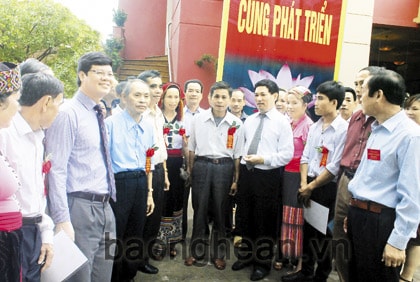
Provincial leaders exchange views with delegates. Photo: Thu Huong
Hailing from Pù Toong village, Pù Nhi commune, Mường Lát district, Thanh Hóa province, Mr. Lầu Thanh Mai (of the Hmong ethnic group) always made an effort to meet Hmong representatives from neighboring provinces. Upon meeting Mr. Vừ Chùa Tủa from Mường Lống commune (Kỳ Sơn district), Mr. Mai embraced him warmly like long-lost brothers. The two men chatted about their family customs, spring festivals, and even the eradication of opium cultivation and restrictions on uncontrolled migration. They then discussed village affairs and economic activities. Mr. Lầu Thanh Mai told his brother: “The lives of Hmong people in Thanh Hóa have improved significantly. They now know how to build small irrigation systems, reclaim land for rice paddies, install clean water systems, and focus on economic development. Importantly, they no longer migrate uncontrollably because they know how difficult and arduous that is.”
During a break, we chatted with Mr. Hoang Ngoc Dinh (of the Muong ethnic group) in Yen Lap town, Yen Lap district (Phu Tho province). Mr. Dinh is a Catholic, a Party member, and a retired official. When asked about his feelings upon arriving in President Ho Chi Minh's hometown, Mr. Dinh confided: "I've passed through Vinh City several times but never had the chance to stop. This time, being in Vinh, I find the city truly beautiful. The houses are spacious, the roads are wide, and the people are friendly. There's also a lively and bustling square. Being able to come to President Ho Chi Minh's hometown to attend this conference makes me extremely happy and proud."
Mr. Hoang Ngoc Dinh's presentation was titled "A respected figure in mobilizing Catholic parishioners to live virtuous lives, closely connected with the nation, and actively contributing to the movement of national unity in building a cultured life in residential areas." He recounted: "Participating in social work, church work, fulfilling the duties of a citizen, and fulfilling the duties of a parishioner is truly arduous. I am determined to always set an example in mobilizing parishioners to live virtuous lives, build strong solidarity, and develop our homeland. Because President Ho Chi Minh, during his lifetime, frequently reminded us of the need for unity between Catholics and non-Catholics, as we are all citizens of Vietnam."
Sitting among hundreds of delegates in the hall, Mr. Lo Van Bien (of the Thai ethnic group) from Cang Na village, Nghia Lo town (Yen Bai province) still stood out with his long, white hair. His artistic appearance attracted the attention of many in the hall. Mr. Bien, nearly 80 years old, was one of the oldest delegates participating in this conference. In conversation with others, he expressed his concern about the risk of the Thai ethnic group's cultural identity fading away. He spoke passionately about the traditional songs, dances, village rituals, and the bamboo flute of the Thai people. According to him, these are the "soul" of the Thai people; if one of these "souls" is lost, it means the Thai people have lost a part of their soul.
Therefore, despite his old age and frailty, he still diligently collects, selects, and teaches these traditions to future generations so that the cultural values passed down from his ancestors will not fade away. He opened classes to teach the Thai script, folk songs, folk dances, and traditional musical instruments. The number of young people coming to learn increased, and he was happy and felt healthier. According to Mr. Bien: “Elders and respected figures in ethnic minority areas must strive to contribute their small efforts to preserve and promote the cultural identity of their ethnic groups. They must raise awareness of preserving, copying, and passing on to future generations the beautiful cultural traditions passed down by their ancestors.”
Meeting Mr. Cụt Phò Lan (Huồi Phuôn 1 village, Keng Đu commune, Kỳ Sơn district) again after nearly a year, he seemed quite quiet and spoke little with people. Recognizing us as acquaintances, he cheerfully said: “I’m from the Khơ mú ethnic group, and I speak Vietnamese very slowly, so I’m quite shy about talking. Listening to their presentations, I saw that everyone was very knowledgeable, and I still have a lot to improve. Tomorrow, when I return to Keng Đu, I’ll tell everyone about this meaningful trip.” When people asked about his hometown, Mr. Cụt Phò Lan spoke enthusiastically. He mentioned that Keng Đu commune is 80 kilometers from the district center, the roads are very difficult to travel, and during the rainy season, it’s sometimes impossible to get through. He also mentioned that Keng Đu is mainly inhabited by Khơ mú people, and although it’s far away, life is no longer as impoverished as before.
Coming from many different provinces, the delegates always showed warmth, joy, and solidarity. Some recognized comrades from the same unit after decades of not seeing each other. Others, belonging to the same ethnic group but residing in two different provinces, took this opportunity to exchange information about the life and customs of their respective ethnic groups. Mr. Vi Duc Tuan (Tuong Duong) sought out Mr. Lo Van Bien to learn more about Thai culture, especially the Xang-Khan Festival and the Xen Ban-Xen Muong Ceremony...
Mr. Va Phai Tenh (Ky Son) sought out Mr. Vang A Tinh (Hoa Binh province) to ask about his experience in persuading the Mong people to settle down and not migrate freely. Meanwhile, Mr. Kha Dien Tam, from Xop Tu village, My Ly commune (Ky Son), shared: “I had to seek out Mr. Lau Thanh Mai in Thanh Hoa province to learn from his experience in drafting and organizing village regulations and clan agreements so that the villagers and their descendants can commit to not violating the law and engaging in social vices.” Like old friends meeting again, their conversation became lively and friendly...
Every meeting must eventually come to an end. After a warm and friendly lunch filled with camaraderie, the delegates boarded their respective vehicles. They all waved goodbye to each other, bidding farewell to the peaceful city of Vinh. These flowers will return to their villages, spreading their fragrance to the world, providing a solid foundation for the cause of building and defending the nation, and serving as a bridge between the Party's will and the people's hearts.
Cong Kien



;)