
The charming village of Vân Tụ
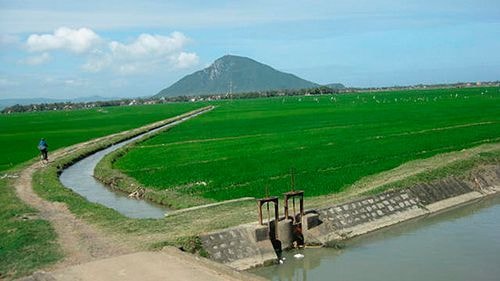
(Baonghean) - Van Tu village is nestled beneath a pine forest, with its back against Tung Linh mountain and overlooking the East Sea, next to National Highway 1A (in Quynh Xuan ward, Hoang Mai town).
The Tùng Lĩnh mountain range stretches out, embracing the prosperous countryside, with many fascinating rock formations and caves such as the King's Cave, Fish Cave, Fishing Net Cave, and Crane Cave... The King's Cave is wide and deep, with water flowing year-round. Inside the cave are many rock formations resembling a king seated in a palace with many guards; some statues, when struck, produce a bell-like sound. The Fish Cave, in particular, has water flowing year-round with a high content of lime and other organic matter, which helps neutralize acidity and improve the soil for the village's fields.
 |
| Illustration photo: internet |
According to archaeologists, this is an ancient land belonging to the "Quynh Van Culture" dating back approximately 5,000 years, with remnants such as scattered scallop mounds around the village. From the Le Dynasty onwards, the Ho, Le, Nguyen, and Tran families came to cultivate the Bo Dam area, building dikes to prevent saltwater intrusion and create the fields of Vang, Trach, Dan, and Noi… Many families have preserved numerous couplets in their ancestral temples to educate their descendants.
"The virtues of our ancestors are passed down to future generations."
"The duty of descendants is to carry on the legacy of their ancestors."
Midway up Tung Linh mountain lies a system of temples and pagodas where incense is burned year-round for worship. Phung Hung Temple is built on the foundation of Diep Lenh hill, also known as Long Hai Son. The temple is structured in the shape of the Chinese character "Tam" (three), consisting of the upper, middle, and lower halls. Built during the Nguyen dynasty, it looks very majestic and dignified. Two pillars in front of the temple entrance, made of green stone, are inscribed with couplets:
"The towering twin pillars stand firm, unshaken by the heavens and the winds."
"The heavy armor of the two armies is strong enough to withstand the attack, making it difficult to defeat them."
(Rough translation: Two pillars as tall as the sky, unshaken by the wind. Two humble sides stand firmly on the ground, uneroded by the pouring rain.)
The temple's structure features carvings on the beams, rafters, purlins, and eaves depicting animals symbolizing the power of the feudal regime (dragon, unicorn, tortoise, phoenix) or folk motifs (dragon, horse, father, animal) commonly found in other temples. Folk verses describe it as follows:
"The dragon-horse pair"
Touching a flock of sparrows
Touching the Cuong couple is also a tradition.
Touching the lion statues is also beautiful.
Touching the pair of deer of the Qin Dynasty
Praise those who are skillful and resourceful.
The stork pecks at the clam...
(Collected locally)
Phung Hung Temple was the secret meeting place of the first Party cell in Quynh Xuan; it was also a storage location for food and ammunition during the resistance war against the US. Currently, the temple has been classified as a national historical monument by the State. An annual procession of the deity is held there in the second lunar month.
In front of the temple is Trung communal house, built during the Nguyen dynasty, dedicated to the village guardian deity. It serves as a meeting place for cultural, social, and spiritual activities of the village community. It has a tiled roof, 24 sturdy ironwood columns dividing it into three bays and two gables.
The beams are carved with motifs such as dragons and clouds, phoenixes and clouds, the four mythical creatures (dragon, unicorn, turtle, phoenix), the four auspicious plants (pine, chrysanthemum, bamboo, plum blossom), and the eight treasures (pen, book, sword, flower, lute, flute, wine gourd, and poetry bag). A horizontal plaque inscribed with the four characters "Long Live the Sacred Palace" (Thánh cung vạn tuế) hangs in the central hall, painted in red and gold. Folk verses describe it as follows:
"The south wind blows strongly against the north wind,
Anyone who wants to go to Vân Tụ to eat shrimp should go.
Our village has been united in one direction.
The pavilion above, the temple below, with mythical creatures and dragons...
(Collected locally)
In the past, the communal house had gongs and drums, and annual ceremonies were held there, such as prayers for peace and favorable weather during droughts. According to the elders, in the early days of the revolution, the villagers gathered in front of the communal house for a rally before seizing power. Later, the communal house became the headquarters of the commune's resistance administrative committee and a school for adult literacy education.
This place is also the cradle of folk songs of Quynh Luu district. On cool, moonlit autumn nights, young men and women sing love songs, exchanging vows of eternal love:
"We love each other, our hearts filled with emotion."
"Here, spread out this shirt for you to lie on..."
(Collected locally)
In the verdant countryside, which is transforming day by day, with village roads becoming urbanized, there still remain the tranquil spaces of banyan trees, riverside docks, and village courtyards, and the gentle, lyrical folk songs still linger...
Tran Huu Duc
Vinh City


