
The Legend of Dien Bien Phu
(Baonghean) - During the resistance war against French colonialism, our province had 8 people who were awarded or posthumously awarded the title of Hero of the People's Armed Forces (6 of whom were Heroes of Dien Bien Phu) for their glorious achievements. Of those 8 people, only Hero Phan Tu is still alive today... Returning to his homeland to live among ordinary people, after long years of serving in the army and serving the people, Hero Phan Tu still shines brightly with the qualities of a soldier of Uncle Ho, serving as an example for the people to follow...
(Baonghean) - During the resistance war against French colonialism, our province had 8 people who were awarded or posthumously awarded the title of Hero of the People's Armed Forces (6 of whom were Heroes of Dien Bien Phu) for their glorious achievements. Of those 8 people, only Hero Phan Tu is still alive today... Returning to his homeland to live among ordinary people, after long years of serving in the army and serving the people, Hero Phan Tu still shines brightly with the qualities of a soldier of Uncle Ho, serving as an example for the people to follow...
Bravely pave the way,subdue the raging waterfall
The golden pages of history of the resistance against French colonialism clearly record the biography, personal details, and heroic deeds of this heroic son of the rice-growing region: Hero Phan Tư, born in 1931 in Thọ Thành commune, Yên Thành district, enlisted in June 1951… Responding to the call of the Party and President Ho Chi Minh, like many other young men of Vietnam, Mr. Phan Tư enlisted and joined the resistance to save the nation. As an engineering soldier of the 351st Division, from 1951 to July 1954, he participated in four major campaigns in the North with various tasks such as opening roads, defusing bombs to ensure traffic, and clearing waterfalls… In any task or position, he always upheld the spirit of courage, overcoming all difficulties and fierce battles, and resolutely completing his mission excellently. Reading again theseThe writings about his heroic deeds would surely inspire admiration in anyone for the courageous and tenacious fighting spirit of the soldiers of Dien Bien Phu.
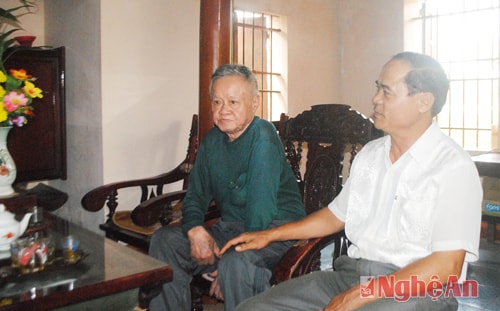 |
| Hero Phan Tư at age 84 (left). |
“In early 1952, the Hoa Binh Campaign entered its most intense phase. Our troops launched attacks aimed at destroying enemy forces, liberating Hoa Binh town, shattering the Da River defense line, and creating conditions for the development of guerrilla warfare in the Northern Delta. The French fiercely resisted by concentrating their defenses and scattering bombs and mines on transportation routes. Phan Tu, then a soldier in Platoon 51, Company 124, Regiment 555, was assigned the task of observing and defusing unexploded bombs to ensure transportation. Many times, the enemy launched fierce attacks, bombs exploded very close, and earth and rocks were thrown into the bunkers. Phan Tu remained steadfast, encouraging his comrades to calmly observe the falling bombs, and when the planes flew away, he would go out to defuse them. One unexploded bomb had penetrated deep into the ground, requiring continuous digging for four hours, exceeding the safe time limit, yet he bravely and resolutely defused the bomb to clear the road. It is impossible to count how many times bombs were dropped, and how many times he and his comrades were injured.” Injuries caused by the pressure of bombs and mines resulted in blood gushing from the body through the mouth, eyes, and nose.
During the Dien Bien Phu Campaign in 1954, Phan Tu served as an observer. When enemy planes dropped bombs, he bravely lay down on the road to observe and pinpoint the bomb's location, marking it for his comrades to defuse. A delayed-action bomb lay in the middle of the road, its safe time unknown, causing thousands of civilian laborers, soldiers, transport vehicles, and artillery trailers to wait, crowding around 300 meters away from the bomb, afraid to cross. The battlefield needed strength from the rear. Squad leader Phan Tu bravely lit a torch and stood next to the bomb, creating a marker for the civilian laborers to cross safely and quickly. His loud shouts echoed from Ta Khoa ferry, upstream of the Da River.
The heroic deeds of Phan Tư were countless, but the event that people remember most is: Phan Tư subdued the fierce rapids on the Nậm Na River... Following President Ho Chi Minh's secret trips to the Soviet Union and China from January 1950 to mid-1953, when large quantities of military aid from both countries were transported close to the border, the Central Committee decided to launch major campaigns in the Northwest. Military units, youth volunteers, and civilian workers were ordered to quickly open completely new waterways and roads connecting to neighboring countries via Ma Lù Thàng, Lai Châu. The Nậm Na River, upstream of the Đà River, was one of these new waterways. The Nậm Na River, stretching 120km from the border to the front lines, had over 90 large and small waterfalls blocking its flow, and 21 giant boulders blocking the way. In February 1954, Phan Tư's 51st Platoon was chosen to undertake the task of clearing the rapids on the Nậm Na River.
This was the first time his platoon had attempted to demolish the waterfall. Lacking experience, they faced numerous difficulties due to the strong current, freezing temperatures, and challenging terrain. Jumping in would easily result in being swept away by the water and thrown against the rocks. Without plastic sheeting, it was difficult to transport explosives underwater… Amidst this, Phan Tư bravely volunteered to dive underwater several times to study the best methods for demolishing the waterfall, choosing the most economical way to use explosives, and drawing lessons for the entire unit. He came up with the idea of using wild banana leaves to waterproof the explosives, and without wax or asphalt, using sticky rice as glue to attach the fuses to the explosives. He personally faced the brink of life and death many times, carrying dozens of kilograms of explosives with pre-ignited fuses, diving into the crevices of the rocks, attaching the explosives, and quickly swimming back to shore before the explosives detonated. Phan Tư's passion and intelligence fueled the strength of his comrades. Thanks to this, Platoon 51 successfully cleared more than 30 rapids, ensuring the deadline was met and clearing the waterway for boats carrying weapons to serve the Dien Bien Phu campaign easily and safely.
With his unparalleled achievements, after the victory at Dien Bien Phu, on August 31, 1955, Mr. Phan Tu was awarded the Third-Class Military Merit Order and the title of Hero of the People's Armed Forces by the President of the Democratic Republic of Vietnam. In the following years, he continued to fight against the American imperialist invasion, and in the wars to protect the southwestern and northern borders. In 1987, Hero Phan Tu retired with the rank of Colonel. He himself was also awarded two Second-Class Military Merit Orders and received 11 commendations from his regiment, division, and the General Political Department.
Back to normal life
We visited the family of hero Phan Tư in Hamlet 5, Thọ Thành Commune, in mid-April, just before the 39th anniversary of national reunification and the 60th anniversary of the Điện Biên Phủ Victory. Hero Phan Tư and his wife have five children and currently live with their youngest son, a teacher at the commune's secondary school. At 84 years old, his health is failing due to old wounds and multiple strokes. When asked about his memories of Điện Biên Phủ and the war against the US, hero Phan Tư became emotional. "Remembering his old comrades, he gets very emotional, and his blood pressure rises," a relative of hero Phan Tư said.
In the humble home of the legendary hero of Dien Bien Phu, Mr. Phan Tu's eldest son, Lieutenant Colonel Phan Duc Nhuan, Deputy Head of Political Affairs, Provincial Military Command, recounted: After the victory at Dien Bien Phu, my father was sent by the Ministry of National Defense to study culture, politics, and military affairs for three months. Like many farmers at that time, due to difficult national and family conditions, my father did not have the means to attend basic literacy classes. The Ministry of National Defense invited the whole family to Hanoi for a meeting and encouragement; my grandfather even received a silk robe from President Ho Chi Minh. After the Emulation and Victory Congress, my father was awarded the title of hero, and from 1955 to 1958, he was sent to study at the Tran Quoc Tuan Army Officer School. After the course, my father was assigned to a unit to participate in combat and combat support in battlefields B and C, working in strategic engineering, ensuring combat support for tanks, artillery, and transport vehicles crossing rivers. During this time, he was also occasionally sent by the Ministry of Defense to study at the Chinese Engineering Academy, as well as to pursue other academic studies…
After the country was reunified, he was also sent to attend several short courses in the Soviet Union on the use of new river-crossing equipment. He continued to command detachments and units in the war to defend the southwestern and northern borders. In 1982, due to work conditions, he requested to retire and received his official retirement notice in 1987. My family has five siblings; my third younger brother passed away at the age of 10. My second sister is currently a doctor working at the provincial psychiatric hospital, and my fourth and fifth siblings are teachers in our village. When we were young, my siblings and I rarely had the opportunity to see our father because he was constantly away on military campaigns, only returning home occasionally. During those brief visits, he only advised his children to be good and study hard, and almost never spoke about the hardships of the war. We didn't know much about what our father was doing, but my siblings and I always looked to our family's revolutionary tradition as inspiration for our studies and personal growth: Our grandfather was a Party member in 1945-1946, two of our uncles were officials in the commune, our father was a Party member, and two of our younger uncles were martyrs in the resistance against the French and the resistance against the Americans.
In 1987, returning to civilian life, People's Armed Forces Hero, Colonel Phan Tu, enthusiastically participated in local affairs, serving as a member of the Executive Committee of the Fatherland Front Committee of Yen Thanh District. When the Yen Thanh District Veterans Association was established, Mr. Phan Tu was appointed Chairman. In the early stages of its establishment (1990-1995), the Association's work faced many difficulties. Many people still saw the hero Phan Tu quietly and diligently riding his old bicycle to the communes in the district to carry out mobilization and organizational work; then, alone, he would cycle nearly 60km to Vinh City to attend meetings at the Provincial Veterans Association. Mr. Ho Sy Khai, Chairman of the Veterans Association of Tho Thanh commune, said: “The Yen Thanh district Veterans Association is strong today thanks in large part to the hero Phan Tu. Even after retirement, he remains very enthusiastic about association work and building local movements…” Mr. Nguyen Khoa Thang, Secretary of the Party Committee of Tho Thanh commune, commented: “Hero Phan Tu is a typical example for the people of the commune in terms of patriotism, bravery in combat, and in his hometown, he always lives harmoniously, simply, happily, works diligently, actively participates in social activities, and regularly helps others. In Party branch meetings, he is an active and exemplary Party member, making many important contributions to building a strong Party branch and Party committee, and developing local movements.”
In the hero Phan Tư, at every moment, we still clearly see the qualities of a soldier of Uncle Ho's army from the past: actively participating, using his actions and deeds to inspire and encourage others to strive to build their homeland and country...
Text and photos:Thanh Chung


