
A new legend about the Tien Ky spring
(Baonghean) - An elderly resident of Thai Minh village, Tien Ky commune (Tan Ky district), recounted: In the past, Tien Ky was a very impoverished area. For a long time, trees couldn't grow due to a lack of water. Strangely, during the rainy season, water flowed out of the Mo cave in abundance, flooding the fields, but during the dry season, the water remained inside the cave, refusing to flow out and causing drought. The people of Tien Ky wished the situation could be reversed.
Troubled by the persistent famine and crop failures caused by the erratic water supply, in early 1963, Mr. Luong Van Hau (born in 1927), the Secretary of the Ky Minh Cooperative, mobilized several villagers to accompany him deep into the cave to investigate the situation. Initially, no one dared to accompany him, fearing a "never-return" experience, as they heard that the cave was home to many fierce tigers, pythons, and snakes. Eventually, four people agreed to go with him: Mr. La Van Minh (born in 1943), Mr. Vi Van Phat (born in 1934), Mr. La Van My (born in 1925), and Mr. Vi Van Hieu (born in 1943).
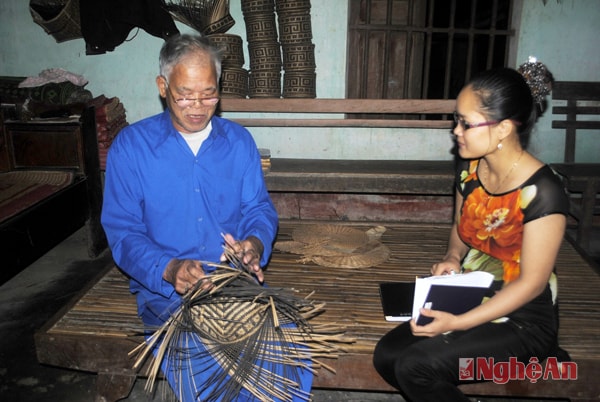 |
| Mr. La Van Minh recounts the "legend" of the past. |
Mr. La Van Minh, the only surviving member of that "expedition," recounted: "The day we decided to enter the cave..."(10/3/1963)"Relatives and villagers wept profusely, many tried to stop us. They organized a meal, and everyone was in tears as they bid us farewell to the Mó cave, like sending soldiers off to the front lines at that time. And so, we 'set off,' with only rice balls, torches, a few knives, and crude sticks in our hands."
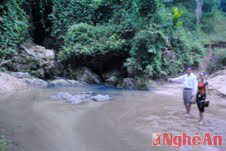 |
| Tien Ky Spring |
Pushing through the dense forest, they reached the cave entrance. Crawling inside was difficult; the entrance was low, dark, and abysmal, like the mouth of death; the rocks were sharp like shark teeth. But once they went deeper inside, they found a spacious and airy space; the beautiful rock formations and cliffs gradually eased their fear. A stream inside the cave flowed quite heavily, in an unusual direction, and its flow was uneven. After hours of deliberation, they decided to pry away the rocks blocking the old flow, diverting the water to flow into the stream leading to the fields... Thanks to this, the villagers now had a regular water supply for irrigation, and the water source was no longer as unpredictable as before. The crops flourished, and the lives of the people became more prosperous...
The villagers were immensely grateful to the team that "opened the water source." In 1965, during the selection of Labor Heroes in the six mountainous districts of Nghe An province, Mr. Luong Van Hau, the initiator of the search for water for the villagers, was honored as a Labor Hero. The water source where he and his team surveyed the area that year became known to the locals as the Luong Van Hau water source.
Currently, the Luong Van Hau spring provides irrigation water for approximately 130 hectares of crops in the villages of Thai Minh, Ke Gieng, Ke Phay, etc., and is an attractive ecotourism destination.
Following the rugged path along the Bục cliff for about 200 meters, visitors will encounter a crystal-clear stream. It's a fairly wide stream, carrying water from the Mó cave to the surrounding fields. The stream is shallow enough for visitors to wade barefoot, experiencing the cool, pleasant sensation of pebbles at the bottom. Inside the cave, small streams trickle down; sparse shrubs grow; and moss-covered rock walls intertwine, creating a poetic beauty of the Mó cave... Every year, on March 10th, the villagers prepare offerings including a chicken, sticky rice, and incense to thank the mountain god for providing this "sacred water" spring. The Mó cave in Tiên Kỳ is considered a guardian deity by the villagers, contributing to the spiritual culture of the Thái ethnic group.
Currently, the local authorities are planning to invest in developing this spring into an attractive ecotourism destination. It is hoped that many investors will come to Tien Ky and join forces with the local authorities to promote tourism based on its existing potential.
Text and photos:Cam Thuy


