
Hyundai i20 Active - a worthwhile choice worth 600 million VND.
Positioned by Hyundai as an urban crossover, the i20 Active, with its attractive styling and convenient features, is a worthy option for those needing a versatile vehicle in the 600 million VND price range.
The i20 Active, launched internationally in March 2015, has achieved considerable success with consistently high sales figures within Hyundai's product range (nearly 13,000 units, including the hatchback version, sold in its launch month, ranking 5th in the entire Indian market).
Just four months later, Hyundai Thanh Cong launched the i20 Active in Vietnam at a price of 619 million VND, aiming to capture the small SUV segment against its main competitor, the Ford EcoSport.
Design
The Hyundai i20 Active boasts a relatively compact size with dimensions of 3,995 x 1,760 x 1,555 (mm) (Length x Width x Height) and a ground clearance of 190 (mm). The highlight of the overall design is its dynamic style, based on Hyundai's Fluidic Sculpture 2.0 design philosophy.
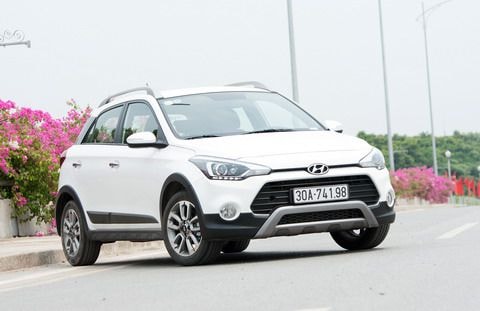 |
| Hyundai i20 Active |
Despite being labeled as a raised-suspension version of the popular i20 hatchback, Hyundai still manages to differentiate the car with aggressive front and rear bumpers, large fog lights, a distinctive modern hexagonal grille with horizontal bars, roof rails, and stylish side skirts. Some details feature European styling, such as LED daytime running lights (DRL), position lights, and automatic cornering lights.
Unlike its competitor, the Ford EcoSport, which is considered to have an unbalanced design, the i20 Active appears more harmonious with an overall pleasing appearance, even though its ground clearance of 190 mm is only 10 mm less than its competitor. Furthermore, the car's 16-inch, 5-spoke U-shaped alloy wheels create a significant aesthetic appeal for users.
Interior
Since its breakthrough transformation in 2005-2006, Korean cars in general, and Hyundai in particular, have consistently offered customers the most comfortable and convenient interiors, and the i20 Active is no exception. The first visual impression of the i20 Active's interior is the combination of a predominantly black color scheme with orange accents, adding a youthful and dynamic feel to the car.
The car's interior layout is quite user-friendly, featuring a 3.8-inch monochrome central screen that displays the time and media information, along with CD/MP3/Radio/AUX/Bluetooth connectivity and eight speakers. This is a valuable highlight in terms of convenience, with sound quality among the best not only in its segment but also compared to many more expensive cars.
The Hyundai i20 Active has a wheelbase of 2,570mm, slightly longer than the Ford EcoSport, so the rear seat space is quite comfortable. Of course, with a small car, it's difficult to expect a rear seat that comfortably accommodates three adults like full-size SUVs. These seats can be folded down in a 6:4 ratio, which is quite useful when you need to expand cargo space, or simply allows rear passengers to access items in the trunk, such as water bottles, without having to stop while the car is moving.
Other features on the car are quite convenient, such as a Smartkey, Start/Stop Engine button, rearview camera on the mirror (with automatic anti-glare), turn signals integrated with power-folding mirrors with heating function. The car is equipped with an automatic air conditioning system that cools quickly and effectively.
The only drawback of the car is the slightly outdated fabric upholstery. However, reupholstering them in leather wouldn't cost too much, and buyers can accept this compared to the car's other amenities.
Engine
The Hyundai i20 Active is equipped with a 1.4L Kappa multi-point fuel injection engine, paired with a 4-speed automatic transmission, delivering 100 horsepower at 6,000 rpm and 133 Nm of torque at 3,500 rpm. Hyundai advertises this engine as fuel-efficient, highly durable, and offering optimal power.
Safety – Operation
The car is equipped with a comprehensive set of safety features, including anti-lock braking system (ABS), electronic brake force distribution (EBD), and six airbags. Other features include rear parking sensors, automatic unlocking in case of collision, and disc brakes on both the front and rear wheels.
| Illustrative image |
Flexible operation
Although marketed as a competitor to the EcoSport, Hyundai targets urban residents, with 70% of its customers being female. This suggests that the South Korean automaker has optimized the car for city driving rather than challenging off-road conditions.
Indeed, the i20 Active proves to be a reliable car for city driving. It handles smoothly, the steering is precise, and the throttle response is quite good with gentle taps; there's no jerking when stopping at traffic lights or in traffic jams. With a ground clearance of 190 mm, the i20 Active easily navigates potholes, readily climbs curbs, and even handles some sections of water up to 40 cm deep on a rainy day in Hanoi.
Testing the car on the highway, while not outstanding, the i20 Active remains stable. At 100 km/h, the steering still feels solid thanks to the electronic power steering. A commendable aspect of the car is its excellent sound insulation; wind noise, engine noise, and tire noise are effectively minimized. The noise level measured at this speed was 57 dB, significantly higher than its competitor, the EcoSport, which recorded 62 dB. The car's chassis is robust, ensuring stability during high-speed lane changes without any rear-end sway.
Conclude
Before the i20 Active appeared, the small SUV segment was dominated solely by the Ford EcoSport. When the Hyundai i20 Active launched in Vietnam, its positioning and strategy were clever, avoiding direct competition with the already familiar EcoSport, yet still attractive enough to appeal to a segment of young customers looking for a compact, agile car for urban driving and a safe, durable vehicle for long journeys. Despite some minor limitations, it remains a worthwhile purchase in the 600 million VND price range.
According to VnMedia


