
America's new enemy is Russia's new friend?
(Baonghean.vn) - According to RT, French President Emmanuel Macron's statement that Europe cannot rely on the US for security, along with signals of warming relations with Russia, reveals a rift in EU-Washington relations – a relationship that is now gradually breaking down amid pressure to end sanctions.
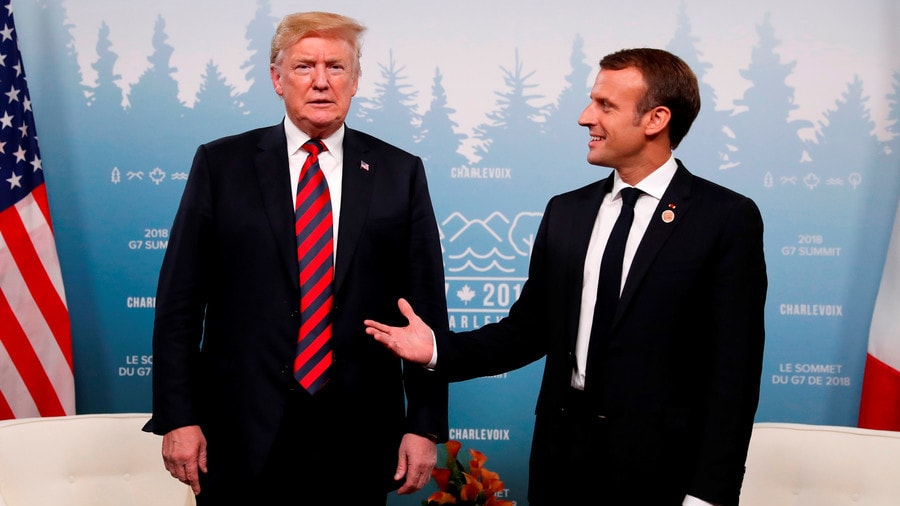 |
| US President Donald Trump and French President Emmanuel Macron at the G7 summit in Canada in June. Photo: Reuters |
"Europe cannot continue to rely on the United States for its security," the French president asserted in a recent foreign policy speech in Paris.
Relations between the US and France had a promising start this year. The "touching" interactions between Donald Trump and Macron at their April summit, when the two leaders planted a tree together on the White House lawn, made it impossible to predict that just one month later, these two allies would turn their backs on each other.
The first rift in relations occurred after Trump withdrew from the historic nuclear deal with Iran. At that time, upon hearing of Trump's withdrawal, the French Minister of Economy urged Europe to stop acting like "vassals of America" and continue trading with Tehran despite the future plans of the "global economic policeman."
Trump's import tariffs on steel and aluminum in September sparked global protests and retaliation from the European Union (EU). Macron called the measures "illegal" and warned that "economic nationalism leads to war," adding that this is exactly "what happened in the 1930s."
"The reshaping of transatlantic relations under President Trump has gone very far," said Yury Rubinsky, head of the Center for French Studies at the Russian Academy of Sciences, adding that Washington initiated such a change.
Independent journalist Luc Rivet put it differently: "The love story between Europe and America has ended in a heated argument."
Friend and foe
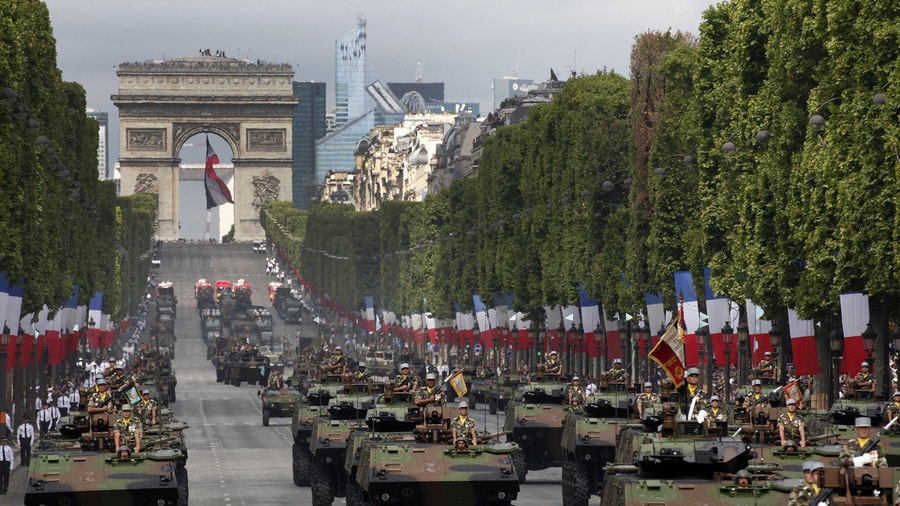 |
| Tanks parade on the Champs Elysee avenue in Paris on the occasion of France's National Day. Photo: AFP |
Withdrawing from the Iran nuclear deal, abandoning the Paris Agreement, and imposing tariffs on aluminum and steel – the White House's tough rhetoric seems to be pushing the EU further and further away from Washington. In fact, Trump set the stage for the rift between the US and the bloc during his presidential campaign, calling the alliance a "hellhole" and a "mess." Later, after winning the election, Trump noted that the US has "many enemies," including the EU.
That is why, in his speech on EU security, the French leader declared that he wanted to launch a security assessment involving all of Europe's partners, including Russia. Days later, at a press conference during a visit to Helsinki, Macron asserted that "having a strategic relationship with Türkiye, as well as with Russia, brings stability, which in the long term will bring more strength and cohesion" is beneficial for the EU.
Russian Foreign Minister Sergey Lavrov believes that Macron's stance did not develop overnight. "The way the US is acting on the international stage is something everyone has to think about," he said.
No country with even a shred of self-respect can tolerate having its policies forced upon it, a senior Russian diplomat noted.
Yury Rubinsky - head of the Center for French Studies at the Russian Academy of SciencesMacron asserted that when he mentioned Russia, he was largely referring to the crisis in Syria and, especially, the reconstruction of this war-torn country after the conflict ends. He questioned: “Where will all the migrants go when the war is over? Who will pay for the reconstruction of this country?”
Meanwhile, Rivet argues that Macron, the ambitious 40-year-old center-left figure who is currently “very keen to seek a significant international role in the EU,” has failed to achieve many of his ambitions. However, journalist Rivet believes the leader could “lead the way towards reconciliation.” In addition, Austria and Hungary, as well as Eurosceptic parties such as the Alternative for Germany (AfD) and France’s National Rally, are calling for closer ties with Russia and urging the lifting of sanctions.
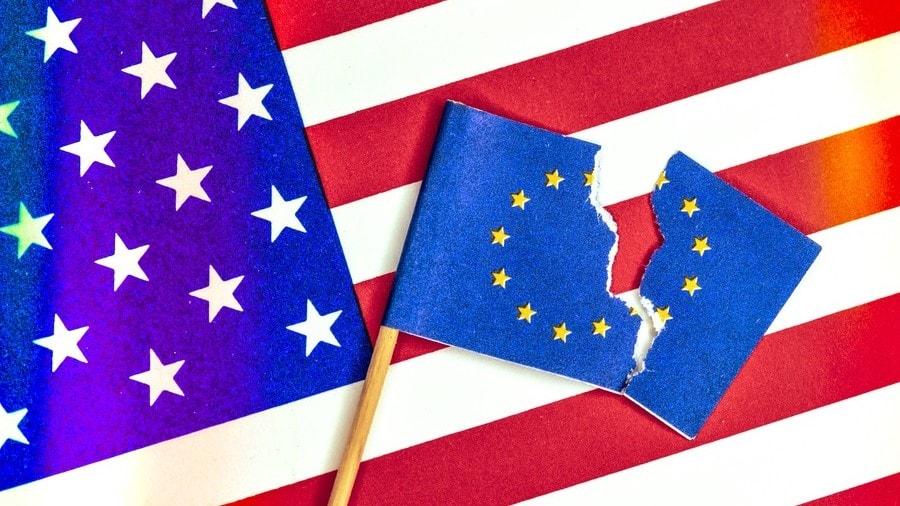 |
| Illustration: Global Look Press |
Europe is beginning to understand that sanctions against Russia are ineffective, while their economies are suffering. “Long-standing lobbying efforts within European businesses and agriculture have been aimed at persuading European politicians to lift the collective sanctions, which are primarily damaging to European agricultural trade,” Rivet said.
However, Rivet also acknowledged that Europe can do little to confront Washington. “At best, the EU will only negotiate to protect its companies and products sold and traded with the US from further US sanctions,” he said. Speaking about the Iran nuclear deal, Rivet stated that Europe has “absolutely nothing” and “can do nothing to save” the deal.
"No European company would dare oppose the US government regarding sanctions against Iran. Europe will not truly confront the US on the Iran issue. European countries would certainly lose," he asserted.
But perhaps Europe is better able to scrutinize its eastern neighbor more closely than the nation across the Atlantic. “Europe is completely paralyzed when it has to deal with the US, except, why not, reopen the door to cooperation with Russia,” Rivet stated.


