
Effective communication channels
(Baonghean)Now, couples in the coastal commune of Quynh Nghia (Quynh Luu district) have changed their way of thinking and viewing population and family planning work. This awareness has been achieved thanks to people participating in the Reproductive Health Care Club implemented by the Women's Association of the commune.
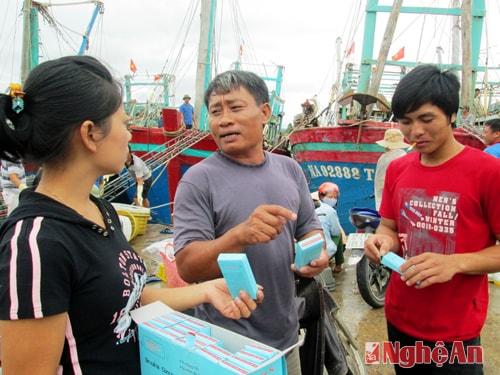 |
| Population awareness collaborator at the fishing port in Quynh Nghia commune (Quynh Luu district). |
Present at the Quỳnh Nghĩa commune's fishing port were the locals, who were gathered waiting for the boats to dock. Among the large crowd of fishermen were 12 population collaborators, each holding a leaflet to distribute to raise awareness about population issues, reproductive health, and family planning.
Quynh Nghia is a coastal commune with 8,247 inhabitants and 2,015 households. The people rely on fishing for their livelihood, and men are often absent from home, generally not paying attention to population issues. Since the implementation of the "Population Control Project in Coastal and Maritime Areas," Quynh Nghia has been selected as one of five pilot communes in Quynh Luu district to maintain reproductive health care clubs and community counseling groups. Since September 2009, the commune has launched and organized activities for the Reproductive Health/Family Planning Club every two months.
Ms. To Thi Mai, the commune's population officer, said: "To encourage members to join the club, each population collaborator, along with women's cadres in the hamlets, went to individual households to persuade individuals and couples to join the club. The club is organized into groups, bringing together people of all ages. Population officers handle the content and script ideas for each meeting. Usually, from the 14th to the 17th (lunar calendar), when the moon is bright and boats don't go out to sea, the groups gather at the commune's or hamlet's cultural center for club activities. Messages about population issues are introduced, such as: the role and responsibilities of the family, the Marriage and Family Law and gender equality, prenatal and postnatal screening, reproductive health care, life skills, etc."
Many women, who previously hesitated to express their thoughts on reproductive health/family planning issues due to their sensitive nature, have become more confident in sharing their concerns after joining the club, seeking guidance on the safest ways to care for their reproductive health. Ms. To Thi Thuy, from Nghia Bac hamlet, Quynh Nghia commune, a member of the club, confided: “I had almost never participated in community activities before. Joining the club has helped us women understand more about these private matters and become more mindful of our own health.”
Sharing about the effectiveness of population work and maintaining club activities, Ms. To Thi Mai added: "We have actively communicated, campaigned, and advised to change behavior; encouraged target groups to sign commitments not to have children outside of planned births. We have intensified many campaigns on reproductive health/family planning care through various forms such as: hanging banners and slogans, providing many pictures, leaflets, and clusters of billboards and posters hung along main roads. We organize dramatized activities in club meetings, regularly provide community counseling, and small group counseling anytime, anywhere..."
In 2013, the Population Committee of Quynh Nghia commune organized gynecological examinations for 505 women, provided free IUD insertion for 120 women, and conducted prenatal ultrasound screenings for 34 women. Since joining the group activities, fishermen's trips to sea have become more lively; besides discussing prices and weather conditions, they share experiences about family planning. With the integrated communication and advocacy campaign providing reproductive health/family planning services, the rate of third births has decreased rapidly, from 30.6% (in 2009) to 21% (in 2014).
Based on the effectiveness of the clubs, in the coming time, the commune will continue to mobilize and promote the expansion of these clubs, considering them a main channel of communication to help the commune achieve the targets set out in Project 52.
Pham Ngan


