
The possibility of raising earthworms.
Raising lugworms for commercial purposes involves low risk, low investment, but relatively high profits. In areas with suitable tidal flats, lugworms are a suitable species for economic development, contributing to poverty reduction.
Biological characteristics
The body of the Tylorhynehus heterocheatus is elongated, consisting of 55-65 segments, with a body length of 45-65 mm. The largest diameter is at the anterior and middle sections, 2-3 cm. The posterior part of the body narrows towards the tail. The dorsal surface is raised and darker pink. The head consists of two parts: the pre-mouth lobe and the peri-mouth lobe. The pre-mouth lobe is small and flattened, with two short antennae on the upper surface and a pair of clearly segmented palps on either side. The dorsal surface of the pre-mouth lobe has two pairs of black eyes. The short peri-mouth lobe bears two pairs of lateral appendages. The pre-pharynx is inverted, exposing the hook-shaped chitinous jaws with teeth on the inside for grinding or gnawing food.
The body of the lugworm is irregularly cylindrical. During the reproductive period, the lugworm undergoes many changes. The body is divided into two distinct parts, especially the posterior part which contains reproductive products. Simultaneously, the limbs in the posterior part enlarge, and the dorsal and ventral tufts of bristles become highly developed. The caudal lobes are the last segments of the lugworm's body, conical in shape, lacking lateral limbs but possessing two long anal appendages. The anterior part of the last segment is the growth zone, where new segments of the lugworm's body will form. The anus is located at the end of the last segment.
In the wild, lugworms move near the bottom surface. Their food consists of organic matter, animal carcasses, and plankton floating in the water. Lugworms have separate male and female individuals, but it is difficult to distinguish them without a high-magnification microscope.
Numerous studies on the lugworm
In 2009, the first study on the reproductive characteristics of the lugworm was conducted by the Research Institute for Aquaculture I in the project "Research on some biological reproductive characteristics of lugworms in Northern Vietnam". The project studied the food composition and reproductive methods of lugworms, mainly from organic detritus and algae species. Lugworms reproduce sexually. The research also successfully conducted experiments on artificial breeding of lugworms and produced 50,000 larvae at the 3-hardened stage. After 6 days, the larvae reached 4 hardened rays, after 8 days, 5 hardened rays, and 16 hardened rays after 35 days. However, the survival rate of larvae after 35 days was very low, at 0.1%, and after 38 days all the larvae died. The cause was due to unsuitable water temperature and rearing area.
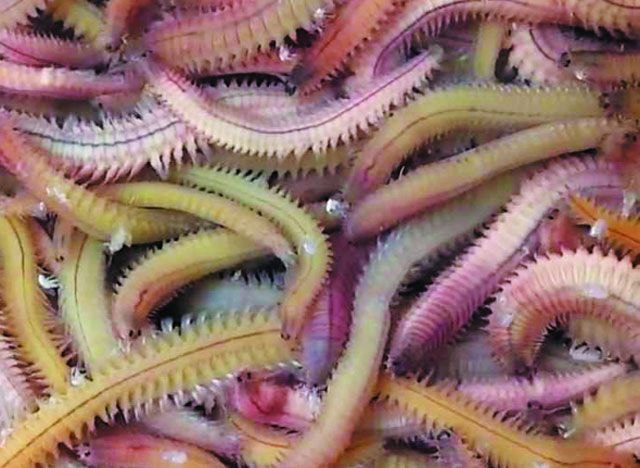 |
| The mudworm is a highly profitable species. |
In 2013, the Research Institute for Aquaculture I continued its project: "Developing a technological process for artificially producing lugworm larvae". To date, the project has yielded promising results, with an estimated maturation rate of over 70% and a survival rate to juvenile size > 1.5 cm of over 5%.
Development potential
As a low-risk, low-investment aquaculture species, the lugworm is considered a suitable species for extensive farming in ponds, swamps, or rice paddies in Hai Phong, Quang Ninh, and other provinces. The main source of larvae is harvested from the wild during the high tides of April-May and September-October. Lugworms feed on organic matter and algae brought in by the tides. Furthermore, no drugs or chemicals are needed for disease prevention and treatment throughout the farming process, thus saving costs. The lugworm farming process is simple, low-risk, and requires little capital, yet can be quite effective; applying extensive farming techniques can achieve yields of 600-1.5 tons/ha, with a selling price of 300,000-400,000 VND/kg, resulting in a profit of 150-250 million VND per year.
According to Vietnam Fisheries


